




GOB vs SMD LED Display
By hqt
Nov 18, 2026Related Posts
How to Choose the Right Pixel Pitch Based on Viewing Distance
November 14, 2026
Corner Protection Rental LED Panel: Damage Prevention and Maintenance Guide
October 30, 2026

How to Choose a Shop Window Transparent LED Display for Retail Stores
October 29, 2026
Iron vs. Aluminum Outdoor LED Display Cabinets: How to Choose
October 28, 2026
The SMD (Surface Mounted Devices) LEDs that are typically covered with a protective resin layer are commonly used in a GOB LED display. In a traditional SMD display, the individual LED packages are stuck to the surface of the display where they can be seen from the outside. It's not a wholly new approach to image making, but it is an additional level of protection.
GOB may be appropriate when accidental contact and frequent handling are possible. When it's a simple repair, familiar construction and initial costs are more important, conventional SMD should also be taken into account.
The first step is to decide on the environment in which the screen will be used and how technicians will service it.
Understanding the Construction
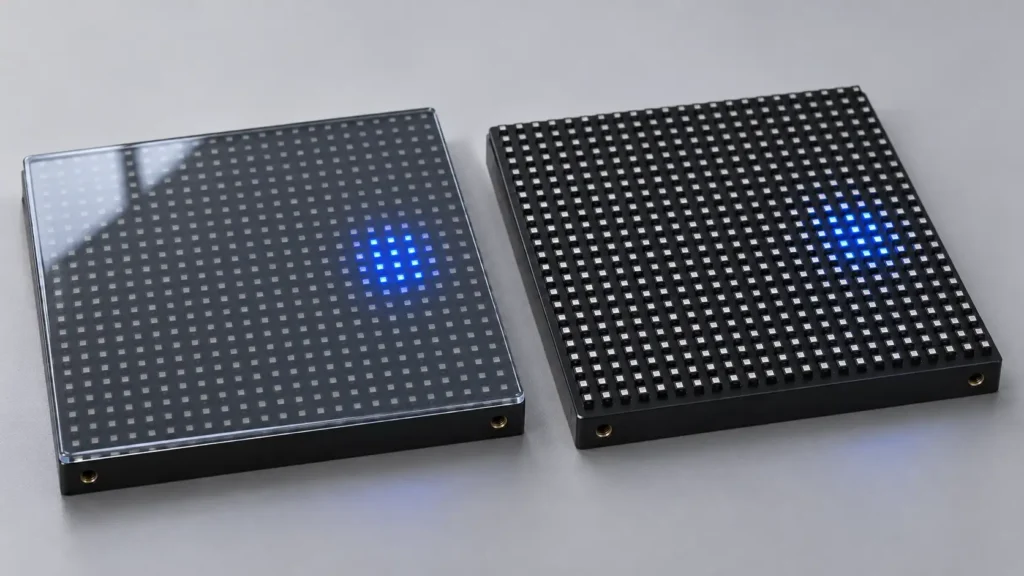
Surface Mounted Device (SMD). Individually packaged LEDs are soldered on to a printed circuit board in an SMD LED module. The packages are the visible array of pixels.
GOB (glue on board). A clear protection resin is applied on top of the surface of the module, which covers and encloses the LED packages. This coated SMD construction is used in commercial GOB modules.
It is important when comparing quotations. Two screens may be based on the same components, one with a protective coating.
| Feature | Conventional SMD | GOB-treated SMD |
|---|---|---|
| LED construction | Individually packaged LEDs | Individually packaged LEDs beneath resin |
| Viewing surface | Exposed LED packages | Continuous protective coating |
| Component access | Generally more direct | May require coating removal |
| Surface appearance | Depends on packages and masks | Also depends on resin and finish |
| Main purchasing question | Does the module meet project requirements? | Does added protection justify its trade-offs? |
Neither label establishes the quality of the LEDs, driver electronics, circuit board, or manufacturing process.
Where Added Protection Matters
Picture a retail display beside a busy walkway. Customers pass close to it, staff clean nearby fixtures, and equipment occasionally moves through the area.
Here, a protective coating may help reduce damage from incidental contact. Similar considerations apply to exhibition screens that crews repeatedly transport and assemble.
But protection has limits. GOB does not make a screen indestructible, and a coated module does not establish the weather resistance of the complete cabinet.
For a permanent commercial installation, MIC’s MC-S indoor fixed LED display is one product route to evaluate. Confirm the proposed module construction and protection options separately.
Ask suppliers for documented test conditions rather than relying on demonstrations involving water or sharp objects.
Does GOB Improve Picture Quality?
It can alter the picture, although there's no guarantee that it will improve.
Reflections and light distribution may be affected by resin formulation, surface texture, coating thickness and production consistency. The color under showroom lights may be different than the color under bright ceiling lights.
There was also a lot of conventional SMD. Picture is influenced by package design, mask, calibration and driver settings.
Compare both with your own text:
Fine text and fine lines.
Dark shades and shadows.
Neutral colours and neutral backgrounds.
Prominent ads with high white content.
Inspect from centre and from angle of sides. Inspect screen while turned off too; area may be uneven, showing differences between modules.
Another configuration that can be considered as an option for reception areas and presentation space is the MIC's MC-PRO indoor LED video wall.
Pixel Pitch Still Controls Detail
The addition of GOB protection will not add to the number of pixels.
The nominal resolution of coated and uncoated modules are the same at the same screen dimensions and pixel pitch. GOB is not a magic solution for converting a coarse pitch screen to a fine pitch display.
A nominal 4,800mm screen at P2.5 will have about 1,920 horizontal pixels. Actual sizes are dependent on the module layout chosen.
Design for reading ease and distance from surface, then determine if further protection of surface is beneficial.
| Installation situation | Main priority | What to evaluate |
|---|---|---|
| Display beyond public reach | Image quality and serviceability | Conventional SMD may be sufficient |
| Screen beside a walkway | Incidental contact protection | GOB with documented protection |
| Frequently handled event screen | Transport and setup durability | Coating, cabinet protection, and repair speed |
| Close-viewing presentation wall | Text and image detail | Pitch, grayscale, reflections, and calibration |
| Outdoor advertising | Environmental suitability | Complete outdoor-rated system |
These are evaluation priorities, not automatic product recommendations.
Repairs: Access Changes the Equation
Conventional SMD generally offers more direct access to individual LED packages. Qualified technicians may replace failed components, depending on their equipment and the module design.
GOB repairs can require removing resin, replacing the component, and restoring the coating. The repaired area must meet both electrical and visual requirements.
That last part is easy to overlook. A functioning repair can still leave a visible difference in gloss or surface appearance.
Ask whether repairs happen locally or require factory return. Also confirm whether replacing an entire module is the preferred service method.
For event projects, MIC’s MCR-S indoor event rental LED screen offers a relevant starting point for discussing handling, cabinet design, and maintenance access. Do not assume a GOB configuration unless it is explicitly included.
Compare Total Cost
GOB adds a coating process, but there is no universal price premium. Component selection, production volume, pitch, and support arrangements all influence cost.
| Cost category | Questions for comparable quotations |
|---|---|
| Hardware | Are dimensions, pitch, LEDs, and electronics equivalent? |
| Protection | What coating, testing, and warranty are included? |
| Spares | How many matching modules are recommended? |
| Repairs | Are resin restoration and shipping included? |
| Downtime | How quickly can the screen return to service? |
Neither construction guarantees lower power consumption. Compare documented typical power under equivalent brightness and content conditions.
Making the Final Choice
Choose GOB when additional surface protection addresses an identified project risk and the supplier provides a workable repair plan.
Choose conventional SMD when the installation already limits contact exposure and accessible component repairs offer practical value.
Before approval, agree on sample quality, spare modules, cleaning instructions, warranty terms, and acceptance criteria. Those details matter more than choosing an abbreviation.
Frequently Asked Questions
Is GOB a replacement for SMD?
Usually, GOB adds protection to an SMD module rather than replacing its underlying construction.
Does GOB make an LED screen waterproof?
Not automatically. Check the complete product’s applicable protection rating, including its rear enclosure and connections.
Is conventional SMD easier to repair?
Component access is generally more direct, but repair difficulty still depends on package size, equipment, and technician capability.
Does GOB eliminate reflections?
No. Reflections depend on the coating finish, lighting, and viewing angle. Test a sample under representative conditions.
Can an existing SMD screen receive GOB coating?
Do not assume so. Coating requires compatibility checks, controlled processing, and supplier approval.
Is GOB better for rental displays?
It may help with surface handling risks. Cabinet protection, transport cases, alignment, and repair turnaround remain equally relevant.
Which lasts longer?
Neither label guarantees longer life. Component quality, temperature, operating settings, maintenance, and actual exposure determine performance over time.
What should buyers request before ordering?
Request equivalent samples, confirmed specifications, protection evidence, repair procedures, spare pricing, and written warranty coverage.
Share on Social:


Contact Us
In This Article
Related Posts
How to Choose the Right Pixel Pitch Based on Viewing Distance
November 14, 2026
Corner Protection Rental LED Panel: Damage Prevention and Maintenance Guide
October 30, 2026
How to Choose a Shop Window Transparent LED Display for Retail Stores
October 29, 2026
Iron vs. Aluminum Outdoor LED Display Cabinets: How to Choose
October 28, 2026


