




LED Mesh Screen vs Transparent LED Film
By hqt
Nov 20, 2026Related Posts
How to Choose the Right Pixel Pitch Based on Viewing Distance
November 14, 2026
Corner Protection Rental LED Panel: Damage Prevention and Maintenance Guide
October 30, 2026
How to Choose a Shop Window Transparent LED Display for Retail Stores
October 29, 2026
Iron vs. Aluminum Outdoor LED Display Cabinets: How to Choose
October 28, 2026
An LED open arrangement of strips or nodes used to form images is an LED mesh screen. Transparent LED film is a thin transparent material that incorporates LEDs and conductive materials to form a film. Generally film is used for store-front windows where depth of installation and openness of the installation is important, whereas mesh is used in large architectural displays.
Product names, however, vary. The terms “transparent”, “mesh” and “film” are not indicators of brightness, weather resistance or image quality. Begin with the physical construction and installation needs.
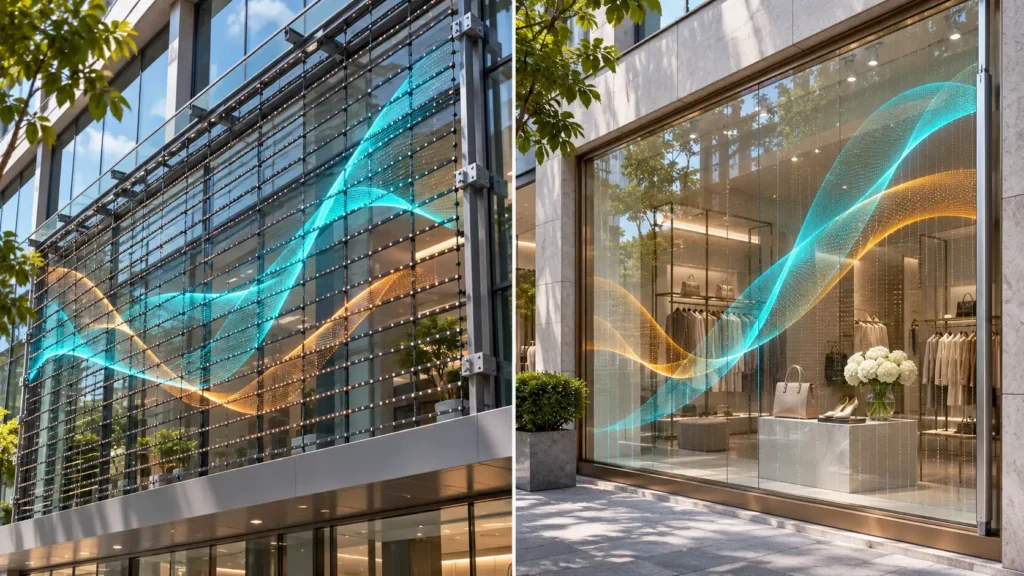
How the Two Technologies Differ
LED mesh screens have gaps between the lighted elements. It can be made up of rigid grille modules, flexible mesh or cable supported nodes, depending on the design.
Transparent LED film is made with a thin base plate that contains both LEDs and electrical components. Self-adhesive versions can be glued to compatible glass surfaces, but there is a requirement for surface compatibility and installation instructions which are product-specific.
Both provide some transparency in the display. When turned off, neither is fully dark.
| Feature | LED mesh screen | Transparent LED film |
|---|---|---|
| Construction | Open strips, grille, or node arrangement | LEDs and circuitry on a transparent substrate |
| Typical support | Frame, cables, or mounting structure | Often compatible glass plus edge hardware |
| Main visual obstruction | LEDs, strips, cables, and support structure | LEDs, conductors, substrate, and connections |
| Common project fit | Facades and large architectural surfaces | Retail windows and glass interiors |
| Service approach | Depends on strip or module access | Depends on bonded sections and connections |
A rigid transparent LED cabinet is another construction. Do not assume it is interchangeable with adhesive film.
Transparency: Compare More Than a Percentage
An impression of the figure can be impressive without describing the object as a figure.A figure may be impressive without describing what people see as a figure.
Open area may be specified in mesh. Optical transmission can be specified in film specifications. There may not be a one-to-one correlation between those measurements.
Question if the price quoted includes glass, adhesive layers, cable, power bars, and frames.
Also, the viewing angle is important. It may be easier to see the slims from the side than from the front. Under certain lighting conditions, the film conductors and surface reflections are also visible.
Inspect from inside and outside – display turned on, turned off. Include actual product and interior lighting of the shop window in a test if required to preserve the view.
MIC’s transparent grille screen provides one product route to assess for open architectural display projects.
Image Detail Depends on Pitch and Dimensions
Transparent displays give up some of the space needed to represent pictures for openness. This makes planning of content more critical.
A large mesh facade can convey big graphics well on the other side of a plaza. This setup might have trouble with short descriptions that are close together.
Film doesn't inherently have more detail. The spacing of pixels in a horizontal and vertical direction, the number of pixels that are present in the original video, and the distance that you intend to view the video from.
Not every pitch number is unique: some have various spacings in different directions.
| Intended content | What to evaluate |
|---|---|
| Large brand graphics | Recognition at the typical viewing distance |
| Short promotional messages | Letter size and contrast against the background |
| Product photography | Pixel density and visible background interference |
| Architectural light patterns | Coverage, movement, and integration |
| Detailed information | Whether a transparent display is appropriate at all |
Dark content deserves attention. On a transparent display, black areas generally mean unlit pixels through which the background remains visible—not an opaque black surface.
Brightness and Background Work Together
Brightness alone does not determine readability.
A transparent screen competes with whatever sits behind it: daylight, merchandise, interior lighting, or moving people. Reflections from the glass add another variable.
Test during the brightest expected conditions and after dark. Content that works in an evening demonstration may become difficult to recognize at midday.
For indoor glass projects, MIC’s indoor transparent LED display is another option to compare. Confirm its construction separately from any proposed film system.
Use clear shapes, generous spacing, and content designed around the visible background.
Installation: Structure Versus Glass Compatibility
A specially designed mounting system is necessary for mesh. It can have openings for ventilation without removing wind loading or the requirement to evaluate attachment points.
The film will need appropriate glass and surface preparation. Test coatings for curvature, joints, temperature exposure and manufacturer's recommended application.
There's no screen-only installation in either of these. Planned locations for power equipment, controllers, cables, and connection bars.
| Installation issue | Questions to resolve |
|---|---|
| Supporting surface | Can the structure or glass accept the proposed system? |
| Cable routing | Where will power bars and wiring remain accessible? |
| Weather exposure | Is the complete configuration approved for the location? |
| Heat | What temperatures occur near the glass or facade? |
| Future replacement | Can sections be removed without excessive disruption? |
A display installed behind glass may still experience significant solar heating. “Indoors” does not settle the thermal requirements.
Maintenance and Ownership Costs
Mesh Maintenance can include replacing strips, nodes or modules. Mounting design and installation height is a factor in accessibility.
Examples of film servicing work are electrical repair or replacement of a bonded section. Talk about what the removal does to the glass, how glass is matched visually when replacing.
Do not assume that film will be removed from and used elsewhere.
Compare the hardware, installation of the work, access equipment, content production, spare parts and perhaps repair techniques. The relatively thin display does not necessarily make the whole project less expensive.
In the case of an opaque curved event backdrop, however, MIC's indoor flexible rental LED screen is a different way to go. Transparent adhesive film is not to be confused with flexible rental cabinets.
Which Should You Choose?
Consider mesh when large-scale architectural coverage and an open physical structure fit the project.
Consider transparent film when compatible glass is available and a thin installation is a priority.
Before ordering, approve a sample using the actual background, viewing angles, lighting, and content. That test is more useful than comparing transparency claims alone.
Frequently Asked Questions
Is transparent LED film clearer than LED mesh?
Not automatically. Compare pixel spacing, native resolution, background visibility, and viewing distance.
Does transparent film require glass?
Many adhesive products do. Confirm the approved substrate and mounting method for the specific model.
Can LED mesh be installed outdoors?
Selected systems can. Verify environmental ratings, structural requirements, connections, and operating limits.
Is mesh unaffected by wind?
No. Open construction can influence wind behavior, but the complete installation still requires structural assessment.
Can LED film be cut to any shape?
Do not assume so. Cutting may only be permitted at specified locations, or may be prohibited.
Can transparent displays show black backgrounds?
Unlit areas generally reveal the scene behind the display. They do not create the opaque black background of a conventional screen.
Which system is cheaper?
Compare equivalent coverage, image requirements, installation, and maintenance. There is no universal winner.
What should buyers provide for a recommendation?
Send dimensions, glass or facade details, viewing distances, lighting photographs, exposure conditions, content samples, and service-access information.
Share on Social:


-
PREV:
Interactive LED Floor vs Standard LED Floor
- NEXT: Null
Contact Us
In This Article
Related Posts
How to Choose the Right Pixel Pitch Based on Viewing Distance
November 14, 2026
Corner Protection Rental LED Panel: Damage Prevention and Maintenance Guide
October 30, 2026
How to Choose a Shop Window Transparent LED Display for Retail Stores
October 29, 2026
Iron vs. Aluminum Outdoor LED Display Cabinets: How to Choose
October 28, 2026


