




Interactive LED Floor vs Standard LED Floor
By hqt
Nov 20, 2026Related Posts
How to Choose the Right Pixel Pitch Based on Viewing Distance
November 14, 2026
Corner Protection Rental LED Panel: Damage Prevention and Maintenance Guide
October 30, 2026
How to Choose a Shop Window Transparent LED Display for Retail Stores
October 29, 2026
Iron vs. Aluminum Outdoor LED Display Cabinets: How to Choose
October 28, 2026
An interactive LED floor will alter its visuals based upon detected movement or contact. A standard LED floor does not automatically respond when people approach it, but instead, it is used to play pre-recorded or scheduled content or play content controlled by an external management system. Both can provide impressive floor graphics but each have different creative and operational requirements.
Use interaction when participation is a key part of the experience. Use standard Playback when it is more important to have predictable visuals, show synchronization, and easier operation.
It's what visitors should see, not what the floor should see that's important.
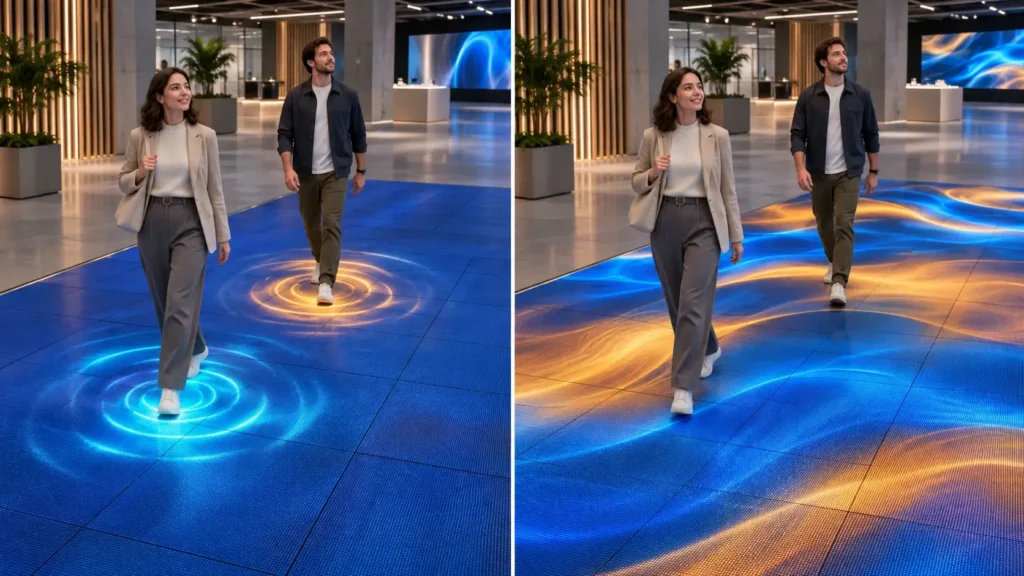
What Makes an LED Floor Interactive?
Interactive floor is a walkable LED wall, integrated with sensing, control software and responsive content. Systems can be detected by integrated sensors, cameras, infrared or other tracking systems.
The software is used to turn the detected activity into an effect: ripples around footsteps, moving particles or changes within a game.
A standard LED floor is fed a show content from a player, processor or show-control system. Its graphics may change, move and synchronize with music without having to react to humans.
| Feature | Interactive LED floor | Standard LED floor |
|---|---|---|
| Content behavior | Responds to detected activity | Follows playback or control commands |
| Additional equipment | Sensing and interaction processing | Playback and display processing |
| Content production | Responsive scenes or applications | Video, graphics, and programmed sequences |
| Commissioning | Includes detection and coordinate alignment | Focuses on playback and display setup |
| Typical objective | Participation and exploration | Presentation and visual continuity |
Both still require appropriate floor construction, supporting hardware, and maintenance access.
When Interaction Adds Practical Value
Imagine a museum installation where children reveal a scene by stepping across the floor. Their actions create the experience. Without sensing, the concept loses its purpose.
Now consider a fashion runway. The production team may want a precise sequence that supports the models and lighting cues. Unplanned visual changes could distract from the show.
Neither approach is inherently more engaging. Content and context decide that.
MIC’s interactive indoor LED floor screen provides a product option to assess for responsive indoor installations. The product page describes interactive sensing and walkable modular construction; confirm the sensing configuration and software included in the quotation.
Display Resolution and Sensor Resolution Are Different
A fine pitch screen can provide detailed imagery but is not representative of how many footsteps a screen could detect.
Display resolution is a specification of the image canvas. Input system is characterized by sensor coverage and tracking performance. There can be multiple display pixels in a single detection zone.
Similarly, the refresh rate of LED doesn't reflect on interaction latency.
The delay experienced by a visitor consists of detection, communication, software processing, rendering and display output. Don't take one flashy specification: ask for an end-to-end demo instead.
Try slow steps, fast movements, standing still visitors and multiple people crossing at the same time. The situations show more than one person demonstration.
Content: A Video File Is Not an Interactive Experience
Standard floor content can usually be produced as video or programmed graphics for the specified pixel canvas.
Interactive content needs rules. What triggers an effect? How long does it remain? What happens when people overlap or leave the area?
These decisions affect development time and usability.
| Application | Useful content behavior | Likely starting point |
|---|---|---|
| Museum discovery area | Visitors reveal or influence a scene | Interactive |
| Product launch stage | Repeatable visuals follow show cues | Standard playback |
| Retail experience zone | Footsteps activate branded effects | Interactive |
| Fashion runway | Graphics maintain a timed sequence | Standard playback |
| Public passageway | Clear visuals support uninterrupted movement | Assess both carefully |
Avoid placing essential information beneath a crowd. People physically cover the display, regardless of its resolution.
For productions combining floor graphics with a vertical backdrop, MIC’s MCR-S indoor event rental LED screen is a related display option. Its role is the backdrop; wall cabinets should not be used as walkable flooring.
Installation and Physical Suitability
Interactivity does not establish load capacity, slip resistance, or outdoor suitability.
Both floor types need a level supporting arrangement, suitable edge transitions, protected cabling, and an approved walking surface.
Confirm distributed loads separately from concentrated loads created by heels, furniture legs, or wheels. Do not infer vehicle suitability from a general load figure.
For exposed projects, MIC’s interactive outdoor LED floor screen provides another product route to assess. Verify the ordered system’s environmental protection, drainage, temperature limits, and approved use.
Outdoor sensing performance also needs testing under the actual site conditions.
Maintenance and Everyday Operation
Cleaning, checking modules and planning module replacement is required for both systems. Interactive installations include a level of sensing and software checks.
If you're a visitor, a visual fault might appear the same as an interaction fault. The maintenance team must have a means to separate out whether the failure is due to a failed pixel, detection, networking or application issues.
What if there is no sensing? A default fall-back might allow the floor to remain functional during the process of troubleshooting.
Also validate software licensing, update responsibility, backup processes, and access to project files. All of these details are important when the original installation crew cannot be found.
Compare the Complete Budget
Interactive equipment can involve additional hardware and development, but there is no universal price premium. A complex standard show can also require substantial content and control work.
| Cost item | Standard floor | Interactive floor |
|---|---|---|
| Display system | Cabinets, processing, and support | Comparable display requirements |
| Content | Playback assets and show sequences | Responsive graphics and application logic |
| Commissioning | Image setup and cue testing | Additional sensing and interaction testing |
| Ongoing support | Display and playback maintenance | Display, sensing, and software support |
Compare quotations using the same floor area, pitch, physical requirements, and support period. Separate included demonstration effects from custom content development.
Frequently Asked Questions
Is an interactive LED floor always better?
No. Interaction is useful when visitor actions support the project’s purpose. Timed performances may benefit more from predictable playback.
Can an interactive floor play normal videos?
Many systems can, but confirm supported inputs, formats, operating modes, and switching procedures.
Can a standard LED floor become interactive later?
Possibly. Compatibility depends on sensing equipment, software, processing, and installation design. Obtain a written upgrade plan before purchasing.
Does higher refresh rate mean faster interaction?
No. Refresh rate describes display behavior. Interaction latency covers the complete input-to-image process.
Can multiple visitors interact simultaneously?
System capability varies. Test the expected crowd density and overlapping movements with representative content.
Does interaction require pressure sensors?
No. Different systems use different sensing methods. Ask which method is proposed and what its limitations are.
Are interactive floors more difficult to maintain?
They introduce additional sensing and software components. Diagnostic tools, documentation, and support arrangements determine the practical workload.
What should buyers provide for a recommendation?
Share floor dimensions, visitor numbers, desired effects, operating environment, load requirements, content plans, and the team’s maintenance capability.
Share on Social:


Contact Us
In This Article
Related Posts
How to Choose the Right Pixel Pitch Based on Viewing Distance
November 14, 2026
Corner Protection Rental LED Panel: Damage Prevention and Maintenance Guide
October 30, 2026
How to Choose a Shop Window Transparent LED Display for Retail Stores
October 29, 2026
Iron vs. Aluminum Outdoor LED Display Cabinets: How to Choose
October 28, 2026


