




Transparent LED Displays for Storefronts
By hyderali
Oct 14, 2026Related Posts
LED Window Display- The Complete Guide for Retail, Advertising, and Commercial Spaces
October 26, 2026
Mini LED Display- What It Is, How It Works, and Where It Fits
October 26, 2026
Naked Eye 3D LED Display - How It Works, Key Specs, Cost and How to Plan One (2026 Guide)
October 16, 2026
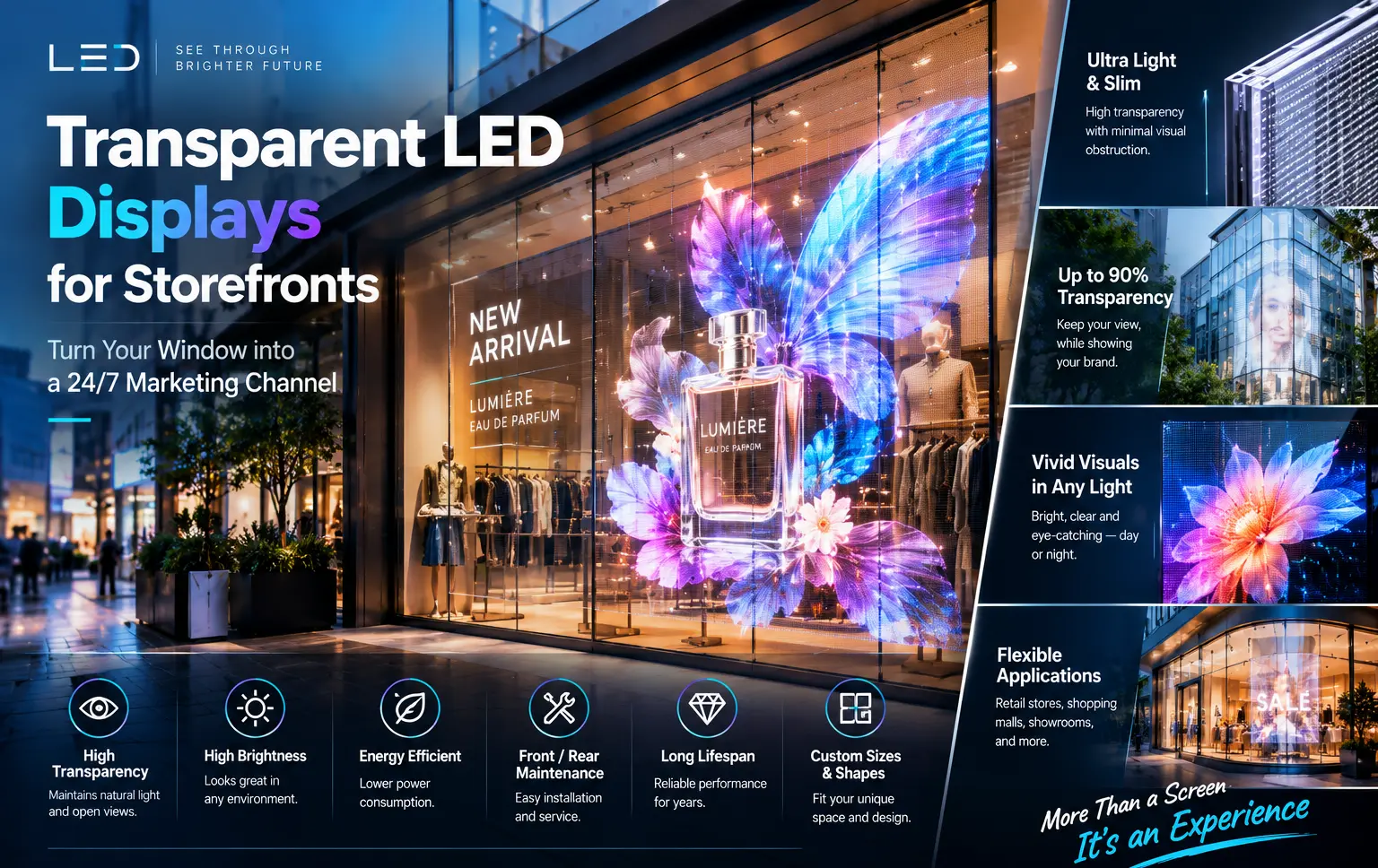
Transparent LED Displays for Storefronts
October 14, 2026
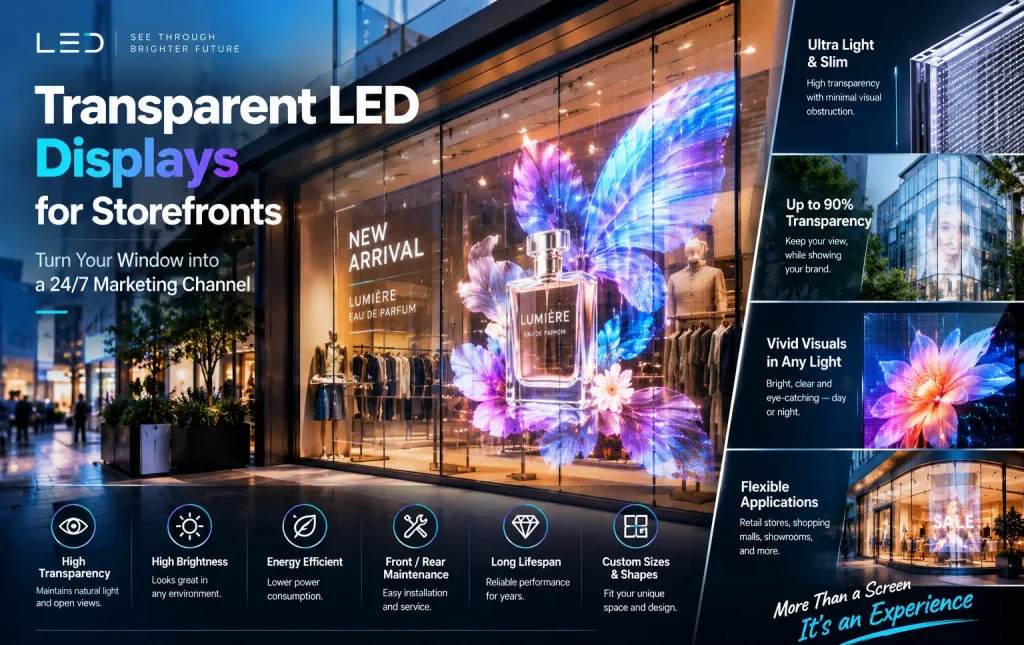
A shop window has two jobs. It sells to the people walking past, and it shows them the store inside. A standard LED wall gives you a powerful screen but blocks both the view and the daylight. A transparent LED display keeps the glass see-through while it plays video on top, so your window can promote a campaign and still show the products behind it.
This guide covers how transparent LED displays work, the types available, how to choose transparency, pixel pitch, and brightness, what installation involves, how to design content for a see-through screen, and what to ask a manufacturer before you order.
Quick Answer
A transparent LED display places LEDs on strips, mesh, or a thin film so light can pass between them. For a storefront, five decisions matter most:
- Do you need see-through at all? If not, a solid LED wall is simpler and sharper.
- Format: panels behind the glass, film on the glass, or glass-integrated for new builds.
- Pixel pitch: chosen from where customers actually stand.
- Brightness: street-facing windows typically need roughly 3,500–6,000 nits to stay legible in sunlight.
- Content: designed for transparency, with dark backgrounds and bold graphics.
What Is a Transparent LED Display?
A transparent LED display is a screen that shows full-colour video and graphics while letting light and sightlines pass through it. Instead of a dense, solid cabinet face, the LEDs are arranged in strips, bars, a mesh, or a thin film, and the gaps between them create the see-through effect.
The key principle is that black is invisible. A pixel showing black emits no light, so whatever is behind the glass shows through. Good transparent content uses that empty space deliberately, letting a mannequin, a car, or a shelf of products become part of the picture.
Transparent LED vs. Solid LED Wall
| Factor | Transparent LED display | Solid LED wall |
|---|---|---|
| See-through | Yes | No |
| Daylight into the store | Largely preserved | Blocked |
| Image density | Lower, because gaps are built in | Highest |
| Best for | Windows, glass façades, showrooms | Dedicated advertising surfaces |
| Content | Needs see-through design | Any content |
| Close-range detail | Limited at coarse pitches | Excellent at fine pitches |
Choose transparent when:
- The store should stay visible from the street
- Daylight needs to reach the shop floor
- A landlord or centre management dislikes blocked shopfronts
- You want motion content without closing the entrance
Choose a solid wall when the screen is the main advertising surface, the content is detail-heavy, or viewers stand within two or three metres. MIC also manufactures indoor LED displays for those cases, so you can compare both options with one supplier.
Transparent LED Formats
| Format | How it works | Typically suits | Consider |
|---|---|---|---|
| Panels behind glass | Strip or bar modules hung on rails behind the window | Daylight-readable shop windows and showrooms | Needs mounting, cabling, and ventilation planning |
| Film on glass | A thin, adhesive layer applied to existing glass | Retrofits where a very light, clean look matters | Surface preparation and content direction matter |
| Mesh | A flexible net with LED nodes | Large façades viewed from a distance | Coarse pitch, so best at long range |
| Glass-integrated | LEDs laminated into the glazing | New builds where glazing is still being specified | Decided at design stage, not easily retrofitted |
The right format depends on your glass, your timeline, and whether the screen will face weather. MIC’s MC-T series covers both indoor and outdoor transparent displays, and the team can confirm which format fits your project. See the MC-T Indoor Transparent LED Display for window and interior use and the MC-T Outdoor Transparent LED Display for exterior projects.
Transparency, Pixel Pitch, and Brightness Are Linked
These three specifications pull against each other, so understanding the trade-off is the most useful thing you can learn before buying.
- Pixel pitch vs. transparency. Wider gaps between LEDs mean higher transparency but a less dense image, so content looks more open up close. A finer pitch gives more detail but reduces transparency and raises cost.
- Transparency vs. brightness. More open space generally means fewer lit points, so there is a balance between a see-through window and a dense, bright picture.
- Brightness vs. power and heat. Running at full output all day increases electricity use and heat.
Transparency percentages are not defined the same way by every manufacturer, so always ask for the measured transparency of the exact model and pixel pitch you are quoting, and compare like with like.
Choosing Pixel Pitch for a Storefront
Choose pitch from the customer’s eye line, not from the shop drawing. The same screen can need a very different specification depending on how far away viewers stand.
| Where the main audience stands | Pitch guidance | Content notes |
|---|---|---|
| 2–4 m | Fine pitch needed, or consider a solid wall | Avoid small text; test logo legibility early |
| 4–8 m | Mid-range pitches suit most high-street windows | Large type, motion graphics, product outlines |
| 8–15 m | Coarser pitches can work | Strong contrast and slower motion help |
| Across a road | Scale and brightness matter more than detail | Treat it like outdoor-facing media |
As a general guide, retail windows are often specified in the range of about 3.9–10 mm pitch. Also check the active height of the screen. In many windows the most valuable zone runs from about waist height to above head height, and the lower section can be blocked by people, fixtures, or window vinyl.
Brightness: The Specification That Makes or Breaks a Window
A storefront screen competes with sunlight, reflections off the glass, and the lighting inside the shop. Street-facing windows typically need roughly 3,500–6,000 nits to stay legible in direct sun, well above a standard indoor panel.
- Orientation matters. A south-facing window in afternoon sun needs more output than a shaded one.
- Reflections matter. If the glass mirrors the sky or bright paving, the screen may need more output.
- Use automatic or scheduled dimming. Most content doesn’t need maximum output all day, and dimming at night saves power, extends LED life, and avoids glare for neighbours.
- Content contrast helps. High-contrast graphics on dark backgrounds can read better than brighter hardware showing low-contrast footage.
For outdoor-facing or sun-exposed installations, review MIC’s outdoor LED display range alongside the MC-T outdoor model to understand protection and brightness options.
Installation: What to Plan
Panels behind glass are usually fixed to rails on the window frame or ceiling void, hanging on the interior face. The glass protects the hardware, and a small gap behind the glass allows airflow.
Film on glass is applied directly to suitable glass. It needs a clean surface and careful planning of the content direction, since film applied on the inside serves viewers outside.
Pre-installation survey checklist
- Glass size, glazing type, and the intended active area
- Fixing points above, below, and beside the window
- Power and data cable routes
- Ventilation and heat behind the glass
- Access for cleaning the glass and the LED surface
- Landlord or building rules on fixings and operating hours
Plan front service. If a module fails, a technician should be able to replace it from inside the store without scaffolding, glass removal, or closing the shop. Agree the service route at design stage.
Design cable routes as part of the finished shopfront. On a transparent installation there is nowhere to hide poor cabling.
Designing Content for See-Through
The most common mistake is running content made for a normal screen. A video with a white background turns those areas into solid glowing blocks and ruins the transparency effect.
- Use dark or black backgrounds. They become invisible and let the interior show through.
- Choose bold, high-contrast graphics. Thin fonts, pastels, and fine detail get lost.
- Keep messages short. Use large type with generous spacing and avoid small legal copy.
- Use simple motion. A price sliding in or a pulsing logo works better than full-screen video.
- Leave intentional gaps where key products sit behind the glass.
- Build day and night versions. After closing, the screen may be the brightest thing on the street, so reduce brightness and avoid harsh white loops.
- Test on site. Preview assets against the real background and lighting before approving the final format.
Power, Heat, and Running Cost
Transparent displays are lighter and slimmer than standard cabinets, but they still generate heat and draw power. To keep running costs sensible:
- Schedule brightness to match daylight hours
- Avoid boxing the screen into a sealed frame
- Ask for typical and maximum power per square meter at your intended brightness
- Keep vents and air paths clear
What Affects the Price of a Transparent LED Display?
Price depends on the specification more than the outer dimensions. A smaller screen at a fine pitch can cost more than a larger screen at a coarser pitch.
| Cost driver | Why it matters |
|---|---|
| Pixel pitch | Finer pitch means more LEDs and more processing |
| Active area | More modules, power, and installation time |
| Transparency level | Different formats and densities |
| Brightness | Sun-facing windows need higher output |
| Indoor or outdoor protection | Weather exposure changes the build |
| Mounting and structure | Straight runs cost less than shaped or concealed work |
| Control system | Simple scheduling vs. multi-site monitoring |
| Customization | Non-standard sizes and shapes |
To get an accurate quote, send MIC your window size, viewing distance, sun exposure, indoor or outdoor placement, and desired content style.
Maintenance and Cleaning
- Clean the glass and LED surface regularly with a soft microfiber cloth
- Check vents, cables, and connectors during routine inspections
- Keep spare modules from the same production batch so replacements match in colour
- Use a media player with scheduling so updates don’t disrupt trading
- Confirm warranty terms and the support route before ordering. See MIC’s warranty page.
Where Transparent LED Displays Work
- Retail windows and shopping malls: promotions, launches, seasonal campaigns
- Showrooms and car dealerships: vehicles stay visible behind the content
- Hotels, restaurants, and entertainment venues: entrance and window branding
- Corporate lobbies and glass partitions: announcements and presentations
- Museums and exhibitions: information layered over exhibits
- Building façades: large-pitch panels for architectural media
Browse MIC’s commercial display solutions and advertising display solutions, and see real installations on the cases page.
Why Work With MIC on a Transparent LED Project
MIC is a Shenzhen-based LED display manufacturer with more than 15 years of industry experience and a 10,000 m² production facility. Its range covers indoor, outdoor, rental, COB, transparent, and custom LED screens, and its products are exported to more than 100 countries and regions.
For a storefront project, that matters in practical ways:
- One manufacturer for several display types. If your project mixes a transparent window with an indoor video wall or an outdoor sign, you can specify everything with one supplier.
- OEM/ODM customization. Non-standard sizes, shapes, and configurations can be discussed at the design stage.
- Engineering support. Site-specific questions such as mounting, cabling, and ventilation can be reviewed with the technical team before ordering.
- Controlled production and testing. MIC states that products go through production controls and testing before shipment.
- Clear after-sales terms. Warranty information is published on the warranty page, and downloads are available on the download page.
Common Mistakes to Avoid
- Choosing pitch from the drawing instead of the customer’s eye line
- Running content designed for a solid screen
- Under-specifying brightness for a sunlit, reflective window
- Paying for transparency you don’t need when a solid wall would do
- Ignoring ventilation and heat behind the glass
- Skipping front-service planning
- Forgetting content direction with film on glass
- Using a temporary or rental-grade product in a permanent shopfront
- Comparing quotes with different pitch, transparency, or brightness
- Not checking landlord, planning, or operating-hour rules before ordering
How to Choose a Transparent LED Display: Step by Step
- Decide whether you need see-through at all.
- Measure real viewing distances from where customers stand.
- Pick the format that fits your glass and project stage.
- Choose pitch and confirm the measured transparency for the exact model.
- Set brightness for orientation and reflections.
- Plan mounting, cables, ventilation, and front service.
- Prepare see-through content and test it on site.
- Compare quotes with identical specifications.
- Confirm warranty, spares, and support before ordering.
Frequently Asked Questions
What is a transparent LED display?
It is a screen that shows video and graphics while letting light and sightlines pass through, using LED strips, mesh, or film instead of a solid cabinet face.
How transparent are transparent LED displays?
It varies by format and pixel pitch, and manufacturers define it differently. Ask for the measured transparency of the exact model you are quoting.
Can a transparent LED display be fitted to an existing shop window?
In many cases, yes. Panels can hang behind existing glass on rails, and film can be applied to suitable glass. Share your window details with MIC’s team to confirm what fits.
Is a transparent LED display visible in direct sunlight?
With the right brightness, yes. Street-facing windows typically need roughly 3,500–6,000 nits, and orientation and reflections affect the result.
Does it block natural light?
Less than a solid screen, because the gaps let light through. The effect depends on the transparency of the model.
What pixel pitch should I choose?
Choose from where customers stand. Finer pitches suit viewers within a few metres, mid-range pitches suit most high-street windows, and coarser pitches suit long distances and façades.
Can it show normal video?
Yes, but content made for a solid screen usually needs rework. Dark backgrounds, bold type, and simple motion work best.
Is there an outdoor version?
Yes. MIC offers the MC-T Outdoor Transparent LED Display for exterior projects.
Can MIC customize size and shape?
MIC supports OEM/ODM customization for commercial projects. Contact the team with your dimensions and requirements.
What should I send to get a quote?
Window or façade size, viewing distance, sun exposure, indoor or outdoor placement, content type, and any mounting constraints.
Final Thoughts
A transparent LED display earns its place when the window is part of the sales journey: it adds a digital layer without closing the shopfront. Match the format to your glass, the pitch to the customer’s eye line, the brightness to the sun and reflections, and the content to the see-through format. Plan service access and ventilation up front, and compare quotes on identical specifications.
Ready to plan your transparent LED project? Explore MIC’s transparent screen range, view the MC-T Indoor and MC-T Outdoor models, or contact MIC with your window size, viewing distance, and sun exposure for a tailored recommendation.
Share on Social:


Contact Us
In This Article
Related Posts
LED Window Display- The Complete Guide for Retail, Advertising, and Commercial Spaces
October 26, 2026
Mini LED Display- What It Is, How It Works, and Where It Fits
October 26, 2026
Naked Eye 3D LED Display - How It Works, Key Specs, Cost and How to Plan One (2026 Guide)
October 16, 2026
Transparent LED Displays for Storefronts
October 14, 2026


