




Aluminum vs Steel LED Display Cabinet
By hqt
Nov 19, 2026Related Posts

How to Choose the Right Pixel Pitch Based on Viewing Distance
November 14, 2026
Corner Protection Rental LED Panel: Damage Prevention and Maintenance Guide
October 30, 2026
How to Choose a Shop Window Transparent LED Display for Retail Stores
October 29, 2026
Iron vs. Aluminum Outdoor LED Display Cabinets: How to Choose
October 28, 2026
Aluminum LED display cabinets are frequently ideal for projects where weight, handling and modular alignment are important. Steel cabinets are practical for fixed installations that are cost-effective for custom dimensions and fabrication. The one material doesn't make a more durable, cooler, or stronger screen by itself.
The entire cabinet design is more of an issue than just the name of the material. Performance is affected by wall thickness, reinforcement, manufacturing accuracy, surface treatment and connection hardware.
When comparing prices, ensure that the quotes are for equivalent screen sizes and screen configurations—and screen cabinet construction.
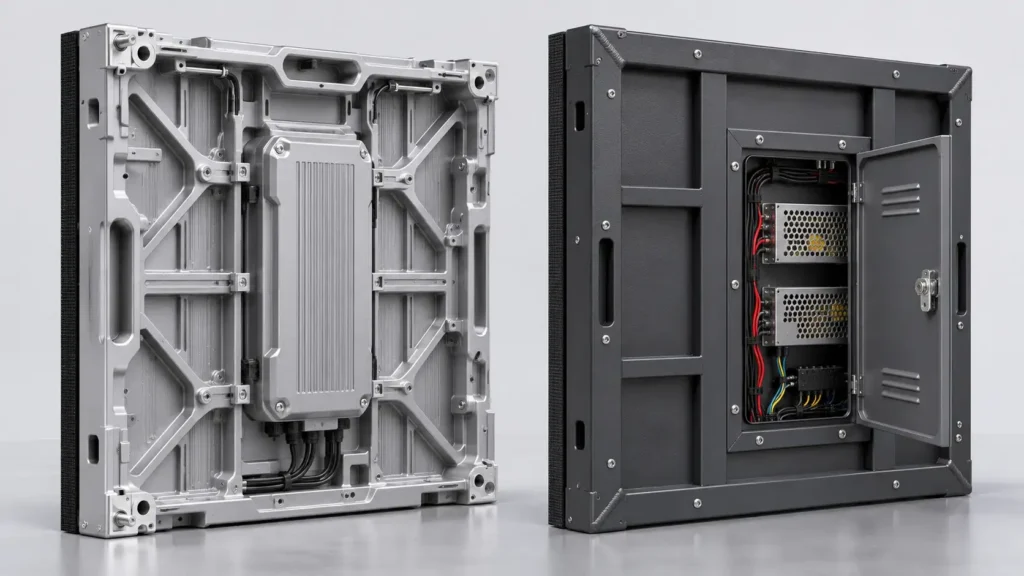
First, Identify What “Aluminum Cabinet” Means
The cabinet can be die-cast aluminium, fabricated from aluminium sheet or made from aluminium extrusions. Different structures are obtained with these methods and different tooling cost.
Ribs, mounting points and locating features can be incorporated into a die-cast design. Customized structures can also be achieved with fabricated aluminum.
Cut, bent and welded sheet metal are a common method for making steel enclosures. This can be done in any size needed for the project but the quality of the welds, finishes, and assembling will have an impact on the finished product.
| Factor | Aluminum cabinet | Steel cabinet |
|---|---|---|
| Common construction | Die-cast, sheet fabrication, or extrusions | Bent and welded sheet fabrication |
| Weight tendency | Often lighter for comparable applications | Often heavier for comparable applications |
| Corrosion considerations | Can corrode; treatment and material combinations matter | Carbon steel needs suitable corrosion protection |
| Heat conduction | Generally higher than common carbon steels | Generally lower than aluminum alloys |
| Customization | Depends on construction and tooling | Fabrication can accommodate varied dimensions |
| Structural performance | Depends on alloy, geometry, and connections | Depends on grade, geometry, and connections |
Be specific about steel, too. Coated carbon steel and stainless steel have different properties and costs.
Weight: Compare the Complete Display
A lighter cabinet can simplify handling and reduce the display’s contribution to structural load. This matters for building-mounted screens and equipment transported between venues.
But an empty frame weight tells only part of the story.
Ask for the assembled weight, including modules, power supplies, receiving cards, and standard hardware. Compare kilograms per square meter when cabinet dimensions differ.
Here is an illustrative calculation: if two complete systems differ by 8 kg/m², a 40 m² display has a 320 kg weight difference. The supporting structure, cables, and other equipment add further load.
For repeated event deployment, MIC’s MCR-S indoor event rental LED screen provides a relevant product option to assess alongside handling and transport requirements.
Lower weight can help, but lifting methods and installation limits still need confirmation.
Strength and Alignment Are Design Questions
Steel is generally stiffer than aluminum at the material level, but cabinet stiffness also depends heavily on shape and thickness.
A poorly designed steel enclosure may not be as good as an aluminum frame with effective reinforcement. However, if the cabinet is well designed and engineered, this can be achieved with a steel cabinet, which offers a sturdy base for a long-lasting screen.
Once assembled, view what happens:
Are cabinets lined up evenly with each other?
Do connection points hold their position?
Are there any breakable parts that bend when touched?
Are adjustments needed to ensure the modules are flat?
There is no resolution increase with cabinet material. But, if there is poor alignment, it can lead to visible steps, gaps or shadows in a high-quality display.
For permanent commercial interiors, MIC’s MC-S indoor fixed LED display offers another configuration to evaluate against installation depth, alignment, and servicing needs.
Outdoor Durability Depends on Protection Details
Aluminum does not develop iron rust, but it is not immune to corrosion. Moisture, salts, surface damage, and contact with dissimilar metals can create problems.
Carbon steel relies on an appropriate protection system. Coating preparation, coverage around welds, exposed edges, and later damage all deserve attention.
For either material, inspect fasteners, drainage paths, cable entries, and seals. A good finish on the outside does not guarantee that internal areas receive equivalent protection.
| Installation environment | Questions to ask |
|---|---|
| Dry indoor space | Is the finish durable enough for handling and cleaning? |
| Humid location | How are condensation and internal corrosion addressed? |
| Coastal site | What material and coating system suits salt exposure? |
| Exposed outdoor structure | How are joints, drainage, and cable entries protected? |
| Frequently transported equipment | How are damaged finishes inspected and repaired? |
An IP rating describes specified ingress protection. It does not establish corrosion resistance or structural performance.
Heat Dissipation: Aluminum Helps Only with a Heat Path
Aluminum is typically a better conductor of heat than typical carbon steel. That can aid with thermal design where heat-generating components are able to flow to the cabinet.
But conductivity of the material is not the only factor that defines operating temperature.
Cooling is contingent on module construction, thermal interfaces, ventilation, power loading, ambient temperature, and solar exposure.
Request the thermal performance at the working conditions. Never assume that an aluminum enclosure will eliminate other cooling provisions or fans.
MIC’s MC-PRO outdoor fixed LED display is one option to assess for outdoor projects; its product page describes aluminum modules and dedicated heat-dissipation features. www.micleddisplay.com
Those features should be evaluated as a complete system.
Compare Total Cost, Not Material Price
Steel fabrication may offer an initial cost advantage in some fixed projects. Aluminum may provide value through reduced handling weight or standardized modular construction.
Neither outcome is universal.
| Cost category | What to compare |
|---|---|
| Cabinet production | Material, tooling, fabrication, and finish |
| Shipping | Packed weight and volume |
| Installation | Labor, lifting equipment, and structure |
| Operation | Measured system performance, including cooling |
| Maintenance | Coating repairs, hardware, and replacement availability |
Custom die-casting tooling can change the economics of a small order. Standard production cabinets may avoid that expense.
Request comparable quotations with the same display area, pixel pitch, electronics, protection requirements, and service scope.
Which Cabinet Should You Choose?
If weight is important, repeated movement of the cabinet is important, or there is an existing modular cabinet platform, consider aluminum.
Use steel for an economical construction that's required to have a specific size for a specific project.
Next, check drawings, assembled weight, finish specification, structural limits and maintenance plan. The cabinet design is up to you, and the best material choice is the one that's supported by that design.
Frequently Asked Questions
Are aluminum LED cabinets always lighter?
No. They often are, but dimensions, thickness, reinforcement, and installed components determine the actual weight.
Are steel cabinets stronger?
Not automatically. Strength depends on the material grade, geometry, manufacturing quality, and connection design.
Does aluminum prevent overheating?
No. Effective cooling requires a complete thermal design and suitable operating conditions.
Can steel cabinets be used outdoors?
Yes, when the complete system has appropriate corrosion protection, ingress protection, and environmental suitability.
Is die-cast aluminum always more accurate?
No. Tooling, machining, process control, and inspection determine dimensional consistency.
Does cabinet material affect image quality?
Indirectly. Alignment and stability affect the assembled surface, while pixels, electronics, and calibration determine image performance.
Which material suits coastal installations?
Evaluate the specific alloy or steel grade, coatings, fasteners, and corrosion evidence. Neither material name alone settles the decision.
What should buyers request before ordering?
Request cabinet drawings, complete weight per square meter, material specifications, coating details, installation limits, service procedures, and spare-part availability.
Share on Social:


Contact Us
In This Article
Related Posts
How to Choose the Right Pixel Pitch Based on Viewing Distance
November 14, 2026
Corner Protection Rental LED Panel: Damage Prevention and Maintenance Guide
October 30, 2026
How to Choose a Shop Window Transparent LED Display for Retail Stores
October 29, 2026
Iron vs. Aluminum Outdoor LED Display Cabinets: How to Choose
October 28, 2026


