




How Long Does It Take to Manufacture a Custom LED Display?
By miashuvo2077
Sep 23, 2026Related Posts
LED Window Display- The Complete Guide for Retail, Advertising, and Commercial Spaces
October 26, 2026
Mini LED Display- What It Is, How It Works, and Where It Fits
October 26, 2026
Naked Eye 3D LED Display - How It Works, Key Specs, Cost and How to Plan One (2026 Guide)
October 16, 2026
Transparent LED Displays for Storefronts
October 14, 2026
Custom LED display lead time is not one fixed number. It depends on whether the screen is a stock or custom build, plus size, quantity, shape and specification. Published supplier examples run from about 1–4 weeks for simple LED sign production to 4–12 weeks from design approval to mass production, and they do not all count the same stages.
Key takeaways
- LED display lead time depends on stock versus custom build, size, quantity, shape and specification.
- Published supplier examples range from 1–4 weeks for LED sign manufacturing to 4–12 weeks from design approval to mass production.
- Factory lead time usually ends when the display is ready for shipment; freight, customs and installation are normally additional.
- Aging and final inspection sit inside the factory timeline, but the sources reviewed here give no universal duration for them.
- No published supplier timeline reviewed here confirms a standard 15-day custom LED display delivery, so treat any such offer as a claim to confirm in writing.
What Counts as Lead Time for a Custom LED Display?
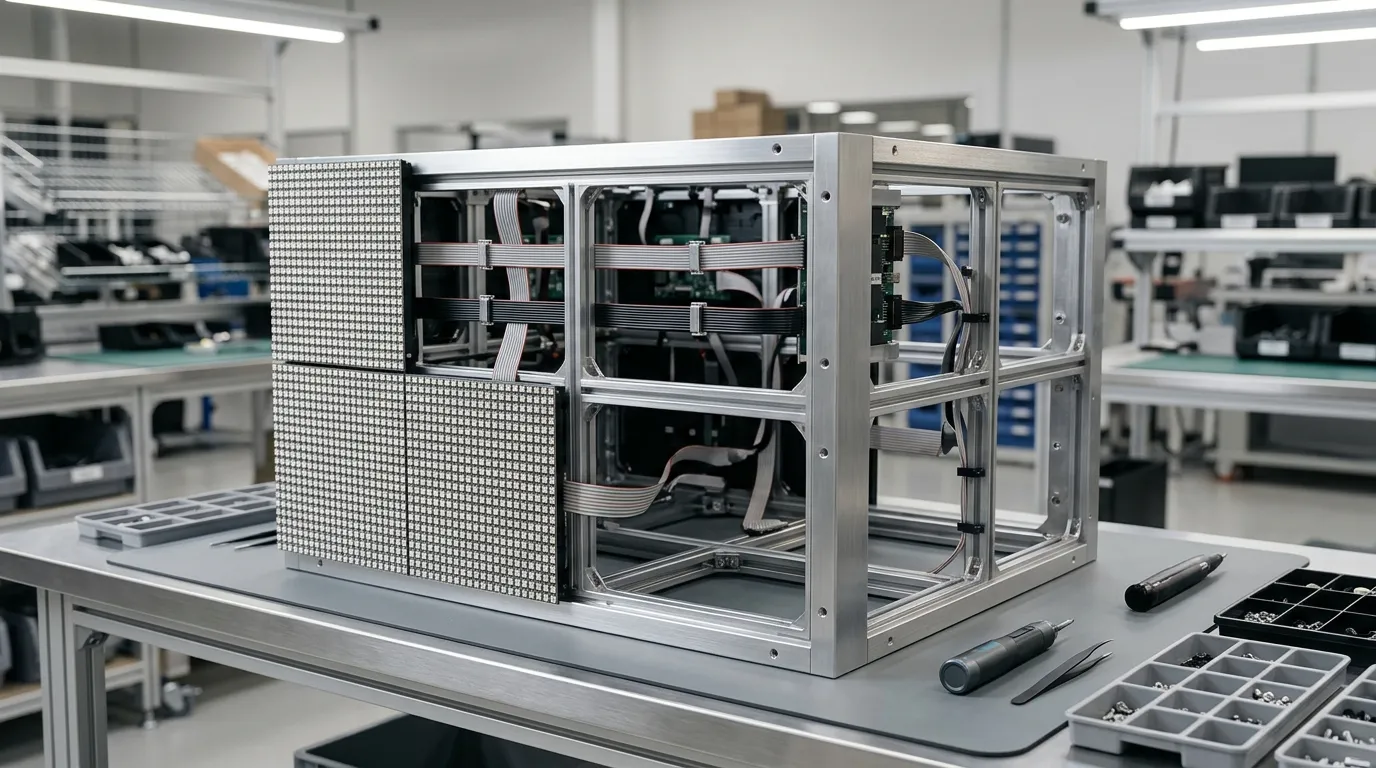
LED display lead time is the period a supplier needs to turn a confirmed order or approved drawing into a display that is ready to ship. For a custom screen, that period normally starts at order confirmation or design approval and ends at ready-for-shipment, not at installation.
The boundary matters because suppliers describe the same weeks differently. Radiant states that its typical 3–5 week lead time includes design, prototyping and production. PixelFLEX describes a longer chain for custom builds: requirements and site details, engineering and design, fabrication and assembly, quality testing, packaging and shipping, and finally on-site installation and calibration.
That is why two quotes of "six weeks" can mean two different things. Before comparing any figures, ask the supplier to write down the start point (order confirmation or drawing approval) and the end point (factory gate, port, delivered site or commissioned screen).
| Stage | Typically inside factory lead time | What to confirm |
|---|---|---|
| Design approval | Often included, but start point varies | Verify with the supplier whether the clock starts at order or at approved drawings |
| Prototyping | Varies by project | Verify with the supplier |
| Production and assembly | Usually included | Verify with the supplier |
| Aging and final inspection | Often included | Verify with the supplier: duration and test conditions |
| Packaging | Usually included | Verify with the supplier |
| Freight and customs | Usually separate | Verify with the supplier and the agreed delivery term |
| Installation and calibration | Usually separate | Verify with the supplier |
[DIAGRAM: A horizontal timeline from order confirmation or design approval through design and engineering, production and assembly, aging and quality control, packaging, freight and customs, and installation, with one bracket marked "factory lead time" and a second marked "full project timeline".]
Stock vs Custom: Why the Timeline Is Different
Stock and standard configurations can ship sooner than custom builds, but availability depends on the supplier's inventory, and the sources reviewed here do not publish a separate stock lead-time figure. A custom build adds design, engineering and non-standard production steps, so it needs a project-specific schedule.
Radiant's 3–5 week figure is for customized displays and includes design, prototyping and production. PixelFLEX's custom-build FAQ states that timing varies with size, shape and complexity rather than giving one number, which is consistent with custom work being schedule-driven rather than catalogue-driven.
A practical approach is to request two written options: one for a standard or stock configuration and one for the custom build you actually need, each stating its own start point. Do not assume the difference is a fixed number of weeks; it depends on what has to be designed and made.
[DIAGRAM: A two-branch decision flow. The first branch asks "stock or standard configuration?" and the second asks "custom build?", with the custom branch listing size, quantity, shape, module or cabinet type, custom electronics and specification as factors that lengthen the schedule.]
What Determines the Timeline? Size, Quantity, Shape and Specification
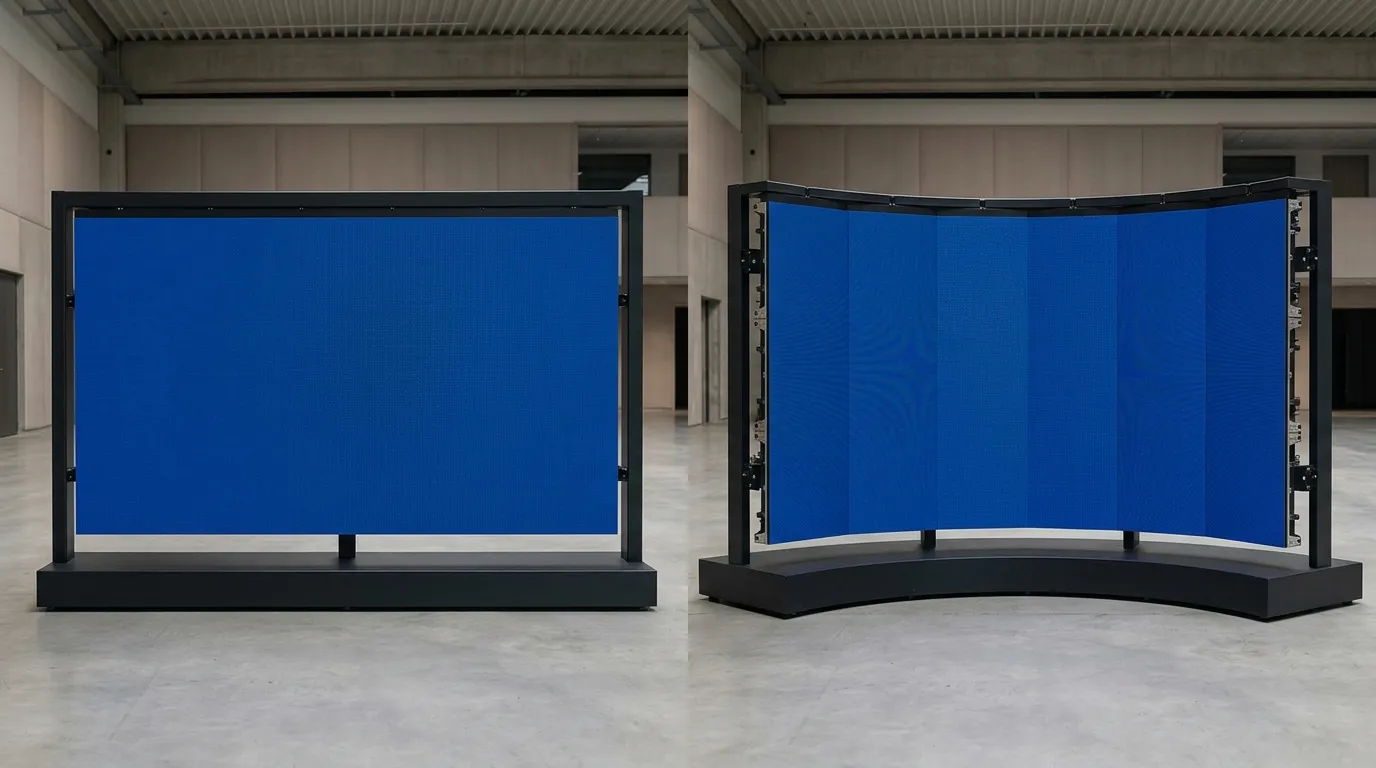
The main variables are the display's size, quantity, shape or structure, module or cabinet type, and technical specification. Complexity, not just total screen area, is what usually stretches a custom schedule.
PixelFLEX's custom-build FAQ states that timing varies with size, shape and complexity. Radiant publishes more specific figures by shape: 5–6 weeks for square and bar screens, and 8 weeks or more for circular or curved, triangular and logo screens. Doitvision lists 3–4 weeks after order confirmation for catalogue shapes, 2–4 weeks for flexible-module shapes and 4–6 weeks for projects requiring custom printed circuit boards (PCBs) — the boards that carry and connect the LEDs.
Pixel pitch is the distance between the centres of two adjacent LED pixels, and it is one of the specifications to confirm with the supplier. The sources reviewed here do not quantify how pixel pitch alone changes a production schedule, so treat it as a specification to state clearly rather than as a predictable delay.
| Factor | Why it can change the schedule | What to confirm |
|---|---|---|
| Size | Larger structures need more material, assembly and handling | Verify with the supplier |
| Quantity | More units mean more production and testing time | Verify with the supplier |
| Shape or structure | Curved, circular, triangular and logo shapes are slower than square or bar screens | Lead time for the exact shape, not a generic figure |
| Module or cabinet type | Non-standard modules change tooling and assembly | Verify with the supplier |
| Pixel pitch and other specifications | Defines the components the design must use | Confirm the effect on the schedule, not just the spec |
| Custom PCB or non-standard electronics | Adds design and fabrication work | Verify with the supplier |
| Installation environment | Affects structure, mounting and protection design | Verify with the supplier |
The Custom LED Display Manufacturing Timeline, Stage by Stage
A custom order generally moves through design and engineering approval, production and assembly, aging and final inspection, then packaging and shipping. Factory lead time usually ends at ready-for-shipment; freight, customs and installation are separate unless the supplier states otherwise.
1. Design and Engineering Approval
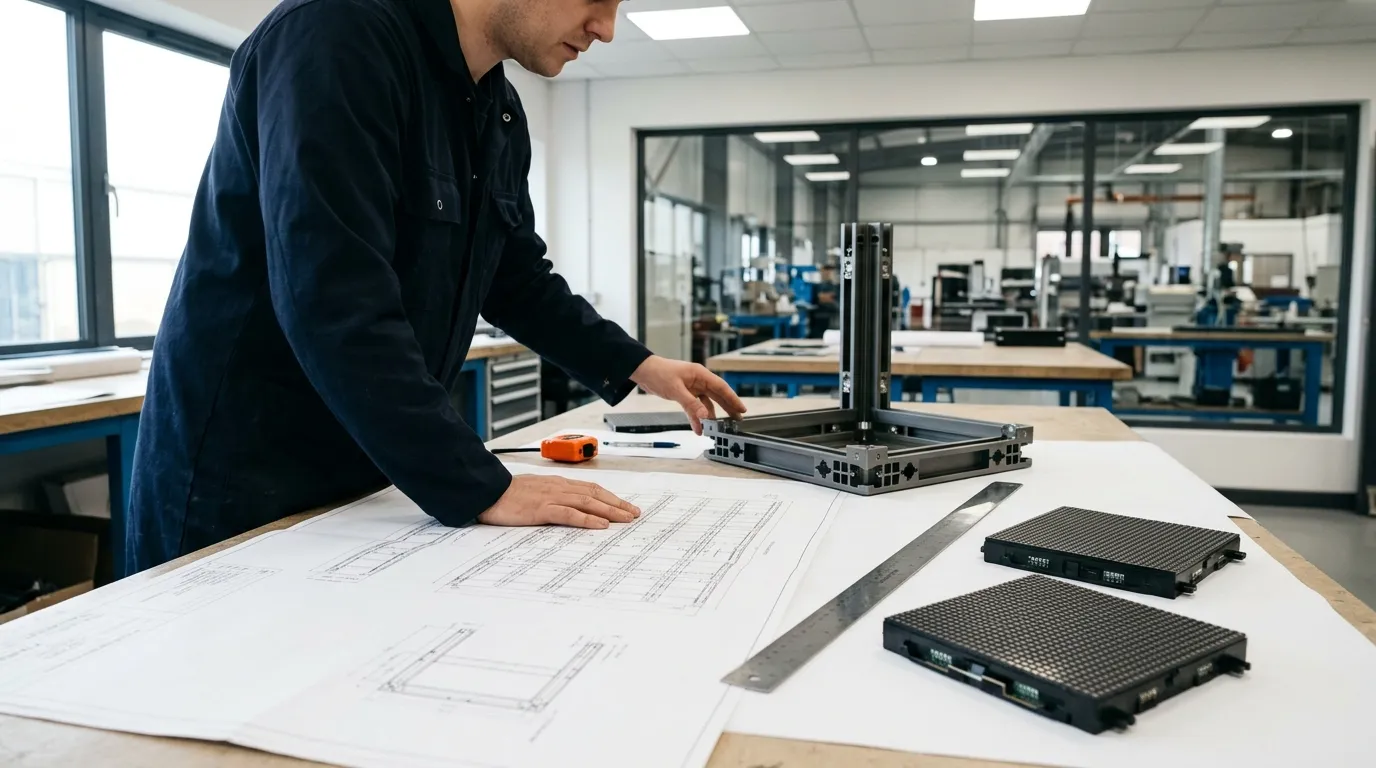
This stage turns project requirements into approved drawings, structure and configuration. Some suppliers count it inside their quoted range, while others start counting only once the drawings are approved.
Radiant includes design, prototyping and production inside its typical 3–5 week figure. Portworld lists approximately 4–12 weeks from initial design approval to the commencement of mass production, which starts the clock later. PixelFLEX places requirements and site details, engineering and design, and fabrication and assembly at the front of its sequence. Confirm the design-approval milestone in writing so you know which of these models you are working with.
2. Production and Assembly
Production covers module, cabinet, power and control assembly. Published examples differ widely by product type, so match the figure to the kind of screen you are ordering.
LED Craft lists manufacturing at 1–4 weeks within its LED sign installation timeline. Doitvision lists 3–4 weeks for catalogue shapes, 2–4 weeks for flexible-module shapes and 4–6 weeks for custom PCB projects. Radiant lists 5–6 weeks for square or bar screens and 8 weeks or more for curved, triangular and logo shapes. If you want to see how a supplier runs this stage, a factory visit is a useful check before you commit to a schedule.
3. Aging Test and Final Inspection
Aging is the process of running a completed display for a set period before shipping so early component failures appear in the factory rather than on site. PixelFLEX places quality testing before packaging and shipping in its custom-build sequence, but the sources reviewed here give no standard aging duration for a custom display.
That gap is worth closing in the quote itself. Ask the supplier to state the aging duration, the test conditions, and whether final inspection sits inside or outside the quoted lead time.
4. Packaging, Freight and Customs
Packaging and dispatch are part of the process, while international transit and customs clearance normally sit outside factory lead time. Confirm what the quote actually ends at: factory gate, port, delivered site or installed and commissioned.
PixelFLEX lists packaging and shipping plus on-site installation and calibration as steps in a custom build. LED Craft separates planning, permitting and site preparation from manufacturing, which is a reminder that project timelines include work that has nothing to do with the factory. State the destination and required delivery date when you request a schedule.
How Long Does a Custom LED Display Take? Published Supplier Examples
Published examples range from about 1–4 weeks for LED sign manufacturing to 4–12 weeks from design approval to mass production, depending on what each supplier counts. They are supplier-specific examples, not an industry-wide standard.
| Source | Stated timing | Start point and scope | Caveat |
|---|---|---|---|
| Radiant | 3–5 weeks typical | Includes design, prototyping and production | Covers customized displays generally |
| Radiant | 5–6 weeks square or bar; 8 weeks or more for circular, curved, triangular and logo screens | Production cycle by shape | Shape-specific, not a blanket figure |
| Doitvision | 3–4 weeks catalogue shapes; 2–4 weeks flexible modules; 4–6 weeks custom PCB | After order confirmation | Published for its own product categories |
| Portworld | Approximately 4–12 weeks | Initial design approval to commencement of mass production | Ends at mass production, not shipment |
| LED Craft | 1–4 weeks manufacturing | Within an LED sign installation timeline | Sign-installation scope, not a video display order |
| PixelFLEX | No numeric range | Custom-build process, requirements to installation | States timing varies with size, shape and complexity |
Do not average these figures. A number that stops at mass production measures something different from a number that ends at ready-for-shipment, and a sign-installation manufacturing window is not the same as a custom video wall build. Use the table to decide what to ask your supplier, not to set a fixed expectation.
Can a Custom LED Display Be Delivered in 15 Days?
No published supplier timeline reviewed here confirms a 15-day custom LED display delivery as a standard offer. Some suppliers do publish short production windows, but those windows cover simpler builds and specific product categories.
Doitvision lists 2–4 weeks for flexible-module shapes and 3–4 weeks for catalogue shapes. LED Craft lists 1–4 weeks for manufacturing within an LED sign project. Neither confirms a general 15-day turnaround for a custom screen, and neither includes freight to an international destination.
If you need an expedited schedule, ask for it as a written commitment rather than an assumption: state the start point, the stages included and excluded, the freight mode, and any conditions attached. If that written schedule matters to your project planning, you can contact MIC Display with your specifications to request one for your own build.
What to Send a Supplier for a Reliable Schedule
To get a usable lead-time estimate, send the supplier your dimensions, quantity, product type, technical specification, installation environment, design status and destination. Then ask them to state the start point and what the schedule excludes.
A written checklist keeps the request complete:
- Screen type and application — indoor, outdoor, rental, fine-pitch COB, transparent, floor tile or poster.
- Width, height or total area, and the number of screens.
- Pixel pitch, resolution, brightness and refresh requirements.
- Installation environment and mounting structure.
- Design status — concept, drawings or approved files.
- Destination country and city, plus your required delivery date.
- The delivery term you want, and whether installation is included.
- A written lead time from order confirmation or design approval to ready-for-shipment.
PixelFLEX begins its custom-build sequence with requirements and site details, and Radiant states that complex or large-scale projects receive a detailed timeline rather than a generic one. LED Craft's separation of planning, permitting and site preparation from manufacturing is also worth copying into your own project plan.
Because you will be evaluating suppliers on how they answer this request, it helps to read a led display manufacturer checklist alongside the quotes, and to check the FAQs for common ordering questions. If you need help interpreting a specification before you send it, technical support can clarify it.
MIC Display is an LED display factory in China established in 2011. Its design team customizes screen structure, size and configuration to each project's installation environment, and its displays carry a 5–8 year warranty with remote technical support and after-sales service. The company has not published a standard manufacturing lead time, so any schedule for your project should be confirmed in writing against your own specification.
[PHOTO: A printed project information checklist card showing the eight items to send a supplier, placed beside a laptop displaying an approved LED display drawing.]
Share on Social:


Contact Us
In This Article
Related Posts
LED Window Display- The Complete Guide for Retail, Advertising, and Commercial Spaces
October 26, 2026
Mini LED Display- What It Is, How It Works, and Where It Fits
October 26, 2026
Naked Eye 3D LED Display - How It Works, Key Specs, Cost and How to Plan One (2026 Guide)
October 16, 2026
Transparent LED Displays for Storefronts
October 14, 2026


