




LED Screen vs Projector for Large Venues
By hqt
Nov 17, 2026Related Posts
How to Choose the Right Pixel Pitch Based on Viewing Distance
November 14, 2026
Corner Protection Rental LED Panel: Damage Prevention and Maintenance Guide
October 30, 2026
How to Choose a Shop Window Transparent LED Display for Retail Stores
October 29, 2026
Iron vs. Aluminum Outdoor LED Display Cabinets: How to Choose
October 28, 2026
However, for larger installations, the LED screen is usually the better option in areas where there is a challenge in controlling ambient lighting, when uninterrupted images are important, or when there's risk of people crossing the display area. A projector can be a viable solution if lighting is under control, a suitable projection surface exists and the conditions for installation allow for the desired image size.
However, there is no one perfect solution for all auditoriums, conference rooms, churches, and exhibition halls. The right choice will depend on what your audience needs to see, the venue and how it works and the total price of the system.
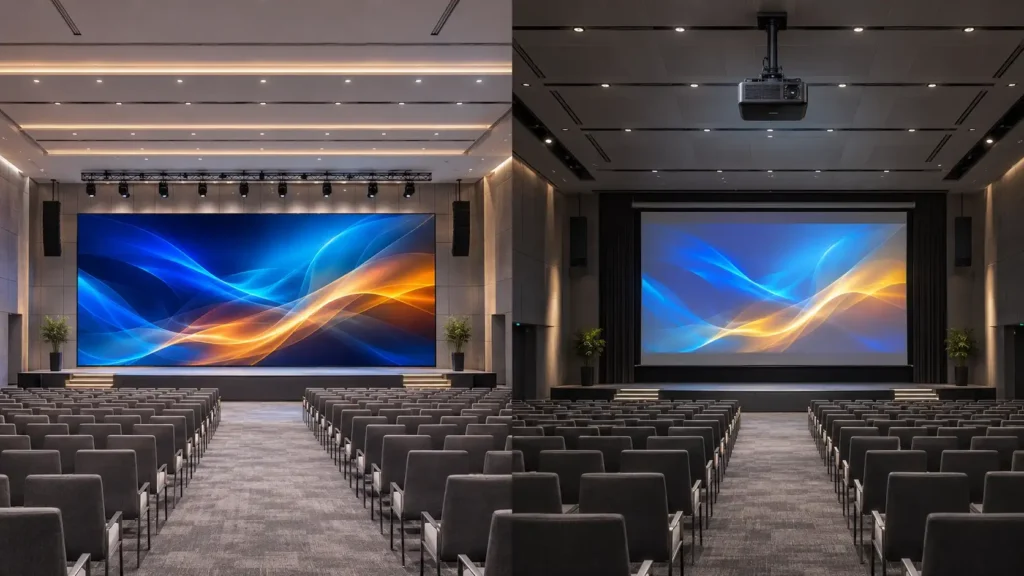
How LED Screens and Projectors Create Images
A direct-view LED screen's images are generated by light emitting pixels. Modules are attached to create a display, the resolution of which depends on the size and resolution of the display, and the pitch of the pixels.
Light is bounced off a different surface by a projector. The image quality will vary based on projector, lens, screen material, ambient lighting and installation geometry.
The difference impacts things from contrast to maintenance.
| Factor | LED screen | Projector |
|---|---|---|
| Image formation | Pixels emit light directly | Light reflects from a projection surface |
| Ambient light | Often suitable for brighter venues | Image contrast depends heavily on lighting |
| Image size | Built from modular cabinets | Depends on lens, distance, and screen |
| Shadows | No projection beam to interrupt | Front projection can produce shadows |
| Installation | Needs mounting structure and power planning | Needs lens alignment and a clear light path |
| Maintenance | Modules and components may be serviced | Optics, cooling, filters, and light source need consideration |
Ambient Light Often Decides the Choice
Think about a conference hall during a daytime event. Doors open, stage lighting changes, and attendees need enough light to take notes.
A projected image may lose contrast as unwanted light reaches the screen. Increasing projector output can help, but it cannot fully compensate for every lighting condition.
An LED screen usually gives venue operators more freedom to keep the room illuminated. However, brightness still needs adjustment. An overly bright display can become uncomfortable during an evening presentation.
For permanent indoor venues, MIC’s MC-PRO indoor LED video wall is one option to evaluate against the room’s lighting and viewing requirements.
Projection remains worth considering in darkened auditoriums and theaters. With suitable equipment and controlled lighting, it can deliver an effective large image.
Screen Size Does Not Tell You the Whole Story
Small text can still be a problem for a large display.
Pixel pitch is the term used to describe the pitch of a Pixel array for LED. A finer pitch provides more resolution in a particular area for presentation slides, subtitles and more detailed graphics.
Visible detail is affected by projection, native resolution, lens performance, focus, screen texture and image size.
The real issue is whether the smallest information that is significant can be read from the back row?
| Venue content | What to evaluate |
|---|---|
| Conference presentations | Small text, diagrams, and spreadsheet labels |
| Concert visuals | Visibility under stage lighting and camera performance |
| Worship services | Lyrics, speaker images, and sightlines |
| Sports viewing | Motion, source quality, and viewing angles |
| Exhibitions | Daylight exposure, close viewing, and operating hours |
Request a demonstration using actual content. A dramatic landscape video won’t tell you whether a technical chart is readable.
Viewing Distance and Audience Comfort
Large venues often have a wide spread of viewing distances. Front-row guests may sit close to the display while others watch from much farther away.
Choosing LED pitch only for the back row can leave nearby viewers seeing a coarse pixel structure. Choosing an unnecessarily fine pitch can increase cost without improving the audience’s experience enough to justify it.
MIC’s fine-pitch COB LED display provides another option for indoor spaces where close viewing and detailed imagery are priorities.
For either technology, check screen height, viewing angles, text size, and comfortable brightness before finalizing the layout.
Installation: Structure or Projection Distance?
LED screens require an appropriate mounting structure, electrical distribution, signal cabling, ventilation, and service access. Suspended installations also need qualified structural assessment.
Projectors need a suitable throw distance and lens. Front projection requires an unobstructed beam path; rear projection needs space behind the screen.
Short-throw systems can reduce distance requirements, but they still need compatible optics, surfaces, and careful alignment.
In temporary venues, installation and dismantling also affect labor costs. Rental LED systems can suit repeated event deployment, although transport, rigging, and crew requirements must be included in the plan.
For permanent halls and commercial spaces, MIC’s MC-S indoor fixed LED display offers a product route to assess alongside the venue drawings.
Compare the Complete Cost
A projector may initially look less expensive than an LED wall. Sometimes it is. But compare complete systems at the required image size and performance.
Projection costs can include lenses, screens, mounts, cabling, alignment, and possibly multiple projectors. LED costs include cabinets, processing, structure, installation, calibration, and spare components.
| Cost category | Questions to ask |
|---|---|
| Initial equipment | Are all required accessories included? |
| Installation | What structure, access equipment, and labor are needed? |
| Electricity | What is typical consumption at operating settings? |
| Maintenance | Which parts need cleaning, servicing, or replacement? |
| Downtime | Can repairs happen without canceling an event? |
| Future changes | Can the system accommodate new content or layouts? |
Avoid assuming either technology always uses less electricity. Compare actual configurations, daily hours, and operating brightness.
Which Is Better for Your Venue?
Bright multipurpose halls, commercial event spaces, and venues where a continuous image without a projection beam are required often benefit from an LED screen.
Adjusting screen placement and throw distance to suit the requirements of darkened auditoriums, cinema-style presentations and installations will enable a projector to be used.
Communicate with the supplier well in advance of purchase the size of the room, audience seating, lighting requirements, content examples and operating times. These details generate a more effective recommendation than just screen size.
Frequently Asked Questions
Is an LED screen better than a projector in daylight?
Usually, direct-view LED is easier to use in bright conditions. The selected screen still needs appropriate brightness, while projection depends strongly on controlling light reaching the surface.
Can a projector work in a large conference hall?
Yes. It needs suitable output, resolution, optics, screen material, and lighting conditions. Test presentation readability across the seating area.
Which option is better for small text?
Either can work. LED needs sufficient pixel density; projection needs adequate native resolution and optical performance. Content size and viewing distance remain essential.
Do LED screens eliminate shadows?
They eliminate shadows caused by interrupting a projection beam. People or objects can still physically block the audience’s view.
Are laser projectors maintenance-free?
No. Laser light sources can reduce lamp-related servicing, but cooling systems, filters where fitted, optics, and alignment still require attention.
What should a venue test before ordering?
Test real content under normal lighting, from several seats. Check readability, brightness comfort, camera recording if needed, and how technicians will access the system.
Share on Social:


Contact Us
In This Article
Related Posts
How to Choose the Right Pixel Pitch Based on Viewing Distance
November 14, 2026
Corner Protection Rental LED Panel: Damage Prevention and Maintenance Guide
October 30, 2026
How to Choose a Shop Window Transparent LED Display for Retail Stores
October 29, 2026
Iron vs. Aluminum Outdoor LED Display Cabinets: How to Choose
October 28, 2026


