




Top LED Screen Manufacturers for Commercial Projects
By miashuvo2077
Sep 16, 2026Related Posts
LED Window Display- The Complete Guide for Retail, Advertising, and Commercial Spaces
October 26, 2026
Mini LED Display- What It Is, How It Works, and Where It Fits
October 26, 2026
Naked Eye 3D LED Display - How It Works, Key Specs, Cost and How to Plan One (2026 Guide)
October 16, 2026
Transparent LED Displays for Storefronts
October 14, 2026
Choosing among top LED screen manufacturers for commercial projects starts with the project, not the logo. Commercial LED screen suppliers differ by what they build and support: retail and advertising displays, control-room video walls, and rental systems for events. Published supplier lists disagree on order, so shortlist against the deliverables each project type actually requires.
- EagerLED's guide states that its numbering is not an independently audited ranking, so no single public list settles the question.
- Samsung Electronics, Leyard, Daktronics, Barco, Unilumin and Absen recur across the supplier lists reviewed here, each with a different stated specialty.
- Retail, advertising, control-room and event projects each demand different supplier deliverables: pitch, environment suitability, structure, spares and support.
- Pixel pitch should follow viewing distance and environment, not the other way around.
- Warranty and after-sales terms are comparison criteria in their own right, and their scope belongs in writing.
What Counts as a Commercial LED Screen Supplier?
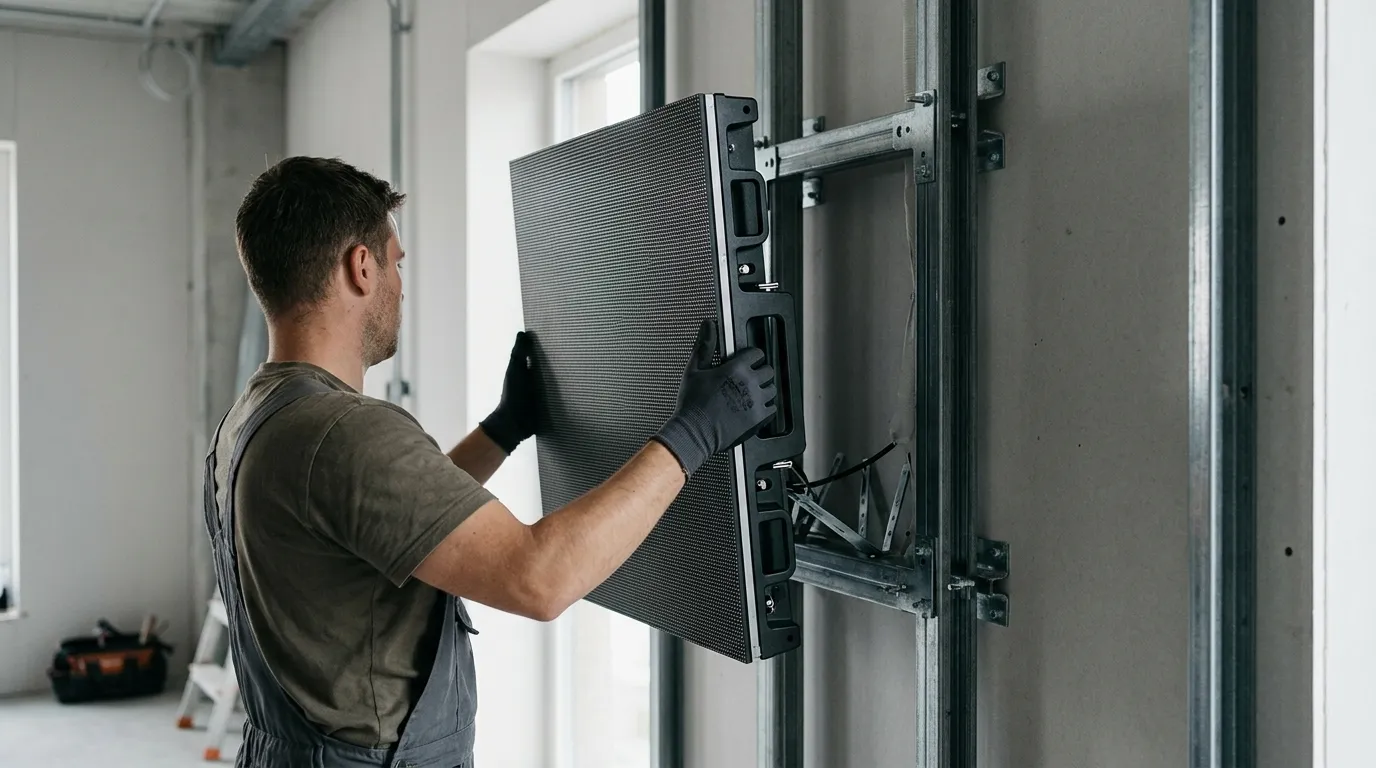
A commercial LED screen supplier is the business that supplies, configures and supports LED display systems for revenue-generating spaces — but the term covers four different roles: display factory or manufacturer, regional distributor, system integrator, and rental or event provider.
Each role carries different responsibilities. A factory controls module design and production. A distributor resells product but may not design structures. A system integrator takes responsibility for the installation as a whole, including control systems and site work. A rental or event provider supplies equipment and crew for a defined show window rather than a permanent installation.
Four supplier roles
- Display factory or manufacturer — designs and produces the modules and cabinets.
- Regional distributor — supplies locally held stock and often handles logistics.
- System integrator — designs and delivers the complete installation.
- Rental or event provider — supplies and supports equipment for temporary use.
UNIT LED's guide illustrates how wide this supplier landscape is: it lists 30 US suppliers and organizes them by headquarters and market focus, including retail and commercial, control-room, outdoor and event-related applications (UNIT LED, https://www.unit-led.com/led-display-suppliers-usa).
How to tell which role you are dealing with: before shortlisting, ask who holds the module design or tooling, who designs the site structure, and which legal entity signs the warranty. Those three answers separate a factory, a distributor and an integrator more reliably than a company name or a showroom.
For a deeper set of verification questions, see the led display manufacturer evaluation checklist, which covers the same ground in more detail.
Reference Table — Manufacturer Names That Recur Across Published Supplier Lists
No retrieved source establishes an objective order. EagerLED's guide states that its numbering is not an independently audited ranking, and Linsn's guide also places the publishing company among the names it lists — so the table below is a sourced reference of who appears where, not a ranking of quality.
The names that recur most often across the sources reviewed here are Samsung Electronics, Leyard, Daktronics, Barco, Unilumin and Absen. EagerLED's guide lists Samsung, Unilumin, Absen, LG, EagerLED, Leyard, Daktronics, Barco, LianTronics and Ledman (EagerLED, https://www.eagerled.com/led-display-manufacturers-world/).
| Company | What the source says it specializes in | Relevant commercial project type | Source |
|---|---|---|---|
| Samsung Electronics | Founded 1969, headquartered in Suwon, South Korea; described as a premium commercial display brand | Retail and commercial spaces | Linsn LED |
| Leyard | Founded 1995, headquartered in Beijing, China; small-pitch LED and control rooms | Control rooms, data visualization | Linsn LED |
| Leyard | Fine-pitch and control-room displays | Control rooms | Royal Display |
| Daktronics | Founded 1968, headquartered in Brookings, USA; stadium and outdoor displays | Outdoor advertising, large venues | Linsn LED |
| Barco | Founded 1934, headquartered in Kortrijk, Belgium; control rooms and visualization | Control rooms | Linsn LED |
| Unilumin | Commercial, sports, outdoor and rental displays | Retail, outdoor, events | Royal Display |
| Absen | Indoor and outdoor, rental, commercial and XR applications | Events, rental, commercial | Royal Display |
Linsn LED's comparison table provides the founding years and headquarters above (Linsn LED, https://www.linsnled.com/top-10-led-screen-manufacturers-in-world.html). Royal Display's China comparison table provides the Unilumin, Leyard and Absen descriptions (Royal Display, https://www.royal-display.com/led-screen-manufacturers-in-china/).
Read the table with two limits in mind. First, inclusion means a company was named on a retrieved list, nothing more. Second, a specialty describes what one publisher wrote, not a verified capability for every product that company sells.
What Does Each Commercial Project Type Need From a Supplier?
Supplier fit is decided by the installation environment and how the screen must perform in it, so the four commercial project types below should be evaluated against different deliverables.
Retail and Commercial Spaces
Indoor retail and commercial spaces usually need close-viewing indoor displays with practical service access and a mounting structure matched to the ceiling, wall or floor.
Viewers in a shop or lobby stand a few metres away, so the pitch must suit that distance and the content must hold up under ambient lighting and reflections. Service access matters as much as image quality, because a screen that cannot be reached easily becomes an operational problem.
What the supplier must deliver: a pitch recommendation tied to the closest expected viewer, a structure designed for the actual substrate, and a stated service method.
One question to ask: "What is the minimum viewing distance for the quoted pitch, and how is the screen serviced?"
MIC Display's website lists commercial space among its solution areas and includes indoor display categories such as indoor fixed and indoor video wall products (MIC Display, homepage). A worked example of this project type is the commercial display solution area.
Advertising and Outdoor Displays
Advertising projects are decided by the site environment, so the supplier must evidence that the exact quoted product suits that outdoor or high-brightness location, together with its structure and power arrangements.
Outdoor advertising screens face sunlight, weather and long viewing distances. Coarser pitch is often acceptable because viewers are far away, but the enclosure, cooling and structural design carry more weight than in an indoor installation. A generic "outdoor range" claim is not evidence — ask for the specification of the model being quoted.
What the supplier must deliver: the environmental specification of the quoted product, a structure designed for the mounting point, and a maintenance plan for a screen that may be hard to reach.
One question to ask: "Which specification in this quotation addresses the environment at this site?"
Linsn's comparison table associates Daktronics with stadium and outdoor displays (Linsn LED, https://www.linsnled.com/top-10-led-screen-manufacturers-in-world.html), and Royal Display's table lists Unilumin with outdoor applications (Royal Display, https://www.royal-display.com/led-screen-manufacturers-in-china/). MIC Display's website includes advertising among its solution areas alongside outdoor and outdoor advertising display products (MIC Display, homepage). See the advertising display solution area for this project type.
Control Rooms and Data Visualization
Control-room and data-visualization projects depend on fine pixel pitch, sustained-duty expectations, colour consistency and remote support terms rather than sheer screen size.
Operators sit close to the wall and read data for long periods, so fine pitch, stable colour and predictable behaviour over long duty cycles matter more than brightness. Downtime is expensive, which makes remote diagnostics and clear escalation paths part of the requirement rather than an extra.
What the supplier must deliver: a fine-pitch recommendation, a stated calibration approach, an expectation for sustained operation, and remote diagnostics.
One question to ask: "How is colour and brightness consistency maintained across the wall over time?"
Linsn's comparison table associates Leyard with small-pitch LED and control rooms, and Barco with control rooms and visualization (Linsn LED, https://www.linsnled.com/top-10-led-screen-manufacturers-in-world.html). Royal Display's table lists Leyard with fine-pitch and control-room displays (Royal Display, https://www.royal-display.com/led-screen-manufacturers-in-china/). MIC Display's website includes data visualization as one of its solution areas, alongside fine-pitch products such as COB displays. Explore the data visualization solution area for this project type.
Events, Stage and Rental
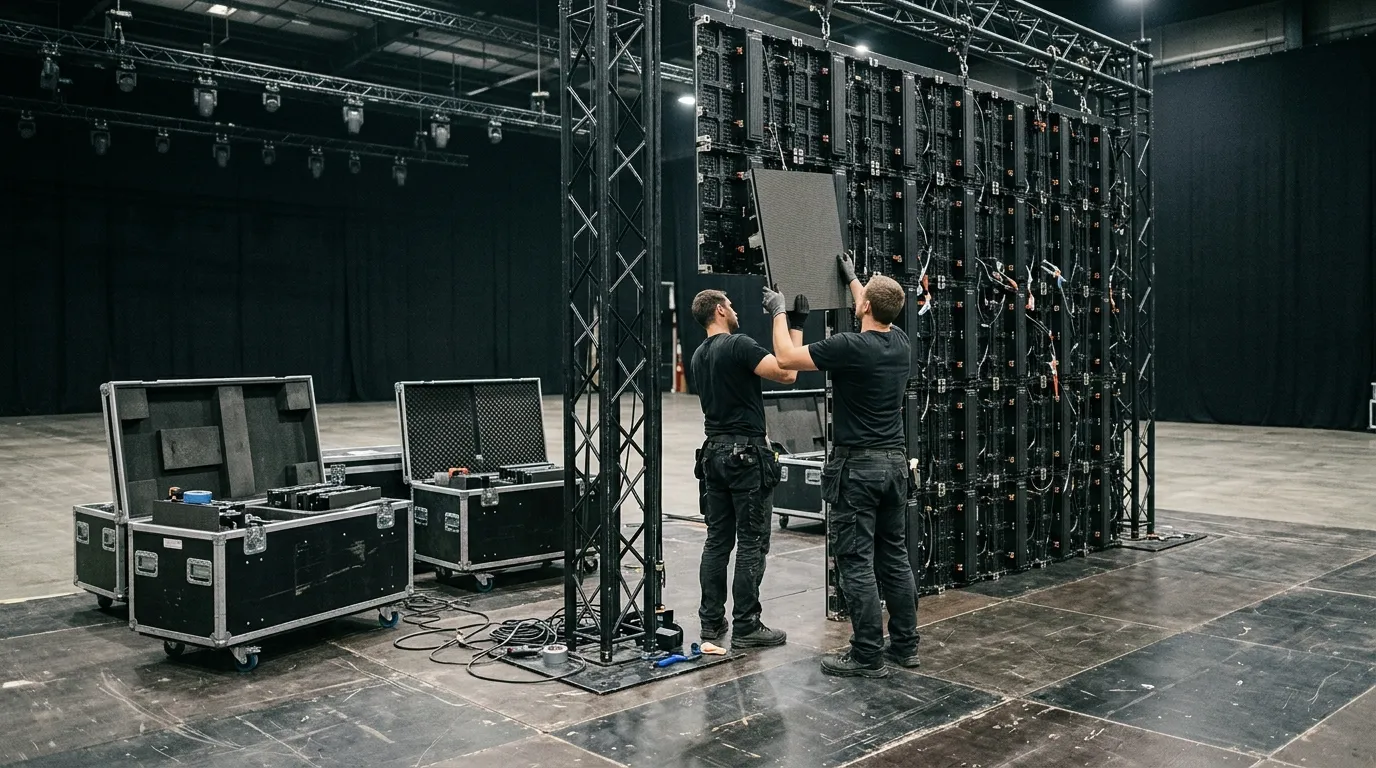
Event and rental projects need supplier deliverables beyond the screen itself: cabinet handling, rigging or stacking design, spares, transport cases and a service plan covering the whole show window.
Rental screens are assembled and struck repeatedly, often by different crews, so speed of assembly and physical durability matter. The schedule is fixed and there is no second opening night, which makes the spare-parts allowance and the named contact during the event part of the quotation, not an afterthought.
What the supplier must deliver: a cabinet system suited to repeated handling, a rigging or stacking design, a stated spare allowance, and a named support contact for the event period.
One question to ask: "How many spare cabinets and modules are included per screen, and who is on call during the show?"
Royal Display's comparison table associates Absen with indoor and outdoor, rental, commercial and XR applications (Royal Display, https://www.royal-display.com/led-screen-manufacturers-in-china/). MIC Display's website lists stage as one of its four solution areas and rental LED display among its product categories (MIC Display, homepage). See the stage display solution area for this project type.
Application-to-Deliverables Matrix
| Project type | Primary display requirement | What the supplier must deliver | One question to ask |
|---|---|---|---|
| Retail and commercial | Pitch suited to close indoor viewing | Structure matched to the real substrate; stated service method | What is the minimum viewing distance, and how is the screen serviced? |
| Advertising and outdoor | Environment suitability for the site | Environmental specification of the quoted model; structure; maintenance plan | Which specification addresses this site's environment? |
| Control room and data visualization | Fine pitch and sustained, consistent output | Calibration approach; duty expectation; remote diagnostics | How is consistency maintained across the wall over time? |
| Stage, event and rental | Repeated assembly and fast turnaround | Handling-ready cabinets; rigging or stacking design; spares; event contact | How many spares are included, and who is on call? |
How Do Pixel Pitch and Viewing Distance Shape the Specification?
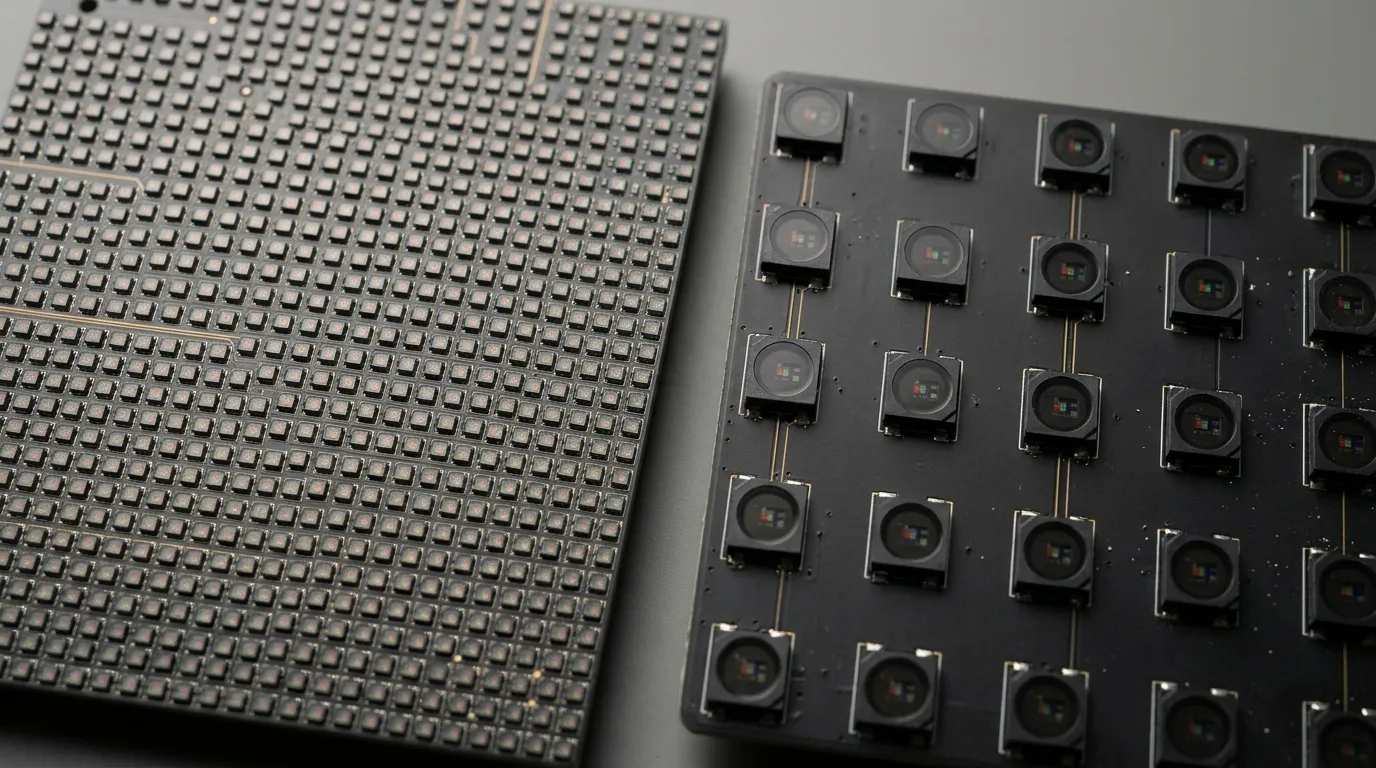
Viewing distance and environment should be set before pixel pitch is chosen: closer viewers and control-room content need finer pitch, while long-distance outdoor advertising can use coarser pitch.
Pixel pitch is the distance between the centres of adjacent pixels, measured in millimetres. A smaller number means more pixels in the same area and a sharper image at close range, but it also increases the pixel count a project has to drive. Choosing a finer pitch than the viewing distance requires adds cost without a visible benefit.
A practical decision rule: write the minimum viewing distance and the indoor or outdoor environment into the brief first, then ask each supplier to justify the pitch it quotes against those two conditions. If a supplier cannot explain its pitch choice, the rest of the proposal is harder to trust.
MIC Display's supplied range covers small-pitch P0.9375–P1.86, indoor P2–P10 and outdoor P2.5–P10 — three separate bands matched to different viewing conditions. Linsn's comparison table associates Leyard with small-pitch LED work (Linsn LED, https://www.linsnled.com/top-10-led-screen-manufacturers-in-world.html).
Note the limit: a finer pitch does not fix a bad viewing angle, a bright reflective surface or a poorly designed structure. Those are separate decisions.
What Should Be Ready Before You Request a Quote?
A supplier can only quote accurately when it has the site environment, the viewing conditions, the screen dimensions, the mounting substrate and the level of support required.
Prepare these seven items before approaching any supplier:
- Installation environment — indoor, outdoor or semi-outdoor, and whether the site is exposed to direct sun, rain or dust.
- Viewing distances — the minimum and the typical distance from which the audience will view the screen.
- Screen size and shape — target width and height, and whether the aspect needs to be non-standard.
- Mounting substrate — wall, ceiling, steel frame, floor or temporary truss, and how the screen will be serviced.
- Control and signal requirements — what content will be displayed and what the screen must connect to.
- Spare-parts expectation — particularly for rental and event work, where spares are part of the delivery.
- Warranty and support scope — what you expect covered and the response arrangement you need.
A useful rule: if two quotations differ sharply on price, compare both against this list before comparing the numbers. Most differences trace back to a different assumption about one of these seven items.
How Should Buyers Compare Manufacturers Across All Four Use Cases?
Compare suppliers on project evidence and proposal completeness rather than reputation, using the same criteria for every shortlisted company.
Work through these six steps:
- Fix the project category — retail, advertising, control room or event — and note which of the four matters most in the application-to-deliverables matrix above.
- Score each supplier against that row. Apply the same criteria to every company so the comparison is like for like.
- Verify who performs each role — module production, structure design, installation and warranty.
- Check the pitch justification against your stated viewing distance and environment.
- Check the warranty and support scope in writing, not as a headline figure.
- Request the same document set from every shortlisted supplier so gaps are visible rather than hidden in differently formatted proposals.
| Criterion | What good looks like | Evidence to request | Supplier A / B / C |
|---|---|---|---|
| Project-type match | Demonstrated work in your project category | Relevant project references or drawings | Verify with the supplier |
| Structure and configuration design | A design matched to your actual substrate | Structural drawings or configuration plan | Verify with the supplier |
| Pitch justification | Pitch tied to viewing distance and environment | Written reasoning for the quoted pitch | Verify with the supplier |
| Warranty and support scope | Defined coverage and named support route | Written warranty and support terms | Verify with the supplier |
| Spares and lead time | A stated allowance and schedule | Quotation line items for spares and delivery | Verify with the supplier |
The led display manufacturer evaluation checklist expands this into a full scoring method if you need more detail than five criteria.
How Do You Assess Warranty, Technical Support and After-Sales Terms?
Warranty and support should be compared as scoped terms — what is covered, for how long, how faults are diagnosed, and who pays for parts and shipping — not as headline years.
A five-year warranty with no remote diagnostics can be less useful to a control room than a shorter term with fast remote support. Distance also matters: for buyers importing from another country, the practical question is how a fault is handled without a site visit.
| Term | What it covers | What to get in writing | Notes |
|---|---|---|---|
| Warranty length | The period during which covered faults are addressed | Start date and covered components | Compare like-for-like scope, not just duration |
| Covered components | Which parts are included and which are excluded | Written list of inclusions and exclusions | Exclusions are usually the decisive detail |
| Remote diagnostics | How a fault is identified before any site work | Described process and contact route | Important where sites are far apart |
| Spare parts | How replacement parts are supplied and shipped | Supply terms for spares | Cover for rental work is part of the delivery |
| Support arrangement | Whether support is remote, on-site or mixed | Response arrangement and escalation path | Depends on the project type |
MIC Display's displays carry a 5–8 year warranty, with remote technical support and after-sales service, and the company's warranty page sets out the terms that apply.
One limit applies here: do not compare one supplier's headline warranty length against another's unless both written scopes are available. Different inclusions make the numbers non-comparable.
Frequently Asked Questions
Who are the top LED screen manufacturers for commercial projects?
No retrieved supplier list agrees on a single order, and EagerLED's guide states that its numbering is not an independently audited ranking. Linsn LED's list names Samsung Electronics, Leyard, LG Electronics, Daktronics and Barco in its first group, while EagerLED lists Samsung, Unilumin, Absen, LG, Leyard, Daktronics, Barco, LianTronics and Ledman.
What is the best LED screen for a commercial project?
It depends on the project rather than the brand. Retail and control-room spaces need finer pitch because viewers sit close, outdoor advertising needs a product specified for the site environment, and events need cabinets built for repeated handling with spares included. Compare proposals against your project type, viewing distance and support needs.
How do I tell a manufacturer from a reseller or system integrator?
Ask who holds the module design or tooling, who designs the site structure, and which legal entity signs the warranty. Those three answers distinguish a factory, a distributor and a system integrator better than a company name. The role matters because responsibility for structure faults and support sits with different parties.
Are certifications or factory capacity enough to shortlist a supplier?
Not on their own. Ask for documentation that applies to the exact quoted product and your target market, and treat general company claims as context rather than evidence. Match every document to the specification you are actually buying, because a certificate for one product line does not automatically cover another.
Matching Suppliers to Your Project
The right commercial LED screen supplier is the one whose evidenced deliverables match your project type, viewing conditions and support expectations.
Start with the application-to-deliverables matrix, confirm the pitch against your viewing distance, and take the seven pre-quote items to each shortlisted supplier. If you are comparing suppliers for a retail, advertising, control-room or event project, MIC Display's team can review your site conditions and proposed configuration — contact us to start that review.
Share on Social:


Contact Us
In This Article
Related Posts
LED Window Display- The Complete Guide for Retail, Advertising, and Commercial Spaces
October 26, 2026
Mini LED Display- What It Is, How It Works, and Where It Fits
October 26, 2026
Naked Eye 3D LED Display - How It Works, Key Specs, Cost and How to Plan One (2026 Guide)
October 16, 2026
Transparent LED Displays for Storefronts
October 14, 2026


