




What Are the Advantages of COB LED Displays?
By miashuvo2077
Sep 15, 2026Related Posts
LED Window Display- The Complete Guide for Retail, Advertising, and Commercial Spaces
October 26, 2026
Mini LED Display- What It Is, How It Works, and Where It Fits
October 26, 2026

Naked Eye 3D LED Display - How It Works, Key Specs, Cost and How to Plan One (2026 Guide)
October 16, 2026
Transparent LED Displays for Storefronts
October 14, 2026
A COB LED display mounts its LED chips directly on the circuit board under an integrated protective layer, and that construction is where its advantages come from: a smoother, more protected front surface, support for finer pixel pitches and close viewing, cleaner black-level contrast, and a shorter heat path. The trade-offs are higher upfront cost and more specialised module-level repair.
Key takeaways
- COB (Chip-on-Board) means LED chips sit directly on the printed circuit board under an integrated protective layer, instead of each chip being individually packaged and soldered (ViewSonic, 2024).
- A tighter pixel pitch means higher pixel density, and ViewSonic's 2024 technology library notes that the benefit is most visible at close viewing distances.
- ViewSonic describes the protective surface as contributing to dust and moisture resistance and reports IP54 for COB in its own comparison — a source-specific figure, not a rating that applies to every COB display.
- LEDMAN's 2026 engineering guide states that direct chip-to-board attachment gives a shorter thermal path than conventional packaged LED structures.
- The same guide lists higher initial cost and more specialised module-level repair as COB trade-offs.
What does COB mean in an LED display?
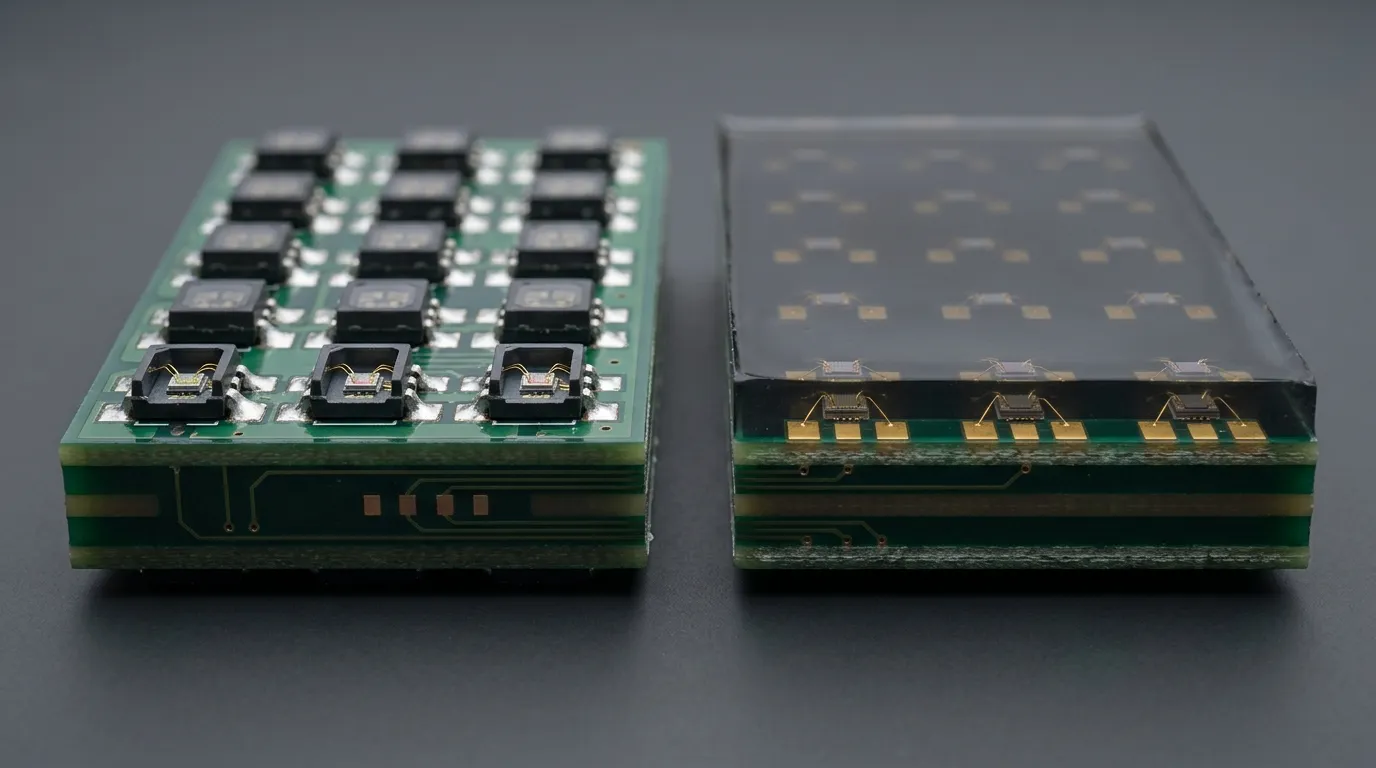
COB stands for Chip-on-Board. In an LED display, the LED chips are mounted directly onto the printed circuit board and covered by an integrated protective layer, instead of each chip being individually packaged and soldered onto the board as it is in a Surface-Mount Device (SMD) display.
That difference in construction is the source of every advantage on this page. According to ViewSonic's 2024 technology library, direct mounting allows higher chip density and a flatter front surface than individually packaged LEDs, and LEDMAN's 2026 engineering guide notes that the same direct chip-to-board contact removes the separate package from the thermal path.
[DIAGRAM: cross-section of a COB module beside an SMD module, labelling the LED chip, printed circuit board, integrated protective layer, and the exposed packaged chip in the SMD example.]
COB is now a product category in its own right, and the COB LED display family covers a range of indoor fine-pitch configurations.
The advantages of COB LED displays
Four advantages follow from that construction, and each one comes with a condition.
Finer pixel pitch and clearer close viewing
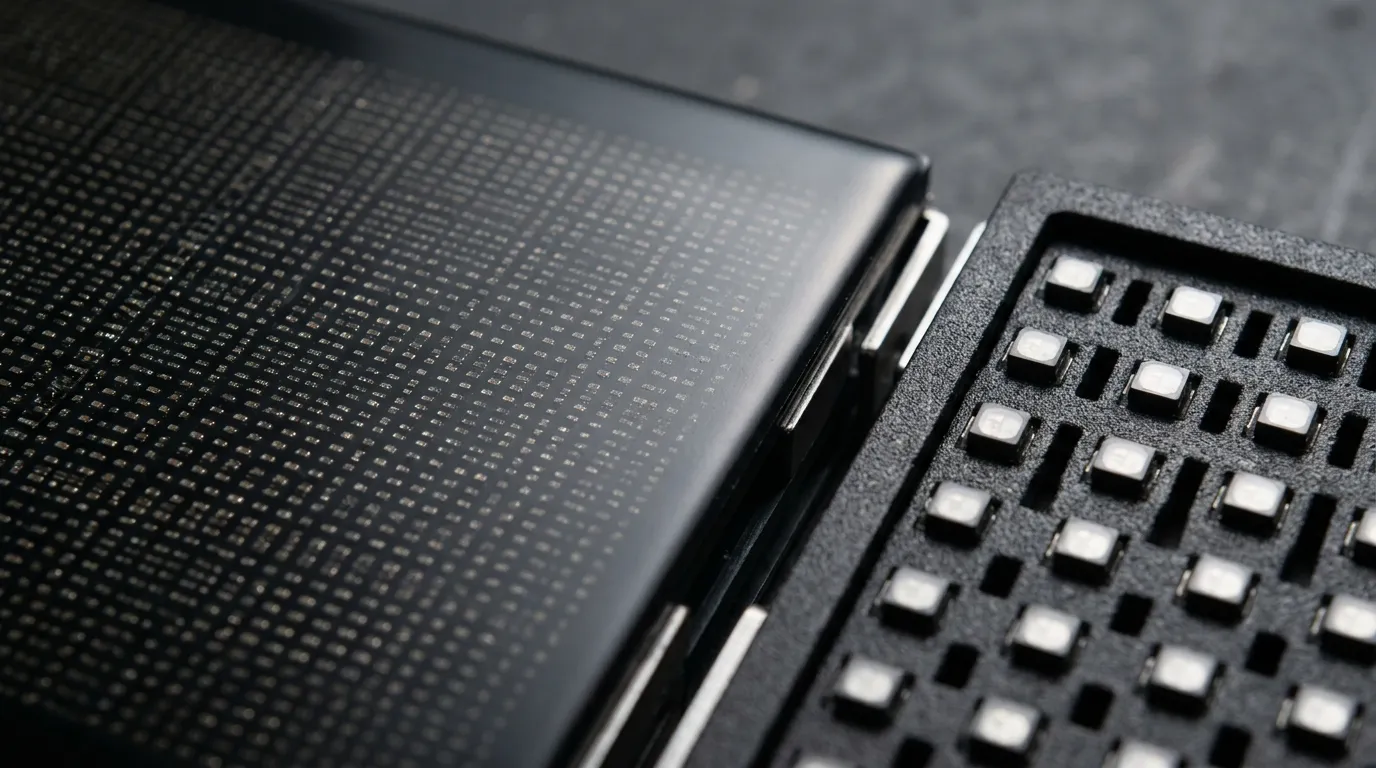
COB construction suits very small pixel pitches, and a tighter pixel pitch puts more pixels into the same screen area, so image detail holds up when viewers stand close.
According to ViewSonic's 2024 technology library, a tighter pixel pitch corresponds to higher pixel density and resolution, and the benefit is most visible at close viewing. MIC Display lists its MC-COB indoor series at P0.78, P0.93, P1.25, P1.56 and P1.875 on the fine pitch cob led display product page; those are the specifications of that specific series, not a pitch range that applies to COB displays generally.
Choose the pitch from your actual closest viewing distance rather than from the smallest number available, and use a led pixel pitch guide to work that distance back to a pitch before comparing products.
[PHOTO: close-up of a COB module surface with an overlaid pitch scale comparing P1.25 and P2.5 at the same viewing distance.]
A sealed, protected front surface
Because the LED chips sit under an integrated layer rather than being individually exposed, a COB display's front surface is smoother and better shielded from contact, dust and moisture than a standard packaged-LED face.
ViewSonic's 2024 comparison describes the resin-protected surface as contributing to dust and moisture resistance and reports an IP54 rating for COB in that comparison. Treat that figure as the rating given in one source and confirm the stated ingress rating of the model you are considering.
This is also where a common over-reading happens. A sealed surface is a design characteristic, not a rating: it does not by itself mean the display is waterproof, suitable for outdoor use, or tested for impact resistance.
Stronger contrast and a cleaner black surface
A darker, more uniform integrated surface can support a better black level than an exposed packaged-LED face, which is where COB's contrast reputation comes from.
MIC Display's MC-COB indoor series product page lists a 15,000:1 contrast ratio and 600 nits of brightness for that series. Those figures belong to that listing, and contrast is a whole-display result rather than a property of the COB package alone — the surrounding structure, the mask and the room's ambient light all affect what a viewer sees. Compare contrast and brightness at the ambient light level the screen will actually face, not in a dim demonstration room.
Better heat handling by design
With the LED chip attached directly to the board, heat leaves the chip through a shorter path than in a conventional packaged structure, which is why COB is often described as easier to cool.
LEDMAN's 2026 engineering guide states that direct chip-to-PCB contact creates a shorter thermal path than conventional packaged LED structures. That source does not establish a universal temperature, power or lifespan result, so ask the supplier for the thermal or aging data behind the model you are quoting.
Where COB LED displays fit best
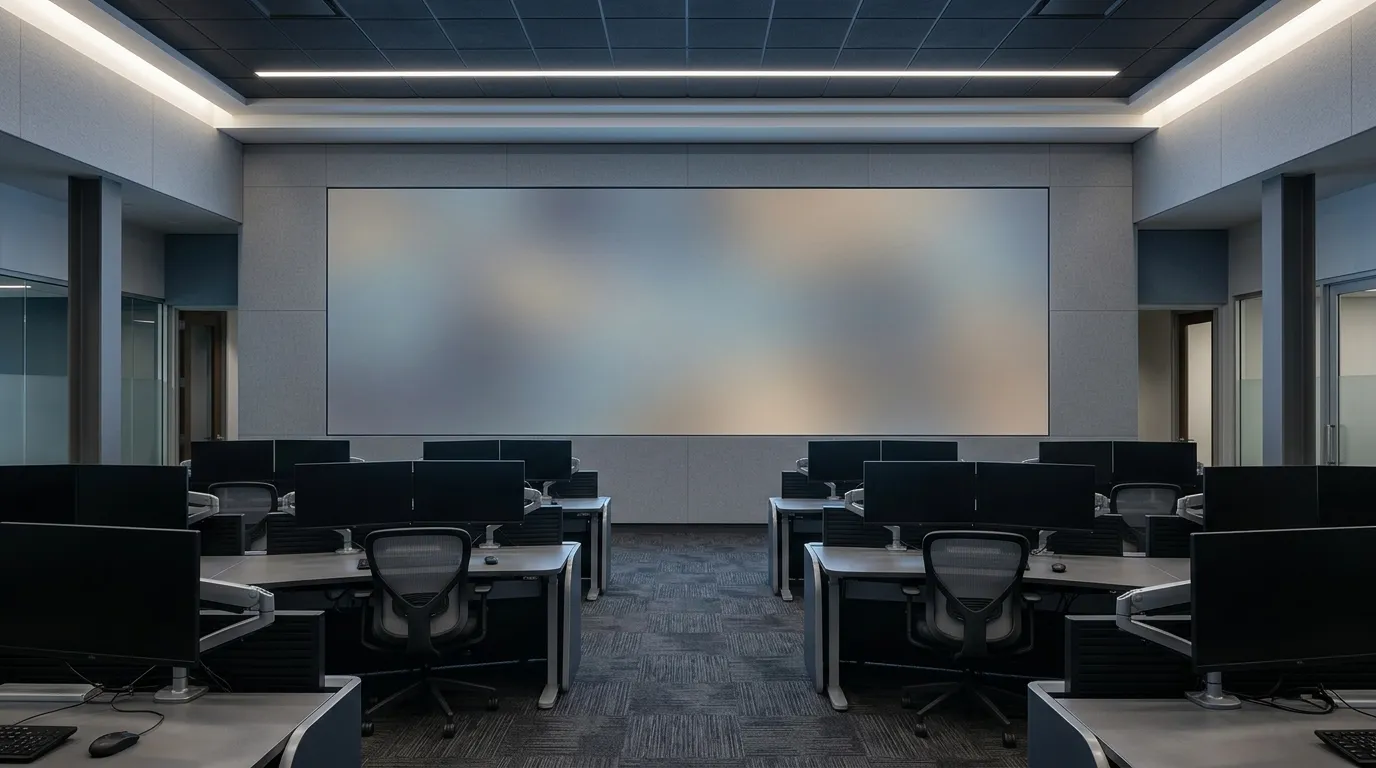
COB LED displays make most sense where viewers stand close and the screen face is exposed.
Fine-pitch indoor video walls in control rooms, command centres, meeting rooms, studios and premium retail are the natural fit, because both conditions apply at once: the viewing distance justifies a small pitch, and the installation environment justifies a protected surface.
The advantage weakens as viewing distance grows. On a large outdoor advertising face seen from across a street, the finer pitch COB supports is largely wasted. For indoor rooms generally, indoor led display options cover the wider range of sizes, while control-room and monitoring work sits closer to a data visualization brief, where pitch and viewing distance are set by the operator positions.
COB vs SMD: the practical differences
Neither technology wins outright. COB offers a protected, fine-pitch-friendly surface and a shorter thermal path; SMD generally keeps upfront cost lower and individual components more accessible to service.
| Factor | SMD | COB | What to verify |
|---|---|---|---|
| Chip mounting | Individually packaged chips soldered to the board (ViewSonic) | Chips mounted directly on the board under an integrated layer (ViewSonic) | The construction described in the datasheet |
| Pixel pitch and close viewing | Tighter pitches become harder to achieve | Suited to very small pitches, with higher pixel density at close range (ViewSonic) | Your actual closest viewing distance |
| Front surface | Individually exposed chips | Integrated, smoother protective surface (ViewSonic) | The model's stated ingress rating |
| Heat path | A separate package sits in the path | Shorter path from chip to board (LEDMAN) | Manufacturer's thermal or aging data |
| Repair approach | Individual components generally more accessible | More specialised module-level repair (LEDMAN) | A written module-swap procedure |
| Upfront cost | Generally lower | Higher initial investment reported (LEDMAN; Toosen) | A like-for-like quote at the same pitch |
The last column is the point of the table: every advantage above is a reason to ask a question, not a reason to stop asking.
The trade-offs you should plan for
Two trade-offs are reported consistently, and both belong in the budget conversation rather than the technical one.
LEDMAN's 2026 engineering guide lists higher initial cost and more specialised module-level repair as COB limitations, and Toosen's 2026 advantages-and-disadvantages article describes a high initial investment as a COB drawback. The higher upfront figure buys the surface protection and pitch capability described above; the service model has to be planned rather than assumed.
Work through these four points before signing:
- Ask how a failed module is replaced, and whether the swap happens at module level or chip level.
- Confirm that spare modules for the quoted model will be available for the life of the installation.
- Check what the warranty covers — the surface, the module, the power supply and the control system may not be treated the same way.
- Establish whether service is on-site or return-to-factory, and who pays for shipping in each case.
MIC Display has designed, produced and sold LED displays since 2011, exports to more than 100 countries, and supports its displays with a 5–8 year warranty, remote technical support and after-sales service.
What to check before you choose a COB display
Six checks decide whether a COB advantage is real for your project rather than a claim on a page.
- Stated pixel pitch against your actual closest viewing distance.
- Exactly what the surface protection is, and the model's stated ingress rating.
- Contrast and brightness figures measured at the room's real ambient light level.
- Thermal evidence supplied by the manufacturer, not a general statement about heat.
- Repair path and spare-module availability, following the points under "The trade-offs you should plan for".
- Warranty scope and the after-sales route for your region.
Frequently asked questions
How long do COB LED displays last?
There is no universal lifespan figure for COB LED displays. Rated life depends on the specific LEDs, the drive current and the thermal design of the product, and LEDMAN's 2026 engineering guide does not establish a category-wide number. Ask the supplier for the quoted model's own rated data rather than accepting a general claim.
Is COB only available in fine pixel pitches?
Fine pitch is where COB is most common and where its advantages show, but available pitches vary by product. MIC Display lists its MC-COB indoor series at P0.78, P0.93, P1.25, P1.56 and P1.875, which shows how narrow the spread can be within one series.
Is COB brighter than SMD?
Brightness is not a COB advantage. It comes from the LEDs and the drive design rather than the packaging method, so a COB display is not automatically brighter than an SMD equivalent at the same pitch. Compare brightness figures in nits at your room's ambient light level instead.
If you are specifying a fine-pitch indoor wall, MIC Display's team can review your pitch, closest viewing distance and installation environment — contact us to start that conversation.
Share on Social:


Contact Us
In This Article
Related Posts
LED Window Display- The Complete Guide for Retail, Advertising, and Commercial Spaces
October 26, 2026
Mini LED Display- What It Is, How It Works, and Where It Fits
October 26, 2026
Naked Eye 3D LED Display - How It Works, Key Specs, Cost and How to Plan One (2026 Guide)
October 16, 2026
Transparent LED Displays for Storefronts
October 14, 2026


