




Where to Buy Fine-Pitch COB LED Screens?
By miashuvo2077
Sep 16, 2026Related Posts
LED Window Display- The Complete Guide for Retail, Advertising, and Commercial Spaces
October 26, 2026
Mini LED Display- What It Is, How It Works, and Where It Fits
October 26, 2026

Naked Eye 3D LED Display - How It Works, Key Specs, Cost and How to Plan One (2026 Guide)
October 16, 2026
Transparent LED Displays for Storefronts
October 14, 2026
Buying fine-pitch COB LED screens means choosing between LED display manufacturers, manufacturers that build COB modules with an established module partner, and AV distributors or integrators. Before ordering, verify the supplier's real COB capability: available pitch range, flip-chip construction where claimed, sample or demonstration access, calibration evidence, and warranty scope.
- Fine-pitch COB screens reach buyers through three routes — manufacturer-direct, a manufacturer working with a COB module partner, or a reseller or integrator — and each route leaves different duties with the buyer.
- Published COB pitch options on retrieved supplier pages run from roughly P0.62 to P1.875, and every figure is supplier-stated, so confirm it for your project.
- "COB" on a product page does not confirm flip-chip construction; ask for written confirmation from the module data sheet or a sample.
- Warranty terms differ between suppliers: MIC Display's displays carry a 5–8 year warranty, while Canbest's page states five years.
- The details supplier pages rarely spell out — sample access, calibration documentation and spare-module supply — are the ones that decide whether two quotes are comparable.
Where Can You Buy Fine-Pitch COB LED Screens?
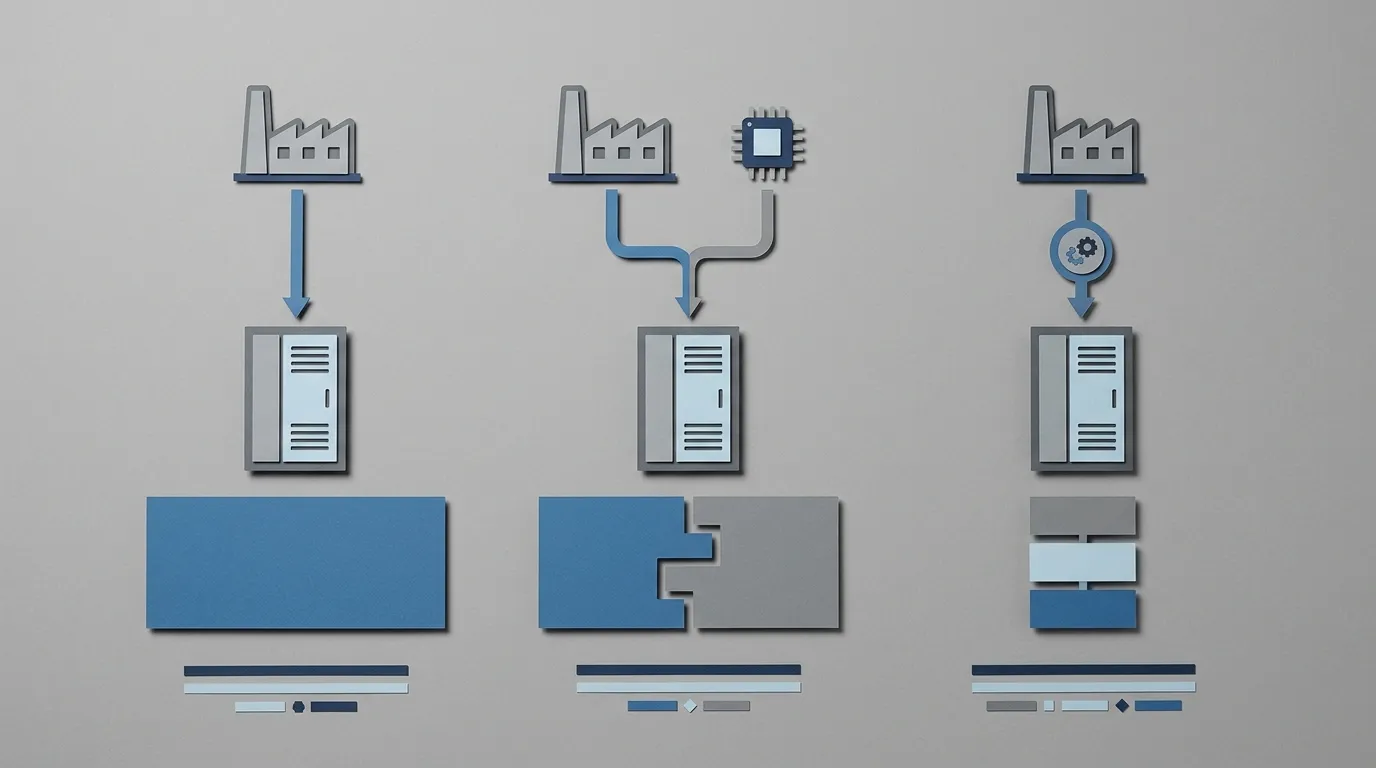
Fine-pitch COB LED screens are bought directly from LED display manufacturers, from manufacturers that assemble cabinets around COB modules from an established module partner, or through AV distributors and integrators. The route you choose decides who owns the module supply chain, the calibration and the after-sales response.
A fine-pitch COB LED screen is an LED display whose red, green and blue LED chips are mounted directly onto the printed circuit board and covered by a protective layer, rather than being packaged into separate surface-mount devices first. That construction is why the buying conversation centres on the module and who controls it.
Manufacturer-direct supply is the most common route in the results for this question. MIC Display's homepage describes the company as a Shenzhen-based LED display manufacturer offering OEM/ODM manufacturing, engineering support and COB display solutions, and its fine pitch cob led display page is an example of a factory selling a COB product line rather than reselling another brand. Canbest's page states one-stop supply from design through installation, which shows that manufacturer-direct supply can extend beyond the cabinet to the installed system. Ecommerce is also present: LEDLightsWorld's collection page lists small-pitch products with displayed prices, but such listings are time-sensitive and do not by themselves confirm that a given product is COB.
| Route | What the supplier typically provides | What the buyer must still verify | Suited to |
|---|---|---|---|
| LED display manufacturer (direct) | Cabinets, modules, control system, configuration to the installation environment | Whether the COB modules are produced in-house or sourced, calibration evidence, warranty scope | Projects where one party should own module supply, calibration and after-sales |
| Manufacturer working with an established COB module partner | COB modules from a partner, assembled and configured into cabinets | Which party is accountable for module quality, spare-module availability, documentation | Buyers who accept a partner-based supply chain but want a single contract |
| Distributor, AV integrator or ecommerce seller | Finished screens, sometimes installation and local service | Original manufacturer identity, exact pitch and cabinet, whether the listing is genuinely COB | Smaller orders where local service or fast procurement matters more than factory contact |
[DIAGRAM: Three-route sourcing diagram showing manufacturer-direct, manufacturer with COB module partner, and reseller or integrator, with the buyer's responsibility labelled under each route.]
How to Verify Whether a Supplier Actually Makes COB Modules
Ask every supplier to state in writing what it manufactures, assembles, calibrates and tests itself, and which components come from a COB module partner. The answer does not prove quality on its own, but it shows who is accountable when a module fails after installation.
The distinction matters because a cabinet assembled around purchased modules can still perform well — the risk is unclear responsibility. As a decision rule, treat any supplier that answers "we make everything" without documentation as unverified, and ask instead for a named contact who owns COB module quality, a module data sheet for the pitch you are buying, and the spare-part path for that exact module.
MIC Display's published pages describe the company as an LED display manufacturer offering OEM/ODM manufacturing and a COB product range; they do not state that MIC Display produces COB modules in-house, so confirm module production directly for your project rather than assuming it. The same discipline applies to every supplier on your shortlist. A broader vendor-evaluation process is set out in this how to choose an led display manufacturer a buyers checklist, which is worth completing before you compare prices.
What to Check Before You Buy a Fine-Pitch COB Screen
Pitch Range and What It Means for Your Project
Published COB options across retrieved supplier pages run from about P0.62 to P1.875, so match the pitch to your viewing distance and content instead of choosing the smallest number available. MIC Display's cob led display page lists P0.78, P0.93, P1.25, P1.56 and P1.875, with module sizes of 150 × 168.75 mm or 300 × 168.75 mm.
MIC Display's COB page also groups P0.78–P1.25 separately from P1.56–P1.875 and gives different stated applications for the two groups, which reflects the usual trade-off: finer pitch suits closer viewing and smaller rooms, while a coarser pitch inside the fine-pitch band costs less per square metre for longer viewing distances. The table below records what each source publishes; it is a specification reference, not a ranking.
| Source page | Stated pitch options | Stated module or cabinet detail |
|---|---|---|
| MIC Display COB page | P0.78, P0.93, P1.25, P1.56, P1.875 | Module 150 × 168.75 mm or 300 × 168.75 mm; 600 nits; 15,000:1 contrast |
| MileStrong SCOB product page | 0.625–1.56 mm | Module 150 × 168.75 mm |
| Chipshow C-Max product page | P1.25, P1.53, P1.86 | Cabinet 640 × 480 × 70 mm; 300–600 cd/m² |
| PTCLed COB PLUS page | P0.93, P1.25 | 600–800 nits; IP54 |
| DOIT VISION COB Pro page | P0.62–P1.875 | Flip-chip COB with surface coating film |
If you need the method behind the choice rather than the catalogue range, work through the led pixel pitch guide with your closest intended viewing distance and typical content before you request quotes.
Flip-Chip COB and Construction Claims
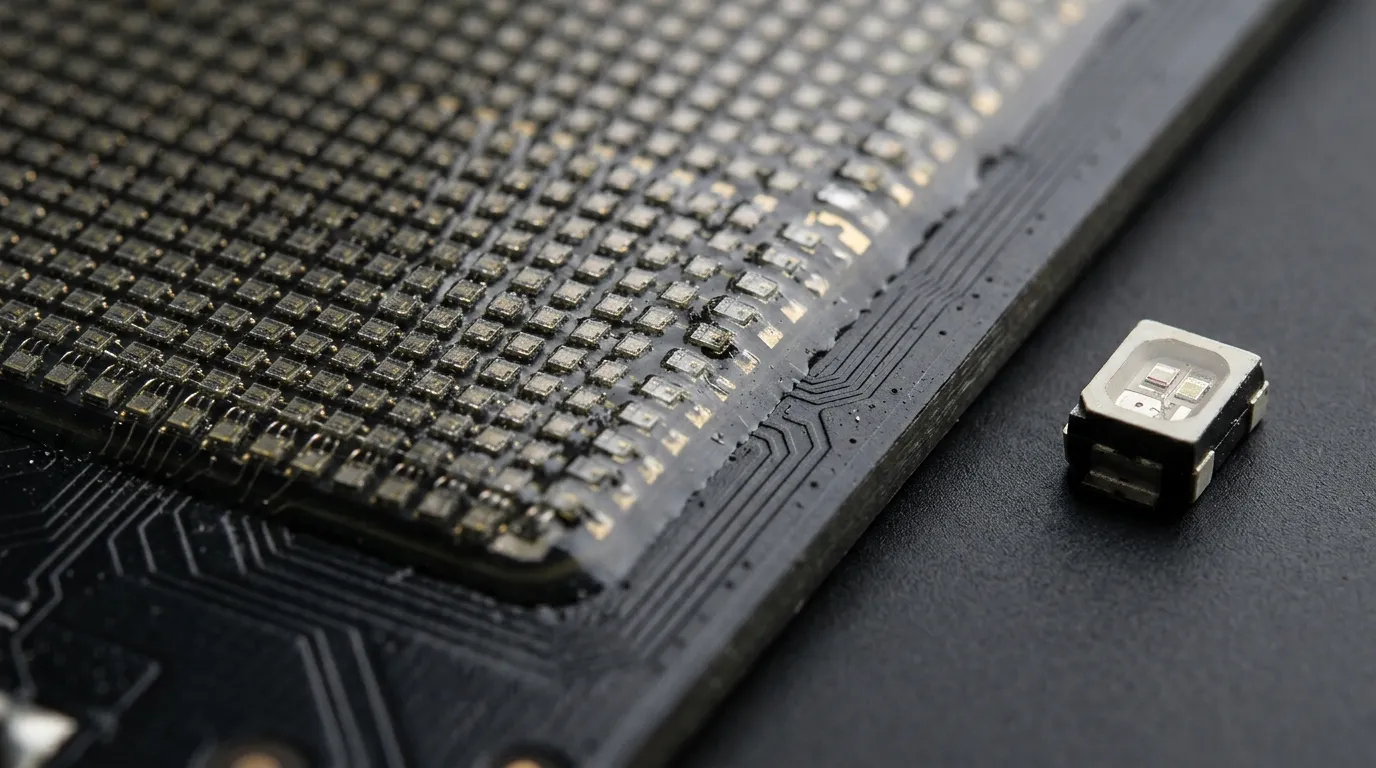
Flip-chip COB is a specific module construction in which the LED chips are mounted face-down, and it should be confirmed in writing on the data sheet for the pitch you are buying, or against a physical sample — the term "COB" alone does not establish it.
DOIT VISION's product page describes its COB Pro as using flip-chip COB with a surface coating film and lists a P0.62–P1.875 range, which is a supplier-stated claim about that company's product. If a supplier advertises flip-chip without naming the module or providing a data sheet, treat it as unconfirmed and ask which module the cabinet will ship with.
[PHOTO: Labelled macro close-up of a COB module surface beside an SMD module so buyers can see the difference in chip packaging.]
Samples, Demonstrations and Factory Visits
Ask for a working sample, a live demonstration or a factory visit before ordering, because colour uniformity, seam visibility and surface quality are judged on the product rather than on a specification sheet. Retrieved supplier pages carry inquiry calls to action but do not promise sample access, so agree it in writing as part of the quotation stage.
If a sample or visit is not possible, request photographs or video of the exact pitch and cabinet you are buying, plus recent project references for the same module. Accepting a demonstration of a different pitch than the one you ordered is a common mistake, because uniformity and seam behaviour change with pitch.
Calibration Evidence
Request calibration documentation for the modules or cabinets you will receive, and ask who performs the calibration, with what equipment, and what happens if modules drift after installation. Calibration affects how uniform the wall looks in low-brightness content, which is exactly where control-room and meeting-room viewers notice problems.
UHLED's buying guide, posted on 4 June 2026, lists calibration alongside pixel pitch, refresh rate, grayscale, brightness, cabinet design, manufacturer capability, warranty and spare-parts availability as criteria buyers should evaluate together rather than one at a time.
Warranty, Technical Support and Spare Parts
Compare warranty scope rather than duration alone: what is covered, who pays return freight, the stated response route and language, and how quickly a spare module in your exact pitch reaches you. MIC Display's displays carry a 5–8 year warranty with remote technical support and after-sales service.
Published warranty figures vary between suppliers, which is why scope matters. Canbest's page states a five-year warranty with one-stop service, and that is that company's own published claim rather than a market norm. Read the terms you are actually offered through the warranty information before you sign, and confirm that spares for your specific module are still available at the end of the warranty period.
What Project Details Should You Send for a Comparable Quote?
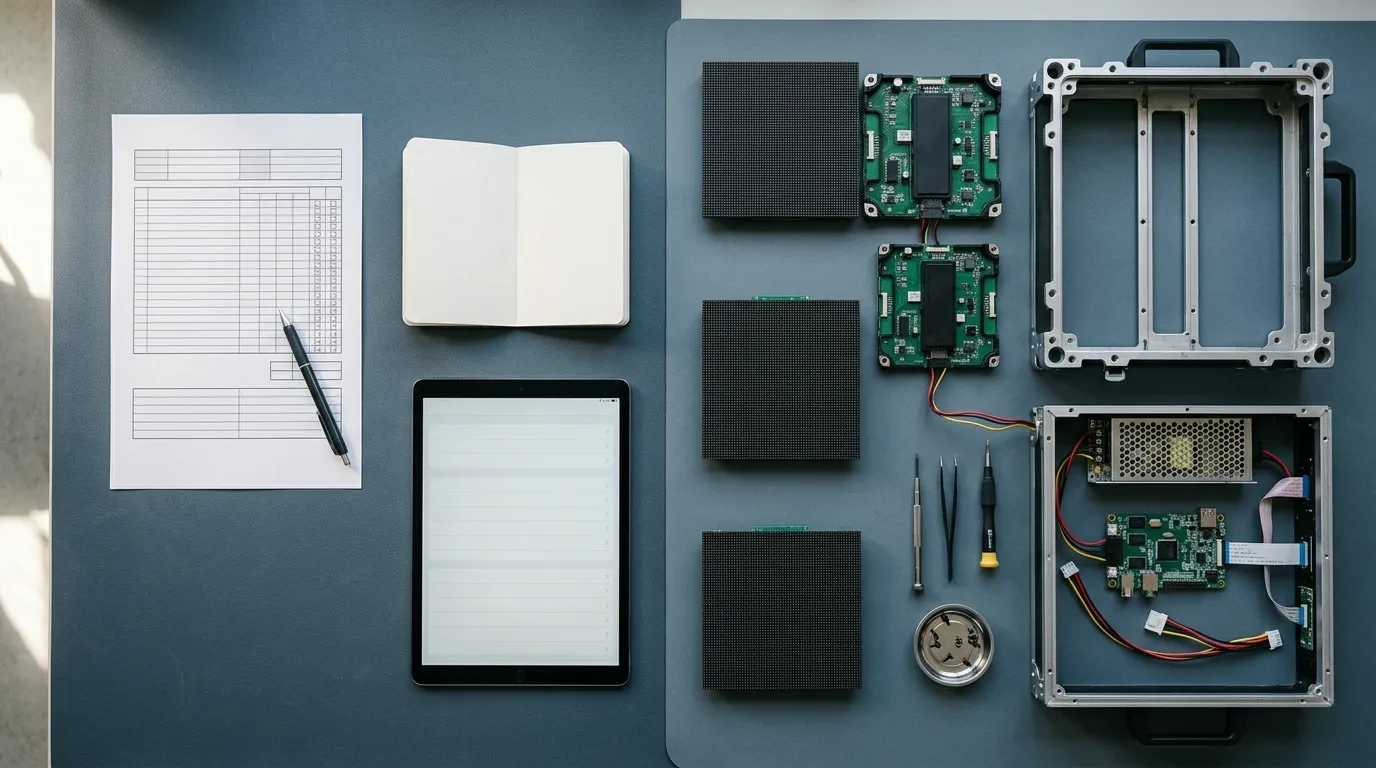
Send screen width and height, target pitch, viewing distance, installation environment, mounting and service access, content type, control-system requirements and delivery location. Without these, suppliers price different scopes and the quotes cannot be compared.
- Screen dimensions and orientation, including whether the wall is a fixed rectangle or a shaped structure.
- Target pixel pitch and the closest intended viewing distance.
- Indoor environment, ambient light level and mounting surface — wall, floor or ceiling-hung.
- Front or rear service access and the depth available behind the screen.
- Content type, refresh needs and any control-system requirement.
- Delivery country, who installs, and the support language required.
[PHOTO: One-page RFQ worksheet template covering dimensions, pitch, viewing distance, environment, service access, content and delivery.]
How to Compare Offers Beyond Headline Price
Normalise every quote to the same scope, then compare what sits inside it — modules, control system, calibration, spare parts, warranty and support. A headline price decides nothing when one quote includes installation and calibration and another does not.
UHLED's 2026 buying guide recommends evaluating pitch, refresh rate, grayscale, calibration, brightness, cabinet design, manufacturer capability, warranty and spare-parts availability as a group, which is a workable basis for turning quotes into comparable documents.
- Rewrite each quote into identical line items using your RFQ list.
- Mark anything missing, including spares, calibration report, freight and installation.
- Flag claims that arrived without documentation, such as flip-chip construction, IP rating or warranty scope.
- Re-engage each supplier on the gaps, and compare the corrected versions before deciding.
If you are ready to scope a fine-pitch COB project, send MIC Display your screen size, target pitch, installation environment and delivery country through contact us and it will confirm which COB configurations it can supply for that project.
Frequently Asked Questions
Who makes fine-pitch COB LED screens?
LED display manufacturers sell them, either producing COB modules themselves or assembling cabinets around modules from an established COB module partner; AV distributors and integrators also resell them. The retrieved supplier pages do not independently verify which vendors produce modules in-house, so ask each supplier for a written supply-chain statement before you shortlist.
How much do fine-pitch COB LED screens cost?
No comparable market price for fine-pitch COB appears in the retrieved sources, and cost depends on pitch, screen area, cabinet design, control system, calibration, warranty and freight. Rather than quote a figure, send identical project details to each supplier and compare the resulting scopes line by line, because a low headline number often omits spares, calibration or installation.
What is the typical pixel pitch for fine-pitch COB?
Retrieved supplier pages list COB options from about P0.62 to P1.875, with MIC Display's COB page naming P0.78, P0.93, P1.25, P1.56 and P1.875. Treat fine pitch as a viewing-distance decision, and confirm the pitch against your closest intended viewer and content type rather than picking the smallest available number.
Share on Social:


Contact Us
In This Article
Related Posts
LED Window Display- The Complete Guide for Retail, Advertising, and Commercial Spaces
October 26, 2026
Mini LED Display- What It Is, How It Works, and Where It Fits
October 26, 2026
Naked Eye 3D LED Display - How It Works, Key Specs, Cost and How to Plan One (2026 Guide)
October 16, 2026
Transparent LED Displays for Storefronts
October 14, 2026


