




Is an LED Video Wall Better Than an LCD Video Wall?
By miashuvo2077
Oct 07, 2026Related Posts
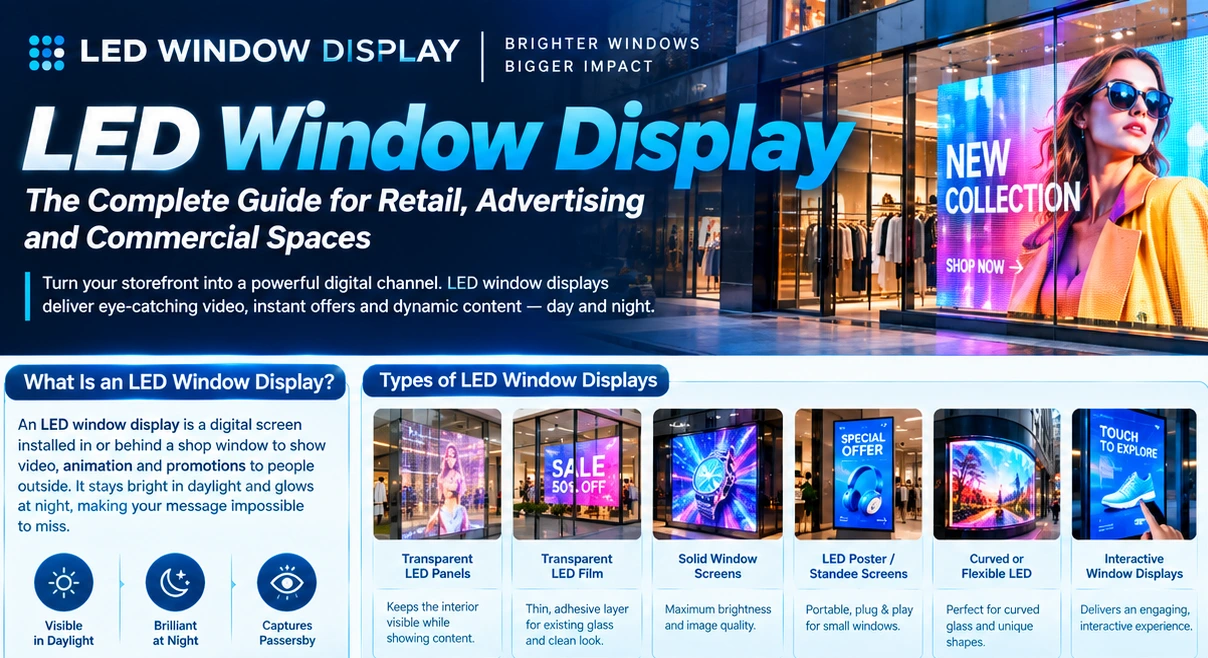
LED Window Display- The Complete Guide for Retail, Advertising, and Commercial Spaces
October 26, 2026
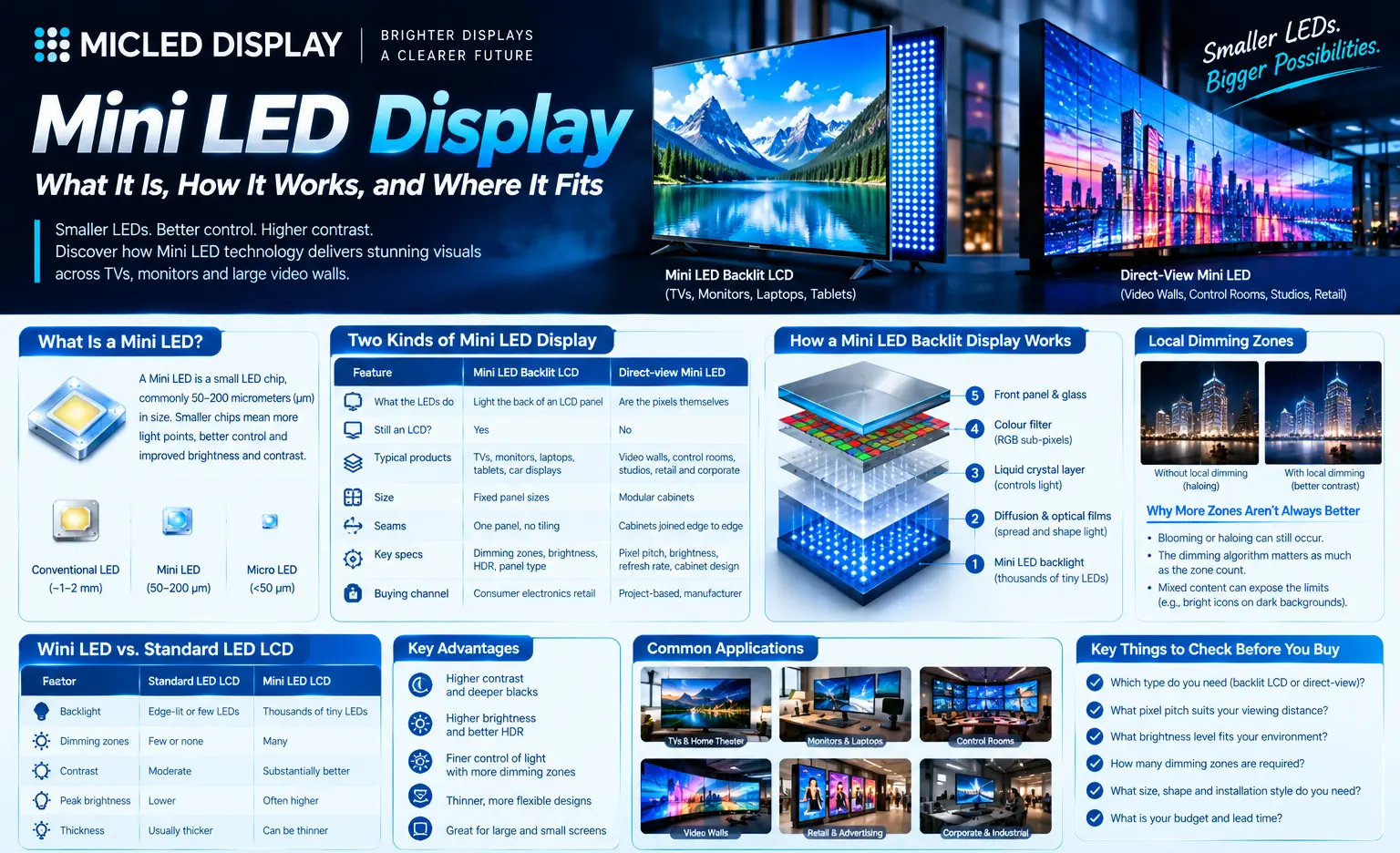
Mini LED Display- What It Is, How It Works, and Where It Fits
October 26, 2026
Naked Eye 3D LED Display - How It Works, Key Specs, Cost and How to Plan One (2026 Guide)
October 16, 2026
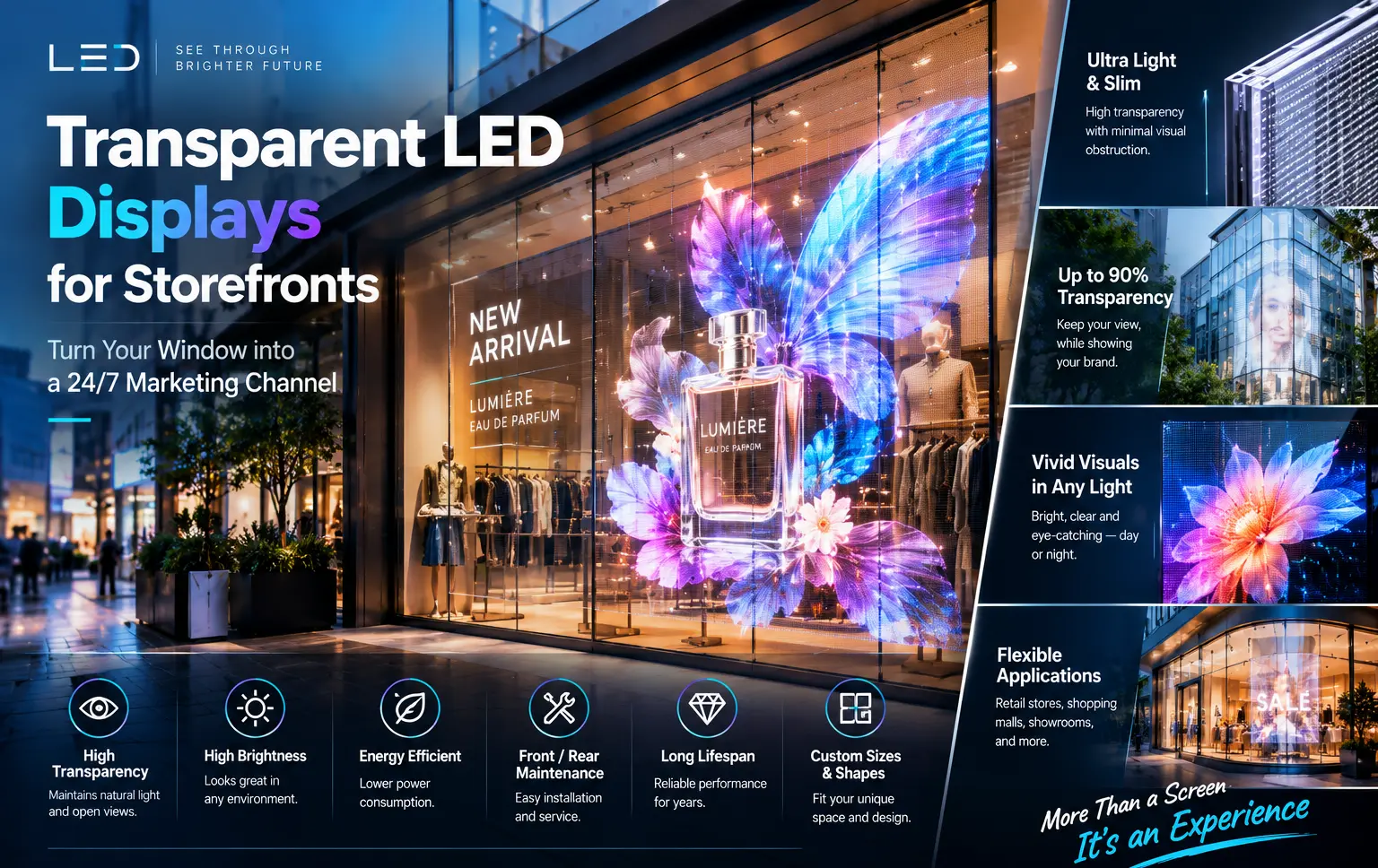
Transparent LED Displays for Storefronts
October 14, 2026
Is an LED video wall better than an LCD video wall? For seamless, large or bright video walls, LED is usually the better choice, because direct-view LED tiles form one continuous image with no panel bezels. LCD can cost less for small walls viewed up close, where its fine pixel detail is an advantage. The right pick depends on size, viewing distance, ambient light and budget.
LED vs LCD Video Walls: The Short Answer
An LED video wall is usually the better choice when the wall must be seamless, very large or very bright. An LCD video wall remains a sensible option when the wall is small, viewers stand close, and entry budget is the deciding constraint. Neither technology wins on every project.
The deciding factors are few. According to ViewSonic Library, direct-view LED uses LEDs as the display pixels and needs no LCD backlighting, while an LCD video wall is assembled from multiple LCD screens. Christie states that LCD panel bezels can be under 1 mm, and that the gaps may be negligible for large walls viewed from 3 m (10 ft) or more — so the seam question depends as much on viewing distance as on the technology itself.
| Decision factor | Direct-view LED video wall | LCD video wall | What usually decides it |
|---|---|---|---|
| Seams inside the picture | No panel bezels within the image | Joins between panels; Christie states bezels can be under 1 mm | Viewing distance from the wall |
| Brightness and ambient light | Suited to bright or daylight-facing locations | Generally specified for controlled indoor light | Light levels measured at the wall |
| Close-range detail | Determined by pixel pitch | Panel-level detail suits close viewing | Nearest viewer's distance |
| Size and shape | Built from tiles, so scale and shape are configurable | Set by the panel grid | Wall opening and mounting |
| Initial cost | Higher entry cost — LamasaTech's 2026 estimates list LED at £40,000–£150,000+ | Lower entry cost — LamasaTech's 2026 estimates list LCD at £5,000–£40,000 | Budget basis |
| Maintenance | Serviced at tile or module level | Serviced at panel level | Service access design |
| Rated life | Constant Technologies reports 80,000–100,000 hours for some LED panels | Verify with the supplier | Operating hours and conditions |
| Typical fit | Large, seamless, bright or outdoor walls | Small walls viewed up close in controlled light | The combination of the factors above |
What Is the Difference Between a Direct-View LED Wall and an LCD Video Wall?
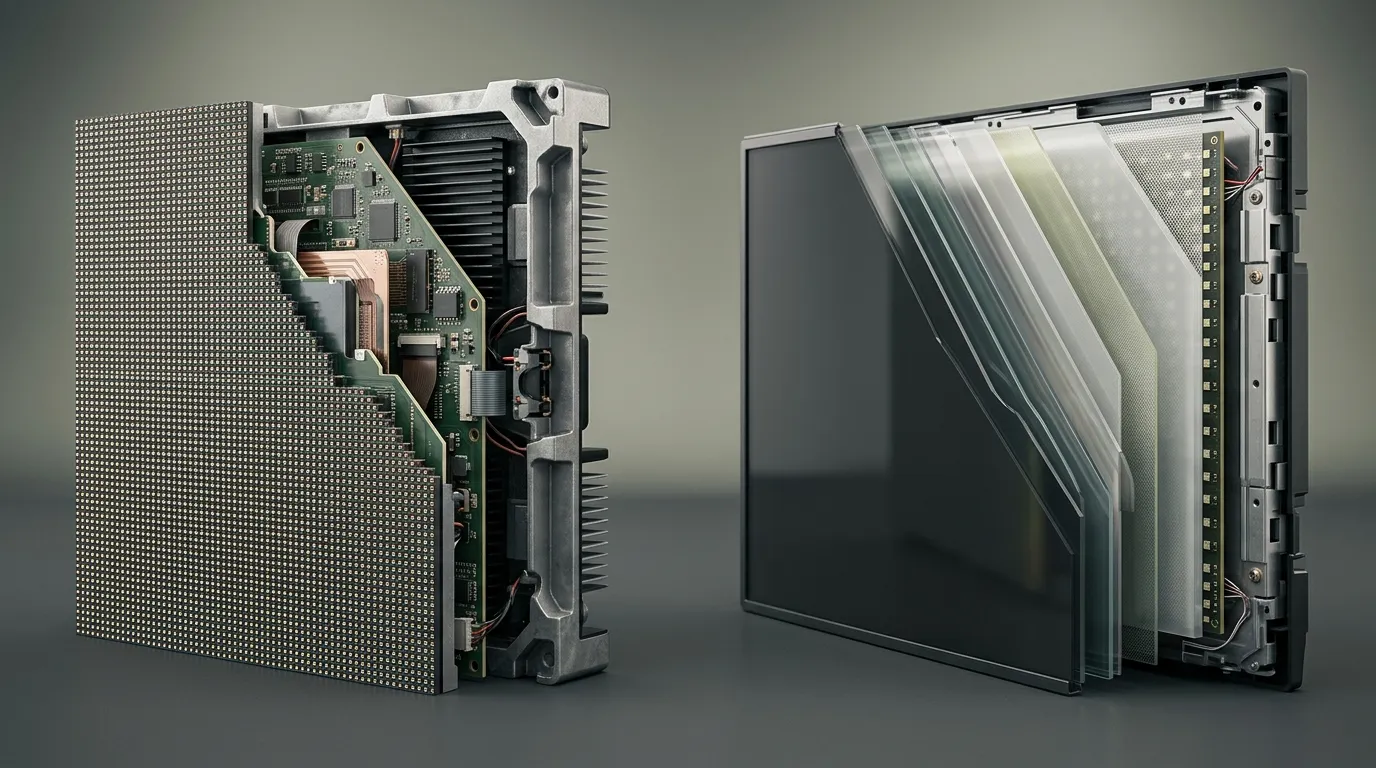
A direct-view LED video wall is a display in which light-emitting diodes (LEDs) form the picture, with each diode acting as an image pixel. An LCD video wall is a grid of separate liquid crystal display (LCD) panels mounted side by side to build one larger image.
The distinction that causes the most confusion is backlighting. Many LCD panels use LEDs as a light source behind the liquid crystal layer, but that does not make them direct-view LED displays. According to ViewSonic Library, direct-view LED uses LEDs as the display pixels and needs no LCD backlighting, and an LCD video wall is built from multiple LCD screens. A simple test: if light passes through a liquid-crystal layer to form the picture, treat the product as an LCD wall regardless of what kind of backlight it uses.
[DIAGRAM: a direct-view LED tile beside an LCD panel, labelling LED pixels, liquid-crystal layer, backlight, bezel and pixel pitch]
Seams and Bezels: Which Video Wall Looks Uninterrupted?
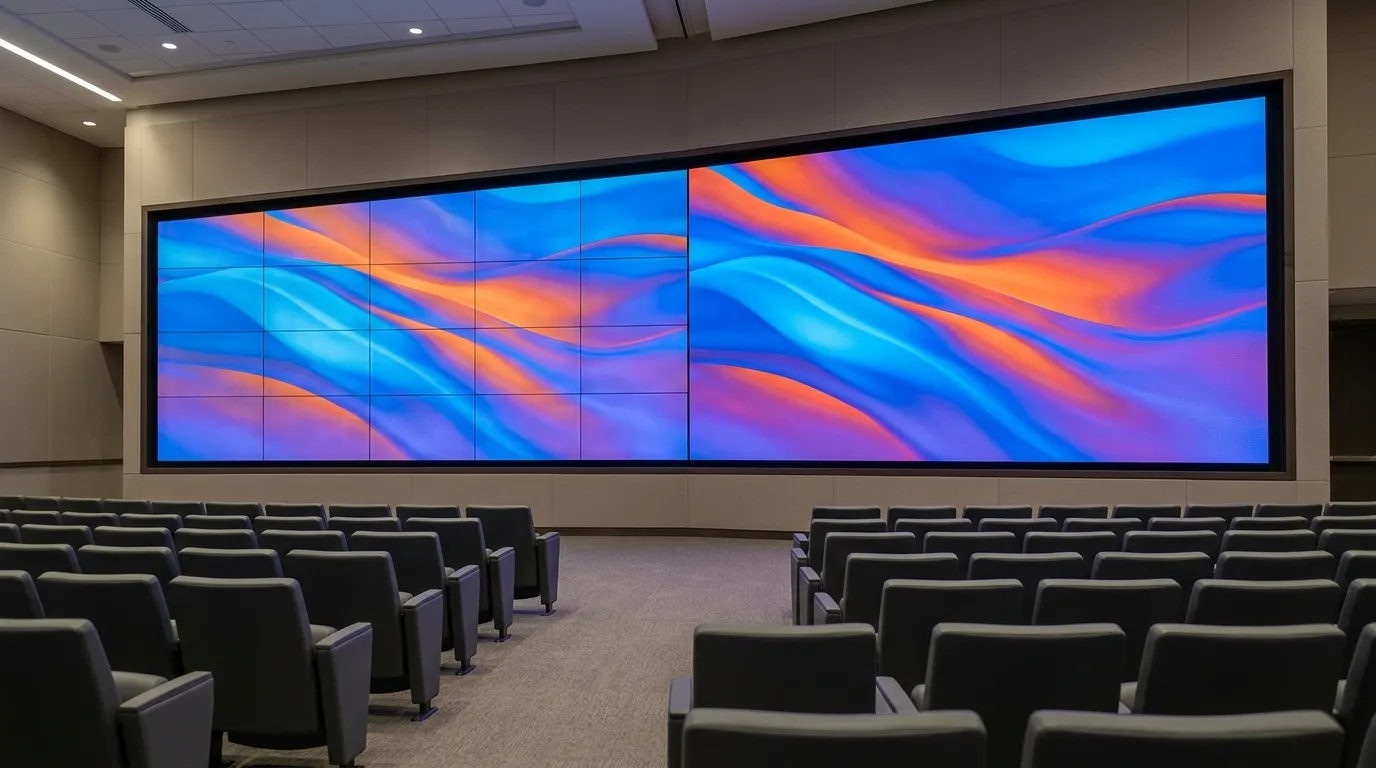
Direct-view LED produces an image with no bezels inside the picture, so the wall stays visually continuous however many tiles it is built from. An LCD video wall always has joins between panels, and their visual impact depends on bezel width and how far away the audience sits.
Christie states that LCD panels can minimize transitions with bezels under 1 mm and that gaps may be negligible for large walls viewed from 3 m (10 ft) or more — a viewing-distance condition, not a universal rule. Christie also describes a high-end all-in-one LED display as 25–35 mm thick with a 5 mm frameless edge; that is one product example from that source, not a general LED specification, so check the actual product's dimensions rather than assuming them.
The viewing-distance rule itself is set out in the next section.
Viewing Distance, Pixel Pitch and Image Detail: Where LCD Can Still Win
LCD video walls are often chosen for smaller installations viewed at close range, where the panel itself supplies the fine detail. Large LED walls instead need a pixel pitch matched to both the nearest and the furthest viewer.
Pixel pitch is the distance between the centres of two adjacent pixels, normally given in millimetres; a smaller number means more pixels packed into the same area. Christie gives a viewing-distance rule of pixel pitch in millimetres multiplied by 8, illustrated with 1.25 mm pitch at 10 ft. Treat that as Christie's rule of thumb rather than an industry standard, and check it against the content that will actually be shown.
MIC Display's range covers small-pitch P0.9375–P1.86, indoor P2–P10 and outdoor P2.5–P10 displays, and its design team customizes screen structure, size and configuration to each project's installation environment. MIC Display also designs and produces fine-pitch COB displays as one option in the fine-pitch part of the market.
Before requesting a quotation, confirm three things: the closest viewer's distance, the furthest viewer's distance, and the smallest detail the content must show. The wider background on pitch selection sits in the LED pixel pitch guide, and fine pitch COB LED display is the related construction to review where closer viewing is required.
Brightness and Ambient Light: Where LED Pulls Ahead
LED video walls are normally the choice where ambient light is high or the wall faces daylight. LCD video walls are generally specified for controlled indoor light, where the image holds up without competing with the room.
Christie suggests starting with a 700–1,000-nit display and reducing brightness to suit the space, which is that source's recommendation rather than a requirement for every project. Nits measure luminance, and a higher number is not automatically better: an over-bright display in a dim room causes viewer discomfort and wastes power.
A useful decision rule is to compare a display's rated brightness with the light measured at the wall's location, at different times of day, instead of judging it in a showroom. Daylight-facing installations are covered under outdoor LED display, where an indoor-rated product is the wrong starting point.
Cost: Initial Price vs Total Cost of Ownership
LCD video walls usually carry the lower entry price for a small wall, while LED video walls carry a higher entry price that scales with area and pixel pitch. The meaningful comparison is total cost over the life of the installation, not the panel price alone — the framing Christie uses when it sets initial cost against total cost of ownership.
LamasaTech's comparison labels its cost figures as 2026 estimates, listing LCD from £5,000–£40,000 and LED from £40,000–£150,000+. Those are one source's dated figures for the products it compared; they are not market-wide prices, and any project quotation depends on size, pitch, structure and installation.
| Cost factor | What drives it | LED consideration | LCD consideration |
|---|---|---|---|
| Display area and pixel pitch / panel count | Area plus the density or panel count specified | Cost rises with area and finer pitch | Cost rises with panel count and bezel grade |
| Mounting and structure | Wall size, weight and building constraints | Tiles and structure are configured to the wall | Frame and alignment across panels |
| Installation and commissioning | Access, mounting height and working hours | On-site assembly of modules | On-site assembly and alignment of panels |
| Power and cooling | Brightness setting and daily operating hours | Consumption follows the brightness the room needs | Controlled indoor settings reduce the load |
| Spares and service access | Whether access is front or rear | Tile or module replacement | Panel replacement |
| Replacement over time | Rated life and real operating conditions | Affected by drive brightness and heat | Affected by panel service life |
| Whole-life total | All of the factors above, over the planned service period | Compare against LCD on the same basis | Compare against LED on the same basis |
Rated life feeds directly into replacement cost, and it is covered below under lifespan ratings.
Maintenance and Service Access: Modular LED vs Tiled LCD
Both technologies are modular, and both need planned service access, but the unit of replacement differs. An LED video wall is serviced at tile or module level, so a single failed unit can be reached without disturbing the whole picture. An LCD video wall is serviced at panel level, which means the join geometry and mounting frame determine how disruptive a replacement is.
Decision rule: before comparing quotations, confirm whether service access is from the front or the rear, where spare parts will be held, and what the warranty covers. Christie treats complete-solution and service considerations as part of choosing video wall technology rather than as an afterthought.
Lifespan Ratings: What They Do and Don't Tell You
A rated lifespan is an expected degradation point measured under defined test conditions, not a promise about how long a specific wall will look right in a specific room. Constant Technologies reports a lifetime rating of 80,000–100,000 hours for some LED panels in its mission-critical discussion; treat that as a source-reported rating for the panels described in that context.
Compare ratings only between comparable products, then adjust for how many hours a day the wall runs, the room temperature, and the brightness level at which it is driven. Ask any supplier to state the conditions behind a figure in writing, because heat and continuous high-brightness operation shorten practical service intervals.
Which Projects Favor LED, and Which Still Suit LCD?
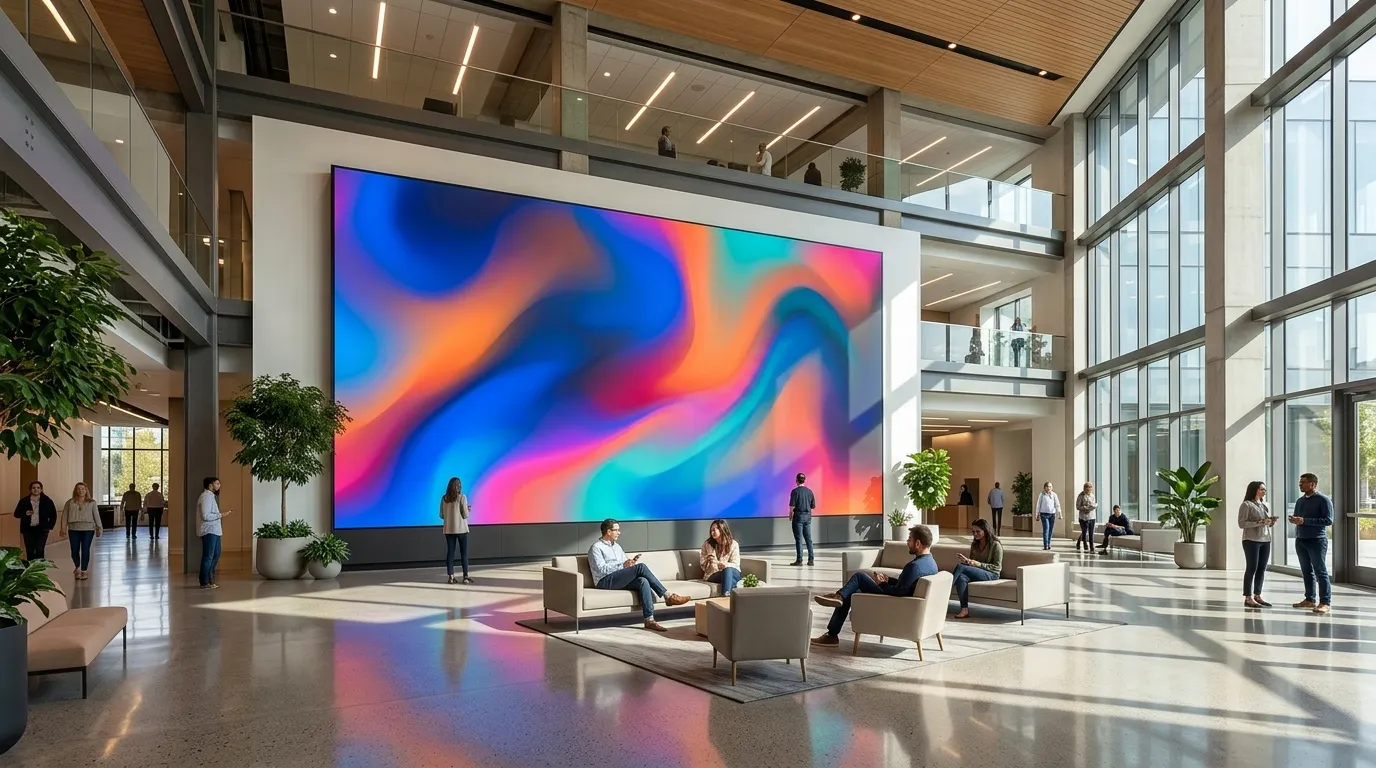
LED suits large, seamless, bright or free-shape walls in commercial, advertising, control-room and stage or event settings. LCD still suits smaller walls viewed up close in controlled indoor light, where the lower entry cost matters most.
Choose LED if:
- the wall is large or may need to be scaled later
- a continuous image with no visible joins is the priority
- light levels are high, change during the day, or the wall faces daylight
- the wall is outdoors, curved or an unusual shape
Consider LCD if:
- the wall is small and viewers stand close
- lighting is controlled and can be managed
- entry budget is the single deciding constraint
MIC Display is an LED display factory in China, established in 2011, that designs, produces and sells indoor, outdoor, rental, fine-pitch COB, transparent, LED floor tile and LED poster displays. Its design team customizes screen structure, size and configuration to each project's installation environment, and it serves commercial, advertising, control room and stage/event projects for integrators, rental and event companies, advertisers and project owners. For indoor projects, indoor LED display covers the product family, and indoor LED video wall shows how a fixed indoor wall is configured.
[DIAGRAM: decision flow — wall size plus nearest viewing distance plus ambient light plus budget basis leading to LED, LCD, or either technology]
Video Wall Selection Checklist: Questions to Answer Before You Request a Quote
Work through these items before comparing quotations, because each one changes the specification a supplier will quote against.
- Measure the wall opening and record the exact viewing distances to the nearest and furthest seats.
- Note light levels at the wall at different times of day, including direct sun or window glare.
- List the content types the wall will show and the smallest text, figure or data label that must stay readable.
- Confirm whether the installation is indoors or outdoors, and whether the wall must be curved, suspended or floor-mounted.
- Set a budget basis that covers the whole installation and its operating life, not only the display panels.
- Confirm service access both before and after installation, and where spare parts will be stored.
- Ask suppliers to quote brightness, pixel pitch and warranty on the same basis so the offers can be compared fairly.
- Require the configuration to be matched to the installation environment in writing.
Are video walls worth the investment?
Whether a video wall is worth the investment depends on how the space uses it and over what period. Compare the total cost — display, structure, installation, power and service — against the alternative for that location. A lower entry price does not automatically mean a lower cost over the life of the installation.
If you are weighing an LED video wall against an LCD video wall for a specific room, send the wall dimensions, viewing distances and light conditions through contact us and MIC Display's team can review how the installation environment affects screen structure, size and configuration. MIC Display's displays carry a 5–8 year warranty, with remote technical support and after-sales service.
Share on Social:


Contact Us
In This Article
Related Posts
LED Window Display- The Complete Guide for Retail, Advertising, and Commercial Spaces
October 26, 2026
Mini LED Display- What It Is, How It Works, and Where It Fits
October 26, 2026
Naked Eye 3D LED Display - How It Works, Key Specs, Cost and How to Plan One (2026 Guide)
October 16, 2026
Transparent LED Displays for Storefronts
October 14, 2026


