




Outdoor LED Billboard Price: Cost Factors and Budgeting
By miashuvo2077
Oct 04, 2026Related Posts
LED Window Display- The Complete Guide for Retail, Advertising, and Commercial Spaces
October 26, 2026
Mini LED Display- What It Is, How It Works, and Where It Fits
October 26, 2026
Naked Eye 3D LED Display - How It Works, Key Specs, Cost and How to Plan One (2026 Guide)
October 16, 2026
Transparent LED Displays for Storefronts
October 14, 2026
An outdoor LED billboard price is not one number. The LED Billboard Cost in any quote depends on what that quote actually covers: screen modules only, an equipment package with cabinets and control, or a full turnkey installation with structure, power, permits and running costs. Published listings range from four-figure module prices to six-figure installed projects because each states a different scope.
Key takeaways
- Scope defines the number: a module-only price and a turnkey installed-project budget for the same screen size are not comparable.
- Screen area and pixel pitch move the display portion of the cost; structure, site work, power and installation sit alongside it in the total.
- Published examples run from module listings to vendor product pages to broad guide ranges, and each is tied to a specific configuration, so treat them as examples rather than benchmarks.
- Recurring costs such as electricity, software and maintenance continue after handover and belong in the budget from day one.
- A quote comparison is only valid when dimensions, pitch, cabinet type, structure, power, installation and warranty are stated on both sides.
What Does an Outdoor LED Billboard Price Include?
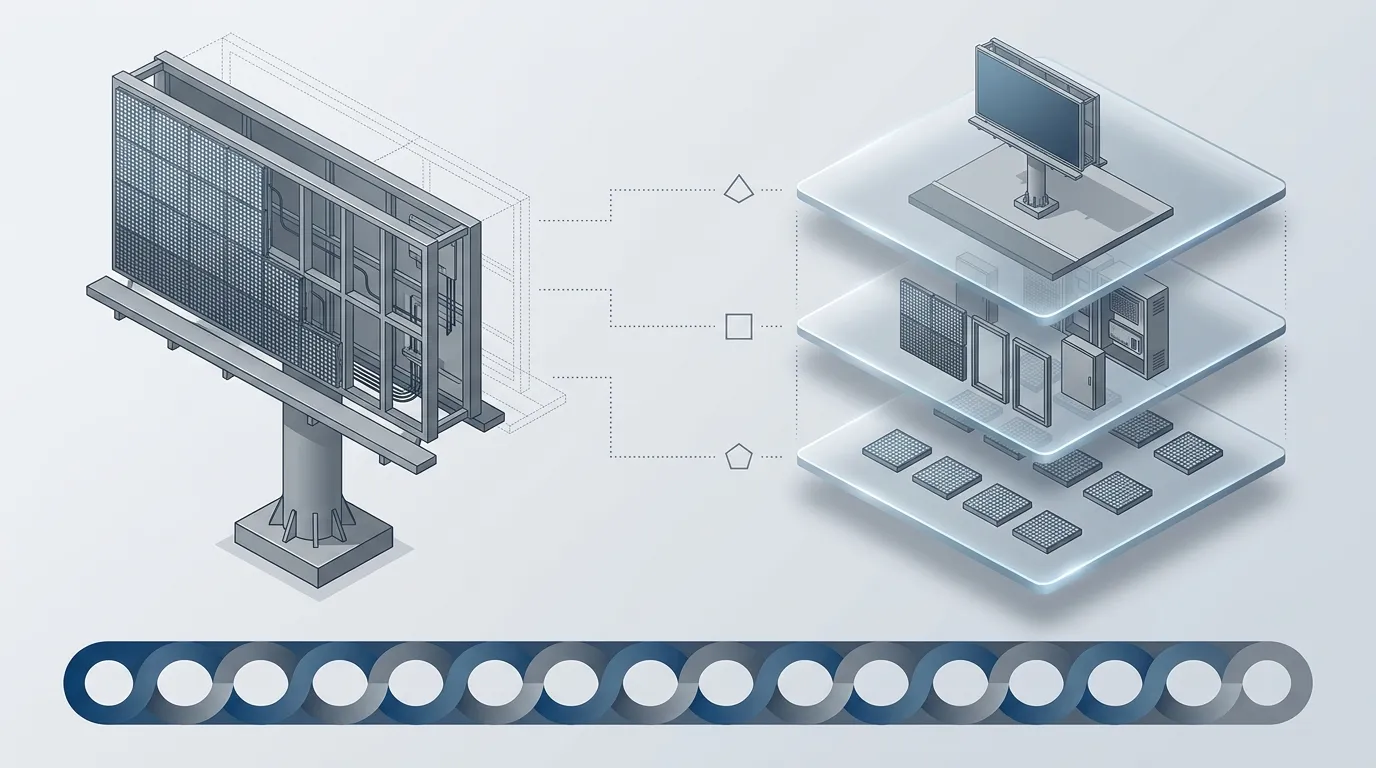
An outdoor LED billboard price covers one of three different scopes: screen-only module pricing, an equipment package, or a full turnkey project. Treating these as interchangeable is the most common reason two quotes for an apparently similar billboard land far apart.
Screen-only, or module, pricing lists LED modules at a price per piece or per area. It does not include cabinets, power supplies, receiving cards, control hardware, structure, or installation.
Equipment package pricing adds the parts that turn modules into a working display: cabinets, power supplies, receiving cards, sending and control hardware, and content-management software, usually quoted against a defined screen size and pixel pitch.
Turnkey project pricing adds steelwork and fabrication, foundation and site preparation, installation labor, permits and engineering, the electrical service connection, and the assumptions behind ongoing running costs.
CHAINZONE's 2025 cost guide separates an outdoor LED billboard budget into display hardware, structure and fabrication, site preparation and labor, permits and engineering, electricity, maintenance and repairs, software, and land or lease fees. That list is a practical way to check what a turnkey figure does and does not contain. For a broader view of the product category behind the quote, see outdoor led display, and for billboard-oriented configurations see outdoor advertising led display.
[DIAGRAM: Three-layer scope stack — module/screen-only, equipment package, turnkey project — with a separate recurring-cost layer showing which items appear at each level]
| Scope type | What it typically includes | What it does not include | Where it appears |
|---|---|---|---|
| Module / screen-only | LED modules, priced per piece or per area | Cabinets, power supplies, control, structure, installation | Supplier module price lists |
| Equipment package | Modules plus cabinets, power supplies, receiving cards, sending/control hardware, software | Structure, site work, permits, electrical service, installation | Vendor product pages and project quotes |
| Turnkey installed project | Equipment package plus structure, foundation, site preparation, installation, permits and engineering, electrical service | Ongoing electricity, maintenance and software/connectivity costs | Project quotes and installation contracts |
| Recurring operating budget | Electricity, maintenance and repairs, software or connectivity charges, land or lease fees where applicable | Purchase and installation of the display itself | Buyer's own operating budget |
Published LED Billboard Prices — What They Do and Don't Represent
The LED billboard prices published online are examples tied to specific sources and configurations, not a market benchmark. Each figure reflects the modules, screen size, pitch or product it was listed for, and none of them is a universal price for a billboard project.
The table below collects the figures reported by the sources named in it, with the configuration and price type each one states. Read the "Price type / scope" column before comparing any two rows: a module price and an installed-project figure are different measurements.
| Source | Configuration as listed | Listed amount | Price type / scope | Caveat |
|---|---|---|---|---|
| CHAINZONE (page dated 2025-12-01) | Outdoor LED billboard, size not specified | USD $8,000–$300,000 | Broad guide range | Source names size, pixel pitch, LED technology and installation needs as cost factors |
| DOIT VISION (updated 2024-01-17) | P4, 256 × 128 mm module | $12–$16 per piece | Module only | Historical module listing; excludes cabinet, power, control and installation |
| DOIT VISION (updated 2024-01-17) | P10, 320 × 160 mm module | $9–$12 per piece | Module only | Same limits as the row above |
| LED Sign City | 4 × 8 outdoor custom LED sign | Starting at $13,648.70 | Vendor product listing | Product page offers DIY and full-service installation as options |
| TechLED | Six-panel outdoor system, 9.4′ × 6.3′, one P8 listing | $8,499 | Vendor product listing | Category page shows prices varying among listed pitches and configurations |
| Smart LED | Double-sided 10 × 20 ft, 6 mm product | $208,560 | Vendor product listing | Product page figure; the same page states 16,000 W total power for that product |
| Smart LED (cost guide) | Smaller, simpler display up to large high-definition screen | $30,000 to over $500,000 | Broad guide range | The guide labels its own estimates as ballpark figures |
Two conclusions follow from the table. First, a module price cannot be multiplied out into a billboard budget, because everything that holds, powers and controls the modules is priced separately. Second, the two broad ranges quoted here come from different sources written at different times, and both describe themselves as indicative rather than fixed.
[DIAGRAM: Visual version of the price-example table, grouping rows into "module prices", "vendor product listings", "broad guide ranges" so the price type is obvious at a glance]
How Screen Size and Pixel Pitch Change the Total
Screen size and pixel pitch change the display portion of an outdoor LED billboard price, and nothing else changes with them automatically. A larger display uses more modules, more cabinets and more power capacity; a finer pitch places more LEDs into each square meter, which raises the display cost per area. Structure, site work, installation and running costs respond to the site, not to the pitch.
DOIT VISION's 2024 module listings illustrate the pitch effect on the display portion alone: a P4, 256 × 128 mm module is listed at $12–$16 per piece, while a P10, 320 × 160 mm module is listed at $9–$12 per piece. Both are module-only figures, and the two modules differ in size as well as pitch, so the comparison shows direction rather than a fixed ratio.
DOIT VISION also lists common outdoor pitches as P4, P5, P6, P6.67, P8 and P10. That is a source-specific list of what suppliers offer, not a recommendation for any particular site. MIC Display's outdoor range covers P2.5 to P10, which sits across the same practical band for outdoor advertising work.
| Variable | What changes | Effect on the screen portion | Effect on other budget areas |
|---|---|---|---|
| Screen area | Number of modules and cabinets | More modules and cabinets at the listed rate | Larger structure, more lifting, longer power and data runs |
| Pixel pitch | LED density per square meter | Finer pitch raises display cost per area | No direct effect on steelwork or installation |
| Single- vs double-sided | Number of display faces and cabinet depth | Two faces mean two display surfaces | Structure must carry both faces |
| Mounting type | Wall, pole or ground installation | No change to the module price itself | Determines steelwork, foundation and access needs |
Decision rule for pitch: choose the pitch from the viewing distance and the content first, then read the cost of that pitch. Selecting on price alone produces a billboard that is either under-detailed for its distance or more expensive than the viewing position can justify. The led pixel pitch guide covers the distance-to-pitch relationship in detail.
What's Included Beyond the LED Modules?
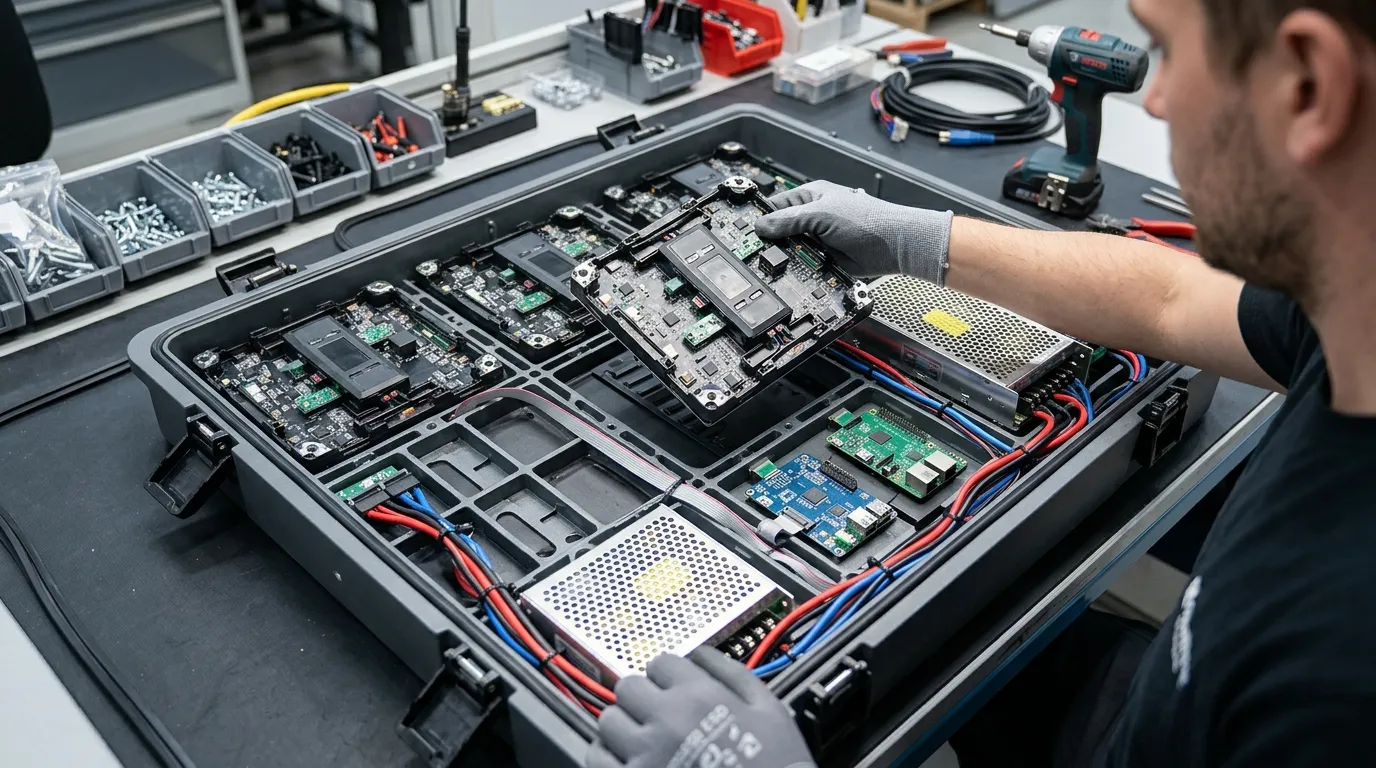
An equipment package adds cabinets, power supplies, receiving cards, sending and control hardware, signal and data cabling, and content-management software to the modules. Each of these can appear as a separate line or be bundled into one figure, so two quotes for the same screen size can total differently without either being wrong.
Cabinet construction is one of those separating choices. Aluminum cabinets are the common option for outdoor fixed installations, and steel or iron-box cabinets are also offered; the choice affects weight, finish and handling, which in turn feeds into the structure and lifting scope. MIC Display's design team customises screen structure, size and configuration to each project's installation environment, so cabinet and frame choices are made against the actual site rather than a standard catalogue. Product examples include aluminum outdoor led display and outdoor iron box led display.
Checklist — confirm each of these is itemised in writing as included, excluded or separately priced:
- LED modules, with pitch and module dimensions stated
- Cabinets, with material and dimensions stated
- Power supplies
- Receiving cards
- Sending and control hardware
- Signal and data cabling
- Content-management software, and whether any licence or subscription applies
- Spare parts kit
This is also the section to test before comparing any two numbers. If one quote includes cabinets and the other does not, the gap between them is scope, not price.
Structure, Foundation, Site Preparation and Installation
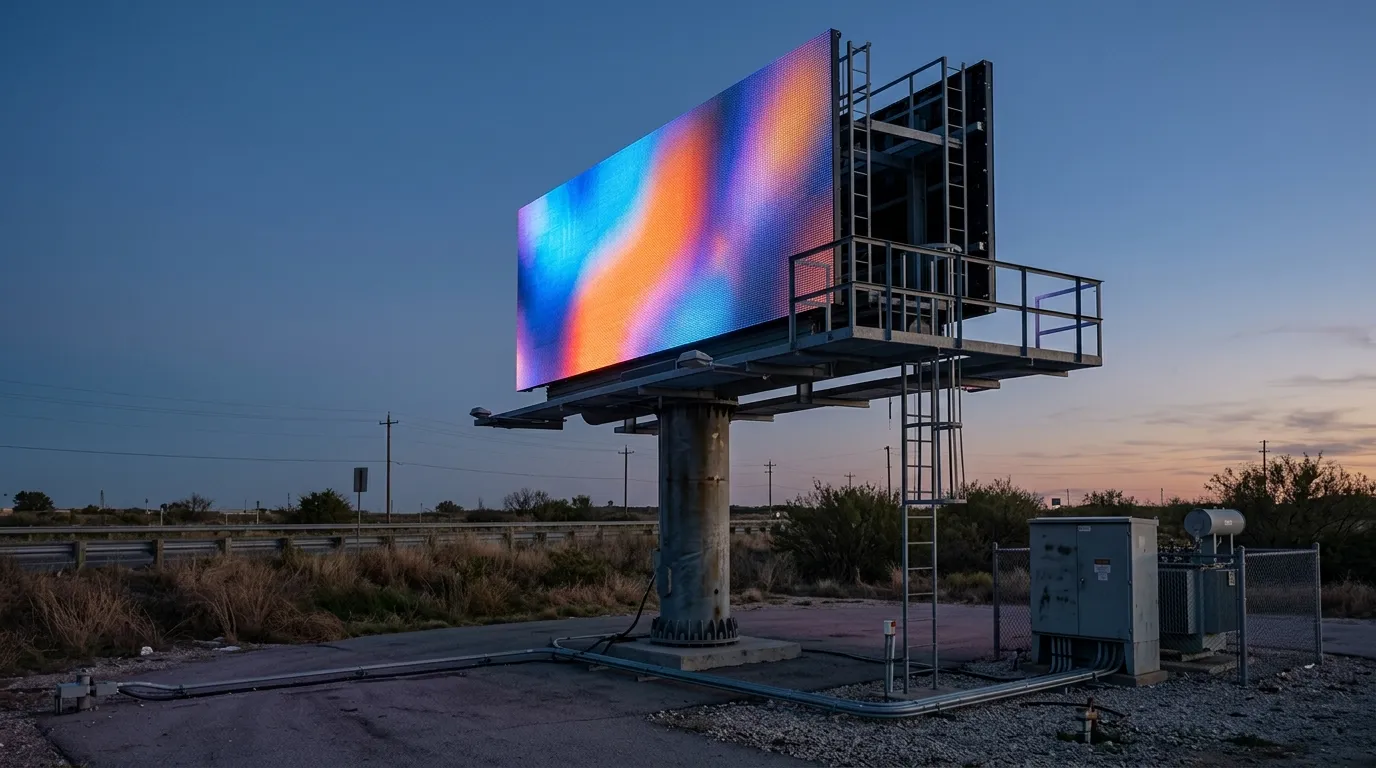
Structure, foundation, site preparation and installation are the project-specific part of an outdoor LED billboard budget, and they are confirmed by local engineering rather than by a product listing. Mounting type, local wind and soil conditions, and site access determine the steelwork, the foundation and the lifting equipment required.
CHAINZONE's 2025 guide lists structure and fabrication, and site preparation and labor, as separate budget categories alongside the display hardware, which reflects how these costs behave in practice: they change with the site, not with the screen specification.
Checklist — site and structure inputs to settle before requesting quotes:
- Mounting type and host structure (existing wall, pole, purpose-built frame, ground-mounted)
- Local wind and soil conditions, as confirmed by a local structural engineer
- Crane or lift access, and whether a road or lane closure is needed
- Distance from the nearest suitable power supply and data connection
- Access for delivery vehicles and installation crews
- The local structural approval path for the mounting arrangement
Vertical and near-vertical fixed installations are the usual configuration for advertising billboards; outdoor fixed led display covers that product family. For any project, the structural design is a local engineering output, and the display supplier's role is to provide accurate screen weight, dimensions and fixing data to the engineer handling it.
Permits, Engineering and Site Conditions
Permits, engineering approvals and site conditions vary by jurisdiction and are not set by the display supplier. They depend on local zoning rules, sign codes, structural review and utility access, so they must be budgeted from local input rather than from an online price list.
CHAINZONE's 2025 cost guide lists permits and engineering as a separate budget category, which is the practical treatment: it keeps a cost that is outside the supplier's control visible instead of buried inside a turnkey figure.
Decision rule: do not use a published permit or engineering dollar estimate from any source as a planning figure. Confirm the categories that apply to the specific site and parcel with the local authority and a local engineer, and record which party, buyer or supplier, is responsible for each submission in the contract.
One further limit is worth stating plainly: no retrieved source establishes a standard permit cost for outdoor LED billboards, because the requirement is municipal, not product-based.
Power, Control, Connectivity and Software
Power and control form their own budget line in an outdoor LED billboard project, separate from the screen and the structure. Before the display goes live, the site needs an electrical service sized for the display's demand, cabling to the screen, receiving and sending hardware, and content software. Each of these can be quoted separately, and the display's power demand sets the electrical scope.
Power figures are product-specific, and the sources show how widely they can differ. Smart LED's product page for its double-sided 10 × 20 ft, 6 mm billboard states 16,000 W total power for that product. LED Sign City's 4 × 8 product page lists 27.6 A at 110 V in its key specification section and a maximum of 3,040 W per side in its product description. Neither figure should be generalised to another screen; both belong to the product each page lists.
| Item | What it covers | How to confirm it in the quote |
|---|---|---|
| Site electrical service | Supply capacity and connection sized to the display's demand | Ask for the display's stated power requirement in watts or amps and confirm who arranges the service |
| Cabling and data runs | Power and signal cabling from source to screen | Confirm the run length assumed and who supplies and installs it |
| Receiving and sending hardware | Cards and control hardware that drive the display | Confirm inclusion and whether spares are supplied |
| Brightness and dimming control | Control of output across day and night conditions | Confirm the control method and who commissions it |
| Content-management software | Publishing and scheduling of content | Confirm licence terms, subscription status and training |
| Connectivity | Network or wireless link to the content source | Confirm the method and whether any recurring service charge applies |
Ongoing Running Costs
Running costs continue after the billboard is live: electricity to operate the display, connectivity or software charges where these apply, and maintenance and repairs. They are not part of the purchase price, but they belong in the budget from day one.
CHAINZONE's 2025 guide lists electricity, maintenance and repairs among the longer-term expenses of an outdoor LED billboard, and identifies land lease as a further ongoing item where the site is not owned by the operator.
Decision rule: do not plan from a published cost-per-kilowatt-hour or cost-per-hour figure for billboard operation. The retrieved sources do not establish one, and consumption varies with screen area, brightness settings, climate and operating hours. Build the estimate from the display's stated power requirement and the local electricity tariff instead.
How to Budget an Outdoor LED Billboard Project
An outdoor LED billboard project budget is built in two layers: a project layer covering screen, structure, power and control, and installation and permits; and a running layer covering electricity, software and connectivity, and maintenance. Then collect comparable quotes by giving every supplier the same written project brief, so each one prices the same scope.
Numbered steps:
- Define screen size and pixel pitch from viewing distance and content type, then read the cost of that specification.
- Confirm mounting type and host structure against the site conditions recorded in the structure checklist above.
- List the equipment inclusions you expect, using the equipment checklist, and state them in the request.
- Separate installation, site work and permits into their own lines rather than accepting a single combined figure.
- Plan the electrical service, control hardware and content software as one budget area.
- Set the assumptions behind recurring electricity, connectivity and maintenance so they can be reviewed later.
- Fix warranty and after-sales terms in writing so the quotes compare like for like.
Checklist — the details both quotes must state before you compare them:
- Screen dimensions and total area
- Pixel pitch
- Cabinet type and material
- Structure scope, including foundation and fabrication responsibility
- Power and control scope, including the display's stated power requirement
- Installation scope, including lifting and site work
- Permit and engineering responsibility
- Warranty length and what it covers
- Service terms and how technical support is provided
MIC Display, an LED display factory in China established in 2011, designs, produces and sells outdoor displays within a P2.5 to P10 range and customises screen structure, size and configuration to the installation environment. Displays carry a 5–8 year warranty with remote technical support and after-sales service, and the company exports to more than 100 countries.
Frequently asked questions
What is a realistic price range for an outdoor LED billboard?
It depends entirely on scope. CHAINZONE's guide, dated 2025-12-01, states a range of USD $8,000 to $300,000 for outdoor LED billboards, naming size, pitch, LED technology and installation needs as cost factors. Smart LED's guide gives about $30,000 for a smaller, simpler display up to over $500,000 for large high-definition screens, and labels its figures as ballpark estimates.
Does a finer pixel pitch always cost more?
Finer pitch usually raises the display portion of the cost, because more LEDs are packed into each square meter, and DOIT VISION's 2024 module listings show P4 modules listed above P10 modules per piece. But the total does not track pitch alone: a coarse-pitch sign on new steelwork can cost more than a fine-pitch sign on an existing wall.
Are installation and running costs included in the screen price?
Usually not. Module and product prices published online are screen-side figures, while structure, site work, electrical service, permits and installation are normally quoted separately. Electricity, software or connectivity charges, and maintenance continue after handover. Confirm each line as included, excluded or separately priced before comparing any two quotes.
Why do two vendors quote very different prices for the same screen size?
Scope differences are the most common cause. One supplier may quote modules only, while another quotes a turnkey package including cabinets, control, structure, installation and permits. The gap is usually scope rather than price. Align dimensions, pitch, cabinet, power and control, installation and warranty terms before drawing a conclusion from the totals.
READYFORWRITING
Share on Social:


Contact Us
In This Article
Related Posts
LED Window Display- The Complete Guide for Retail, Advertising, and Commercial Spaces
October 26, 2026
Mini LED Display- What It Is, How It Works, and Where It Fits
October 26, 2026
Naked Eye 3D LED Display - How It Works, Key Specs, Cost and How to Plan One (2026 Guide)
October 16, 2026
Transparent LED Displays for Storefronts
October 14, 2026


