




How Bright Should an Outdoor LED Display Be?
By miashuvo2077
Oct 02, 2026Related Posts
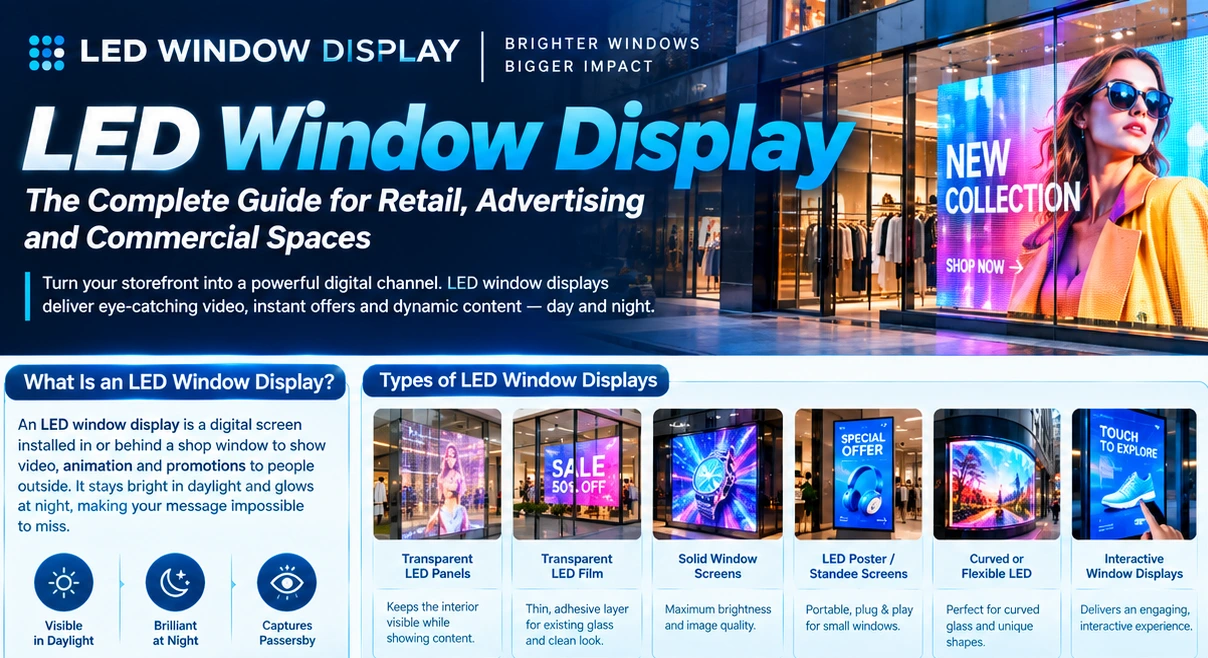
LED Window Display- The Complete Guide for Retail, Advertising, and Commercial Spaces
October 26, 2026
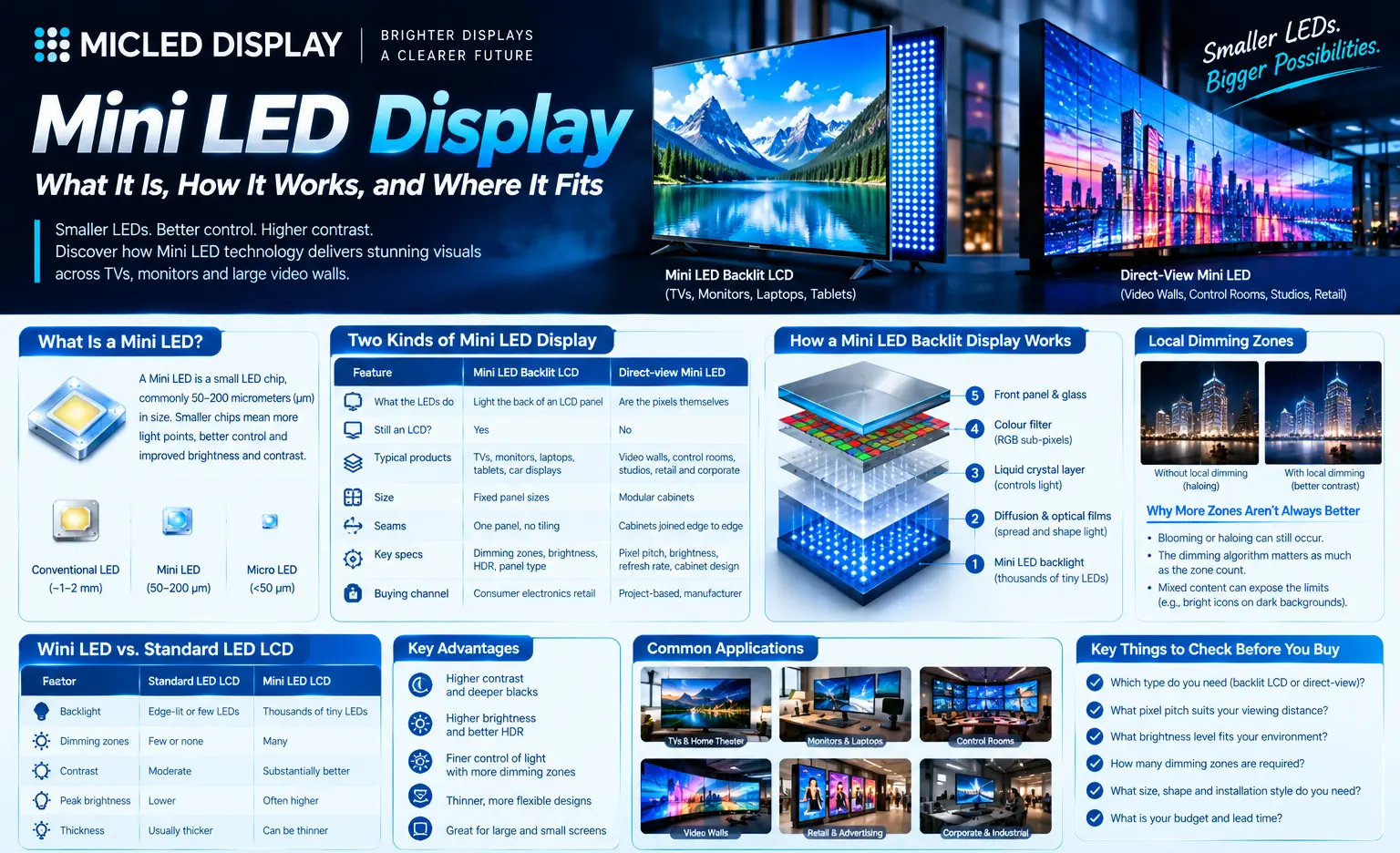
Mini LED Display- What It Is, How It Works, and Where It Fits
October 26, 2026
Naked Eye 3D LED Display - How It Works, Key Specs, Cost and How to Plan One (2026 Guide)
October 16, 2026
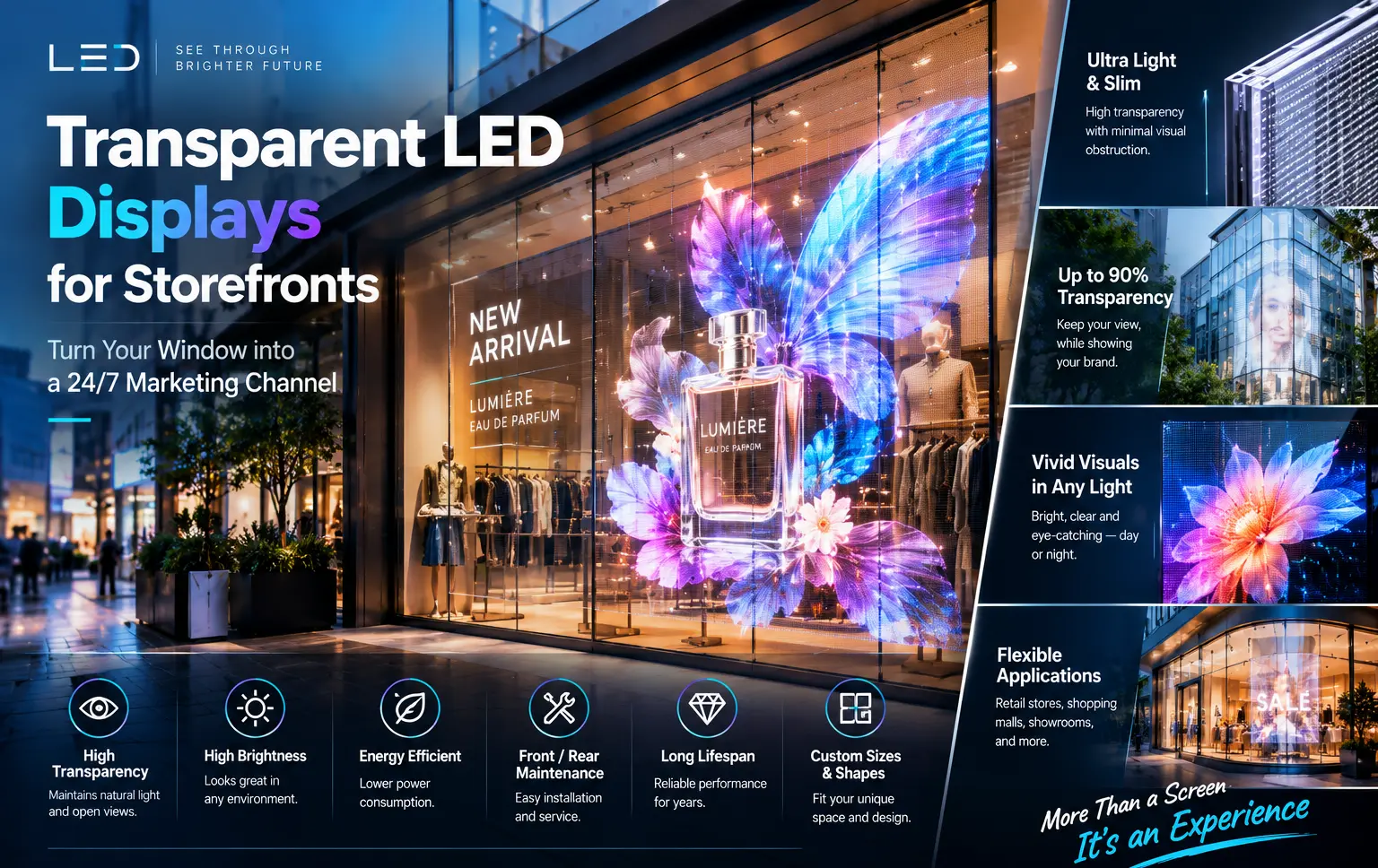
Transparent LED Displays for Storefronts
October 14, 2026
There is no single required figure, but the practical starting points are roughly 3,000–4,500 nits for shaded or semi-outdoor sites, around 4,500–6,500 nits for mixed and partial-sun positions, and 5,500–8,000 nits or more for direct-sun billboards. Published recommendations vary by source, so confirm the display's sustained output, not only its peak rating.
Key takeaways
- A nit equals one candela per square metre (cd/m²) — the two terms describe the same luminance unit, according to EagerLED.
- Shaded and semi-outdoor installations are commonly placed at 3,000–4,500 nits (Uniview LED).
- Direct-sun billboards are commonly placed from about 5,500 up to 8,000 nits or more (DOIT VISION; LED Craft).
- Automatic brightness adjustment lets an outdoor screen reduce output after dark instead of running at daytime levels.
- Published ranges differ widely, so the useful buying question is what sustained output can be documented for the site — not what the highest number is.
Quick answer: how many nits for shaded, partial-sun and direct-sun sites
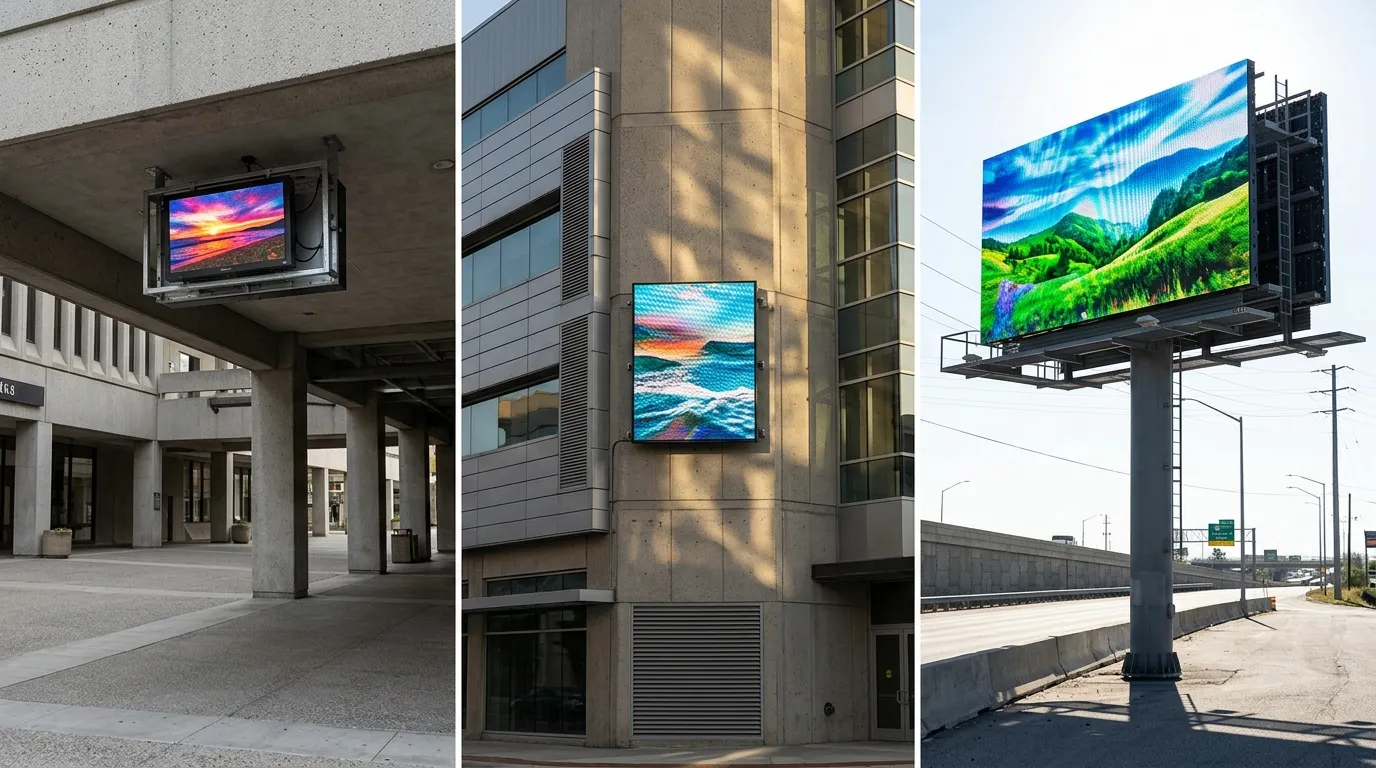
Match the screen position to the sunlight it actually receives: shaded or covered sites need the least output, mixed and partial-sun positions sit in the middle, and fully exposed direct-sun billboards need the most. These bands apply to any outdoor led display, whether it is a permanent installation or a temporary structure.
Outdoor LED brightness is the luminance of the display surface, measured in nits or candela per square metre (cd/m²). EagerLED's technical standards guide states that one nit equals one cd/m². The figure that matters for a specific site is the output the screen can hold during the hours it actually operates.
| Site condition | Source-reported starting band | Source | Notes and limits |
|---|---|---|---|
| Shaded, covered or semi-outdoor | 3,000–4,500 nits | Uniview LED | Source does not state measurement conditions |
| Semi-outdoor, under canopy | 3,500–4,000 nits | DOIT VISION | Source does not state measurement conditions |
| Shaded or north-facing façade | 4,500–5,500 nits | DOIT VISION | Source does not state measurement conditions |
| General outdoor advertising | 5,000–6,000 nits | Uniview LED | Source does not state measurement conditions |
| Low-sunlight locations | 5,000–6,000 nits | LED Craft | Source does not state measurement conditions |
| Urban areas | 5,000–6,500 nits | Esdlumen (2019) | Older guidance; may predate current products |
| Direct-sun billboard | 5,500–6,500 nits | DOIT VISION | Source does not state measurement conditions |
| Direct-sun billboard | 6,000–8,000 nits | Uniview LED | Source does not state measurement conditions |
| All-purpose outdoor | 6,500–8,000 nits | LED Craft (2025) | Described as a general working range |
| Direct sunlight | 7,000+ nits | Esdlumen (2019) | Older guidance; may predate current products |
| Harsh light and fast traffic | 8,000–10,000+ nits | LED Craft (2025) | Aimed at roadside conditions |
Every band above is a vendor recommendation, not an industry standard. None of the sources states the ambient light, measurement distance or test conditions behind its figure, which is why the bands overlap and disagree.
[DIAGRAM: three site silhouettes — shaded canopy, partial façade, direct-sun billboard — each labelled with its source-attributed nit band and a "starting point, not a standard" note]
Why the recommended nit ranges differ so much
The ranges differ because each source is describing a different combination of ambient light, viewing distance, content and measurement method, and none of the published pages states its measurement conditions. DOIT VISION reports roughly 100,000 lux of direct noon sunlight on a south-facing surface, which shows how far the ambient-light variable moves between a covered entrance and an exposed billboard.
Publication date is a second reason. Esdlumen's guidance dates from 2019, while LED Craft's page is dated 2025, so the two pages may be describing different generations of display hardware. Treat every published number as a starting band, then convert it into a site-specific figure through the checks in this article.
Site factors that move the number up or down
Screen orientation, operating hours, content and viewing distance all shift how much output an outdoor LED display needs to stay legible.
Orientation and afternoon sun
Yes, screen direction changes the requirement. A screen facing the sun during its display hours needs more output than one that is shaded by the same building at the same moment. DOIT VISION's table gives 4,500–5,500 nits for shaded or north-facing façades and 5,500–6,500 nits for direct-sun billboards, a gap that reflects exposure rather than display quality. Investment in the highest exposure band is wasted on a north-facing wall that never sees direct sun.
Operating hours, content and viewing conditions
A covered entrance used mainly at night does not need a direct-sun rating, while a roadside billboard running all day in bright content does. Long viewing distances also make low-contrast content harder to read. Pixel pitch and viewing distance affect legibility in their own right, so treat brightness as one input rather than the whole answer — the led pixel pitch guide covers that side of the decision.
Peak brightness vs. sustained brightness: which number should you ask for
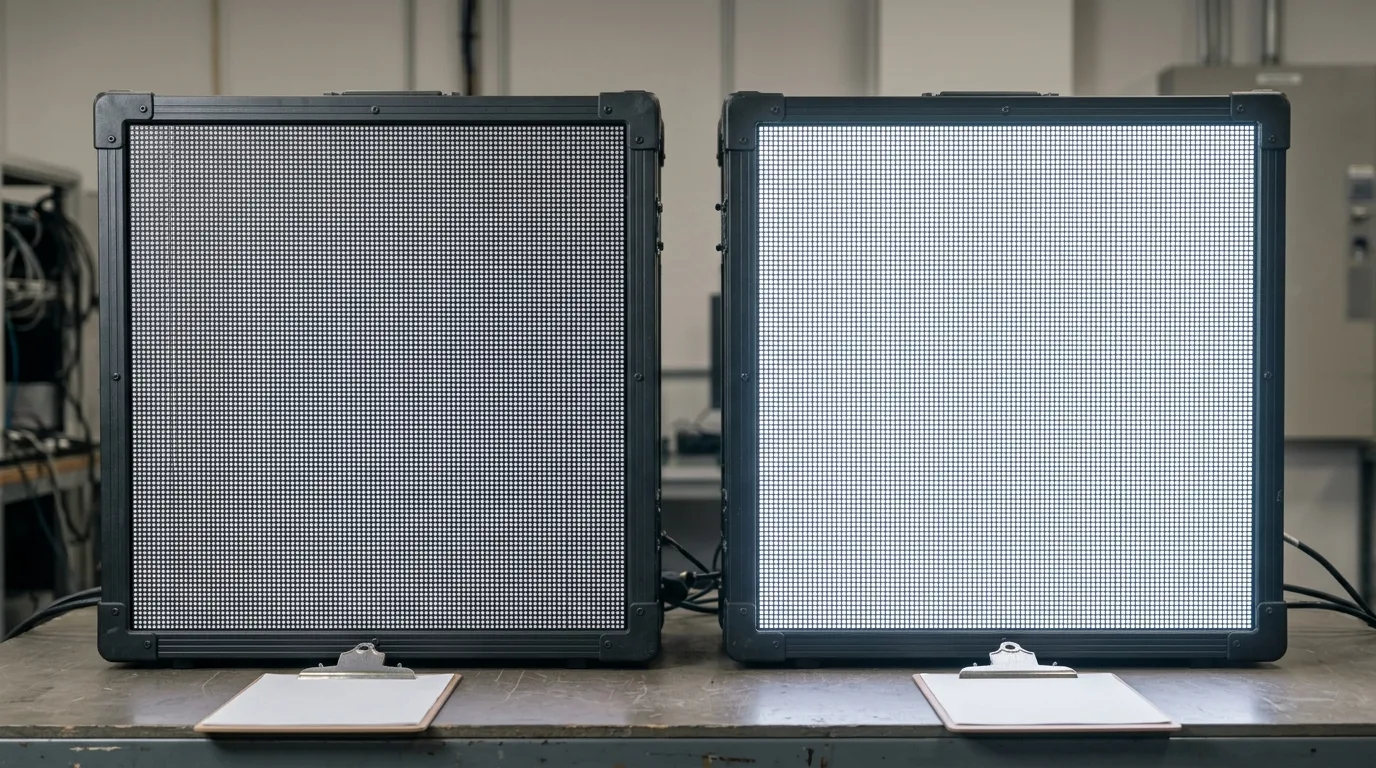
Ask for sustained or operating brightness measured under defined conditions, because the headline figure on a datasheet is usually a maximum that the screen cannot hold continuously without cost. Uniview LED states that higher brightness can increase power use and thermal load, and DOIT VISION separates sustained output from peak output while discussing overspecification and lifespan.
A short checklist for the specification conversation:
- Ask what ambient temperature, distance and content pattern the brightness figure was measured under.
- Ask for sustained or operating output, not the maximum rating alone.
- Ask how output behaves as the cabinet warms up during a full day of operation.
- Ask how the figure is verified and what documentation accompanies it.
How automatic brightness adjustment works at night
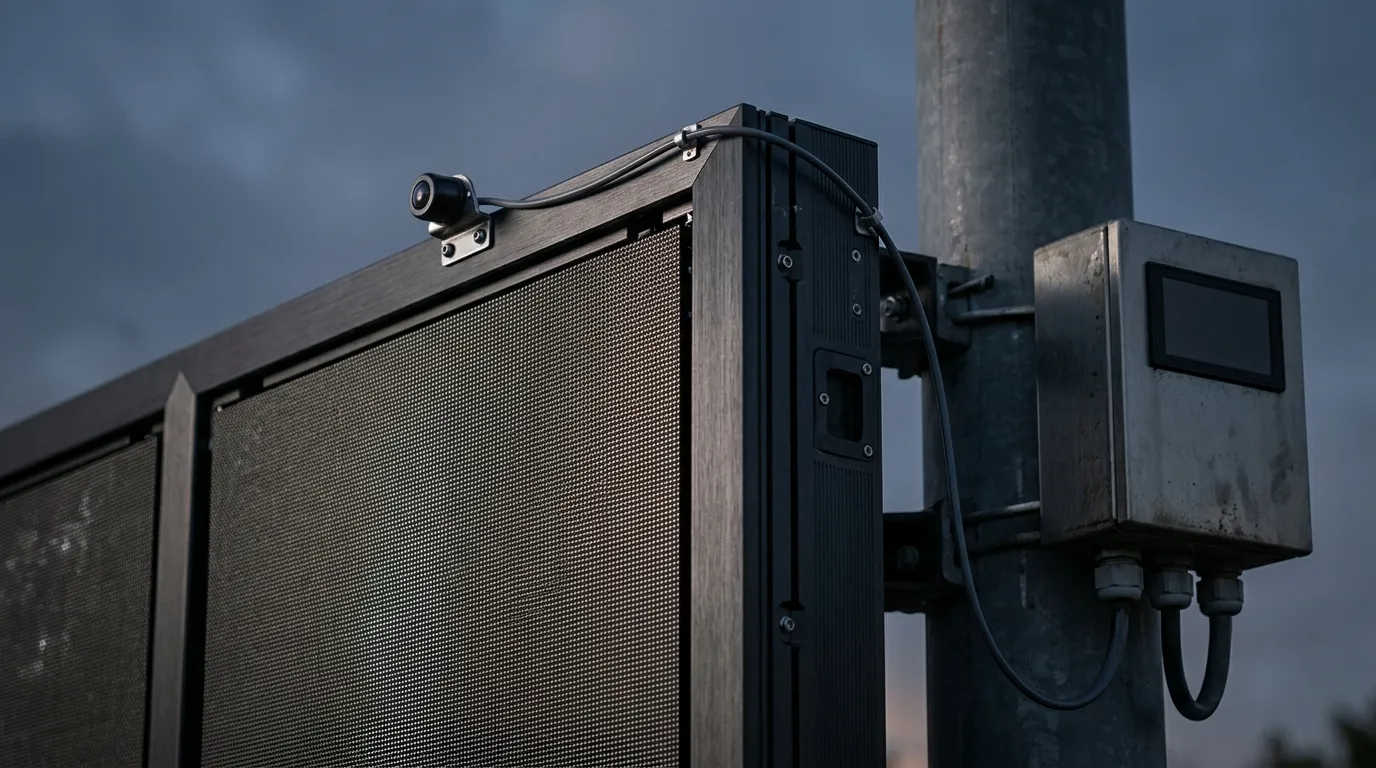
An ambient-light sensor or a brightness schedule reduces output after dark, so the screen stays readable without glaring at drivers, pedestrians or nearby buildings. The display does not need to run at its daytime output all night. Uniview LED describes automatic dimming as a way to adjust output to ambient conditions, and Esdlumen describes automatic brightness adjustment as an energy-management feature of outdoor screens.
Check the applicable local rules for nighttime luminance before fixing a schedule. Brightness that is comfortable in daylight can be intrusive at night, and the permitted level varies by jurisdiction rather than following one universal limit.
[DIAGRAM: a day-to-night dimming curve showing ambient light falling while screen output steps down to a reduced nighttime level]
Why too much brightness costs you — power, heat and glare
Buying well above what the site needs does not buy a better picture. It raises power draw and thermal load, and it can make the screen uncomfortable to look at after dark. Uniview LED links higher brightness with increased power use and thermal load, and DOIT VISION associates overspecification with power, heat and reduced lifespan.
The practical rule is to specify for the worst realistic viewing condition the screen will meet — not for the brightest condition the site could theoretically experience. A display rated far above its operating band is paid for twice: once at purchase and again in running costs.
[DIAGRAM: a bar comparison showing a headline maximum brightness figure beside a lower sustained operating figure, with callouts for power, heat and glare]
Outdoor LED brightness specification checklist
Use these steps to turn a general brightness question into facts you can compare across suppliers.
- Define the site's sunlight exposure and the direction the screen faces.
- Define the display hours, including how much of the schedule runs after dark.
- Ask for sustained output with its measurement conditions.
- Ask how dimming is controlled and scheduled.
- Check the model's published figure against the band you selected in the table above.
MIC Display, an LED display factory in China established in 2011, publishes brightness figures for its outdoor models: ≥5,500 cd/m² for the MS aluminium series, 7,500 nits for the MC-PRO series and >5,000 nits for the MC-S advertising series. These are MIC Display's published specifications rather than third-party test results, and they can be compared against any outdoor fixed led display shortlist alongside the equivalent figures for an outdoor advertising led display or a temporary outdoor event rental led screen where the duty cycle differs.
If you send MIC Display your site conditions and required viewing hours, the team can recommend a brightness and configuration for the project.
Frequently asked questions
What is the recommended screen brightness for outdoor use?
Shaded or semi-outdoor sites are commonly placed at 3,000–4,500 nits according to Uniview LED, mixed and partial-sun positions at roughly 4,500–6,500 nits, and direct-sun billboards from 5,500 to 8,000 nits or more according to DOIT VISION and LED Craft. These are starting bands, not standards.
How many nits are enough for an outdoor display?
Enough is the band that matches the site's real exposure, not the highest number on the market. A shaded façade that meets Uniview LED's 3,000–4,500 nit band does not need a direct-sun rating, and specifying one adds power and heat without improving legibility.
Is 10,000 nits too bright for an outdoor LED display?
Not automatically. LED Craft lists 8,000–10,000+ nits for harsh light and fast traffic, so that level suits a hard-driven roadside billboard. For a shaded or night-heavy site it is overspecification, with the power and thermal consequences Uniview LED associates with higher brightness.
How do I verify a supplier's brightness claim?
Ask for sustained output rather than the maximum rating, and ask for the conditions the figure was measured under. A supplier who can state ambient conditions, distance and content for the measurement gives you something comparable; a headline number without context cannot be checked against another supplier's.
READYFORWRITING


Contact Us
In This Article
Related Posts
LED Window Display- The Complete Guide for Retail, Advertising, and Commercial Spaces
October 26, 2026
Mini LED Display- What It Is, How It Works, and Where It Fits
October 26, 2026
Naked Eye 3D LED Display - How It Works, Key Specs, Cost and How to Plan One (2026 Guide)
October 16, 2026
Transparent LED Displays for Storefronts
October 14, 2026


