




Best Outdoor LED Screens for Commercial Buildings
By miashuvo2077
Oct 02, 2026Related Posts
Best COB LED Display Manufacturers: How to Evaluate
October 10, 2026
LED Poster Screen Guide: The Smart Alternative to Print Advertising
October 09, 2026
Rental LED Cabinet Sizes: 500x500 vs 500x1000 Compared
October 09, 2026
Rent vs Buy LED Screens: A Cost Guide for Event Companies
October 09, 2026
The best outdoor LED screen for a commercial building depends on the facade, not on one universal model. Building facade LED screens divide into three practical options — fixed screens, transparent displays and grille screens — and the right one is decided by cabinet weight and facade support, wind exposure, how much of the building must stay visible, and how the screen will be serviced.
Key takeaways
- Building facade LED screens fall into three mounting options — fixed, transparent and grille — and the choice is driven by facade conditions rather than by a single product.
- Cabinet weight alone does not establish facade suitability; the mounting design, support structure and local wind exposure need review by a qualified structural professional.
- According to ROE Visual, wind effects on an outdoor screen depend on structure height, location, terrain, screen dimensions, shape and installation method.
- Maintenance access is a design decision: some cabinets listed on MIC Display's outdoor LED display page are described as front-and-rear serviceable and others as rear-serviceable only.
- Brightness, pixel pitch and IP protection are site- and distance-dependent specifications to verify against the project, not fixed guarantees.
What Types of LED Screens Can Be Mounted on a Commercial Building Facade?
Commercial buildings use three practical facade approaches: a fixed opaque screen mounted to the building structure, a transparent display installed against or in front of glazing, and a grille or mesh screen that lets air and some light pass through. Each is a different structural and visual commitment, so the display type follows from the facade rather than the other way around.
A fixed facade LED screen is a permanent display mounted to the building structure or to an added support frame, and it produces the most continuous image of the three. A transparent facade display is built for glazed elevations where the building's appearance behind the screen still matters. A grille or mesh screen uses an open cabinet pattern; Planar lists mesh among the features used to lower wind resistance on outdoor LED products (Planar, Outdoor LED Solutions).
According to MIC Display's outdoor LED display category page, the range covers outdoor fixed and outdoor advertising series for permanent installation, alongside indoor, rental and customized displays. The specifications and comparisons on that page describe the configurations shown there, so they are starting points for a project discussion rather than universal values.
Fixed, Transparent or Grille: How the Three Facade Options Differ
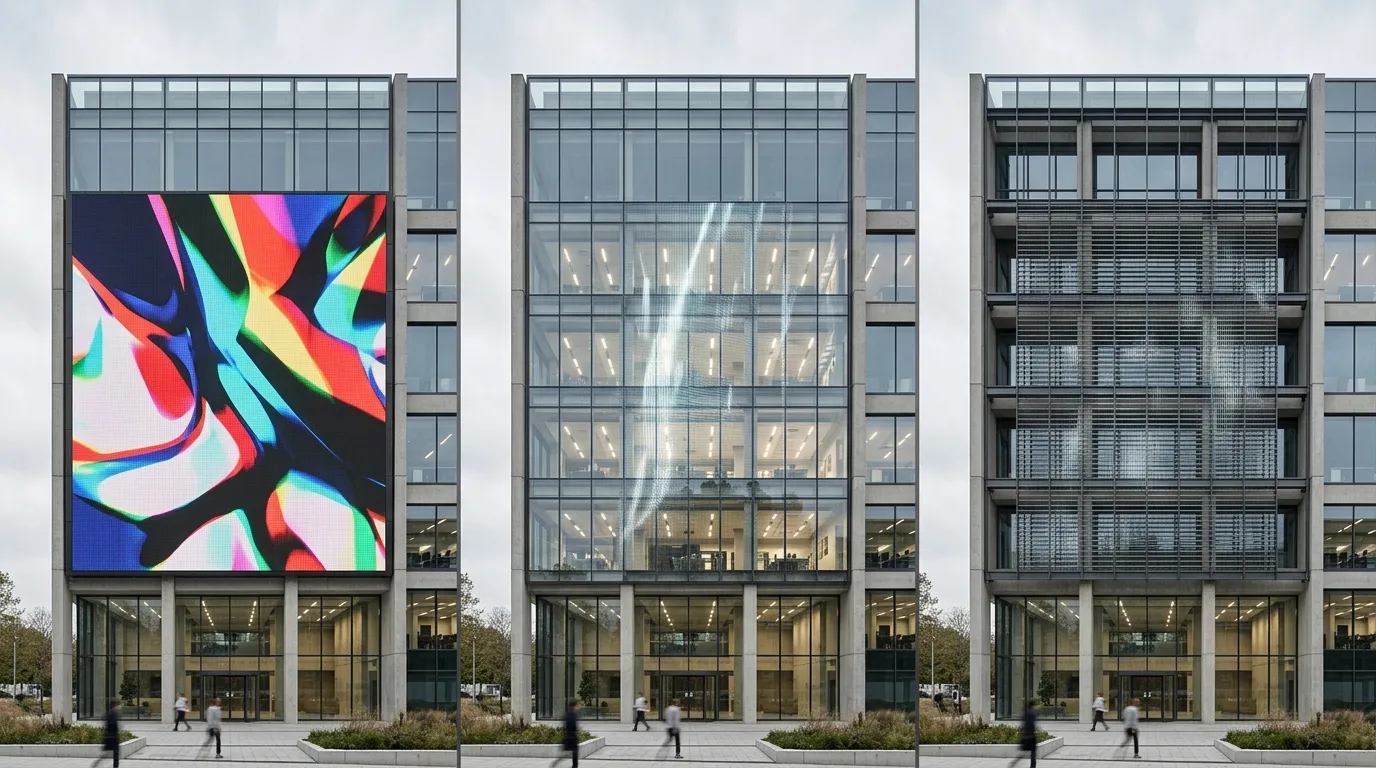
Fixed screens deliver the most continuous image and suit solid walls; transparent displays preserve some view through glazing; grille screens reduce wind resistance and weight but show a more open image. The trade-off is between image density, view-through and structural load, and no single option wins on all three.
| Facade option | Best-fit facade condition | Image character | View-through of building | Structural watch-outs to confirm | Service access to confirm |
|---|---|---|---|---|---|
| Fixed facade LED screen | Solid wall, concrete or steel structure able to take bracket loads | Most continuous, highest density | None — the screen covers the area | Bracket load path and fixing method | Front, rear or walk-in route |
| Transparent facade display | Glazed elevation where the building must stay visible | Bright image with visible background | Partial — depends on cabinet openness | Mounting to the glazing system or a separate frame | Module replacement without removing glazing |
| Grille or mesh facade screen | Large elevations, high wind exposure, weight-sensitive structures | Open, segmented at close range | High — open areas remain visible | Reduced wind resistance is a design aim, not a rated figure | Access to modules behind the open pattern |
According to MIC Display's outdoor LED display page, die-cast aluminum cabinets are positioned for premium fixed installations and iron-box cabinets as a cost-effective option for permanent billboards and large outdoor signage. Planar reports that outdoor LED models deliver up to 6,000 nits and lists waterproofing, UV-protective treatments, mesh for lower wind resistance and dust-tight enclosures among the features it uses (Planar, Outdoor LED Solutions).
Fixed facade LED screens
MIC Display's fixed product line covers outdoor fixed led display cabinets for permanent building installation. Fixed screens are the option to compare against first when the elevation has enough solid area and the building does not need to be seen through the display. They also commit the building most fully: the screen occupies the wall, so facade servicing routes must be planned around it.
Transparent facade displays
A transparent facade display is intended for glazed buildings where daylight and the view behind the screen remain part of the design. MIC Display's outdoor transparent led display page describes the product for glass facade use. Transparency values, weight and wind data for a specific configuration were not confirmed in the sources reviewed here, so ask the supplier to state them for the exact configuration at the exact pixel pitch.
Grille and mesh facade screens
Grille screens sit between the two: more open than a solid screen, more image-dense than a bare structure. MIC Display's transparent grille screen page covers this type. Because the open pattern changes how wind and view-through behave, treat grille specifications as configuration-specific and confirm them against the elevation rather than the product family.
Weight, Facade Support and Wind Load: What to Confirm
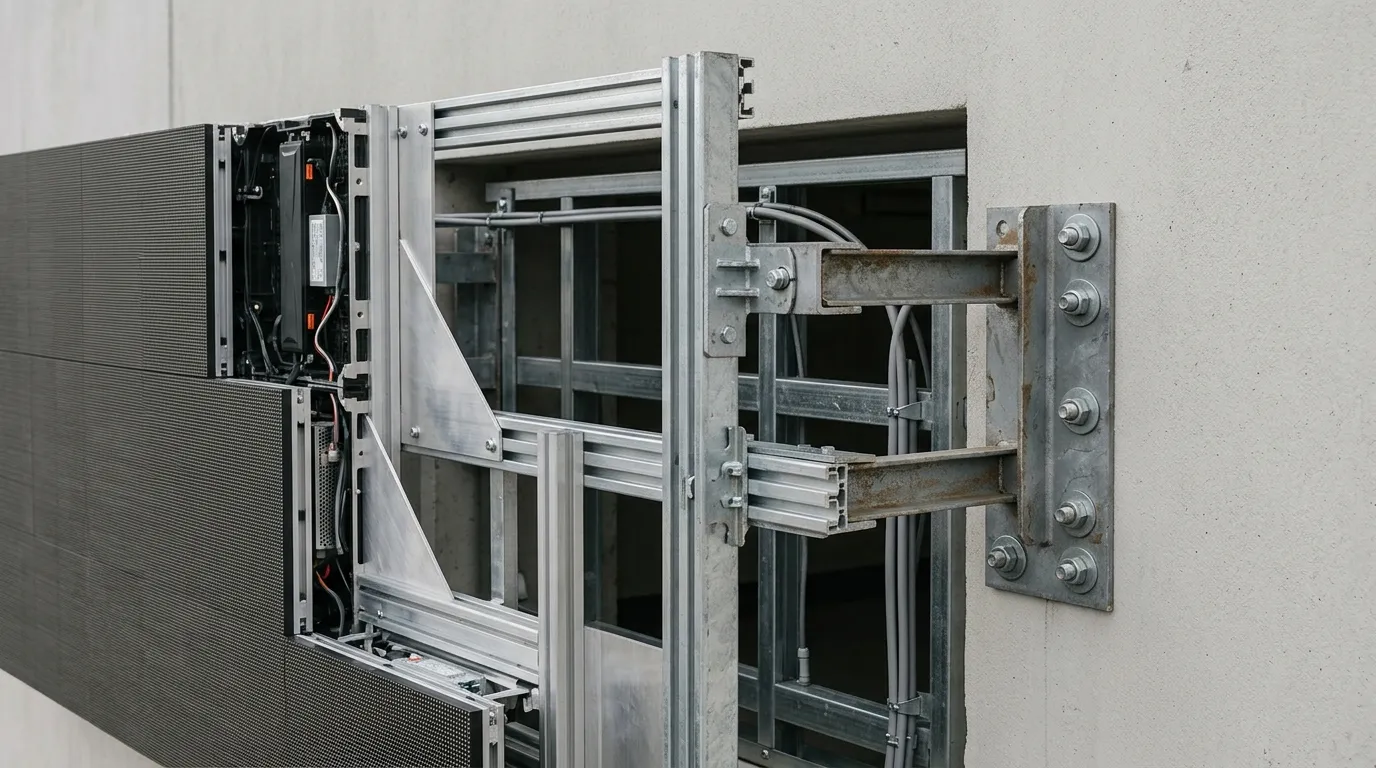
Compare weight per cabinet and per square metre on the same basis, then hand those numbers to the structural professional who owns the facade. A lighter cabinet is not automatically easier to mount — bracket design, fixing-point spacing and the existing support structure all matter.
| Listed cabinet type | Listed example weight | Listed maintenance access | Verification needed |
|---|---|---|---|
| Die-cast aluminum | Approximately 18 kg | Front and rear | Cabinet size basis and weight per m² |
| Iron box (P2.5 example) | 13 kg | Rear only | Cabinet size basis and weight per m² |
| Iron box (P4 example) | 30 kg | Rear only | Cabinet size basis and weight per m² |
According to MIC Display's outdoor aluminum led display range and the outdoor LED display comparison, these figures describe the examples listed on those pages. The source page does not state a single comparable size and weight basis for all three, so do not treat them as a like-for-like comparison without confirmation.
Decision rule: ask every supplier for weight per cabinet and weight per m² for the exact configuration, plus fixing-point spacing, before any facade review begins.
Who verifies wind load?
Wind load is a project calculation, not a product specification. According to ROE Visual, wind effects depend on variables including structure height, location, terrain, screen dimensions, shape and installation, and the company cautions that a structural report may not cover every building location (ROE Visual, Outdoor LED Screen Use).
ROE Visual also defines a Temporary Demountable Structure as one intended for repeated assembly and disassembly at different locations for a maximum duration of 90 days. That definition describes temporary event structures, not permanent facade design, so it should not be used as the code basis for a building-mounted screen. Confirm structural adequacy with the project's qualified structural professional, and keep any supplier figure in context until that review is complete.
Transparency: How Much of the Building Should Stay Visible?
Transparency is a design compromise rather than a single percentage. More open screens preserve the facade's appearance and can reduce wind resistance, but they also reduce image density — so decide what the building must still look like before choosing a product.
According to Planar, mesh is one of the features used in outdoor LED products for lower wind resistance (Planar, Outdoor LED Solutions). MIC Display's transparent product page was reviewed only as a summary describing use on glass facades, with no transparency percentage, weight or wind-load figure confirmed, so this page does not state one for any model.
Decision rule: require the supplier to state transparency and weight for the exact configuration at the exact pixel pitch, and to supply a rendered or photographic view of the installed appearance on a comparable facade before approval.
Maintenance Access: Front, Rear or Project-Specific?
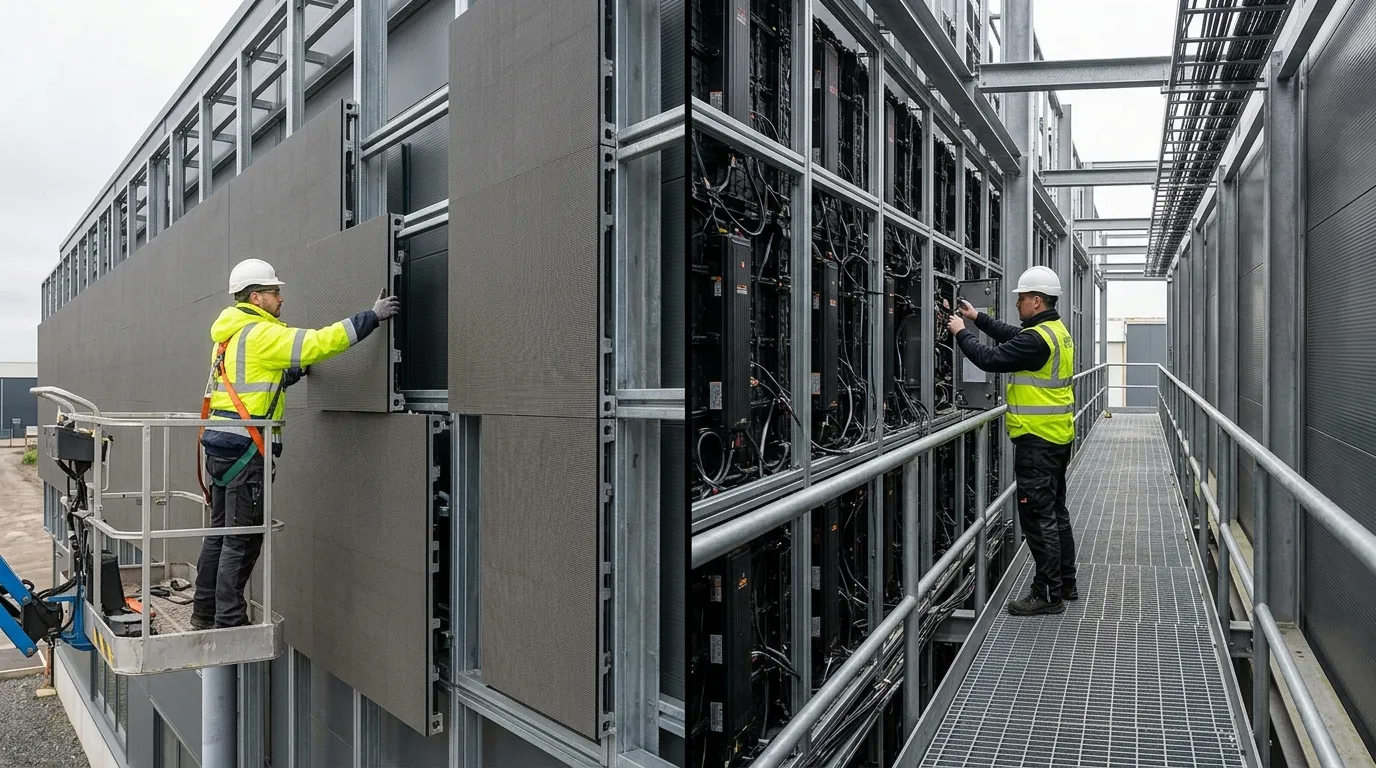
Maintenance access determines whether a screen can be serviced at all. Decide between front access, rear access or a mixed approach before finalising the mounting gap and the building's available service routes.
According to MIC Display's outdoor LED display comparison, die-cast aluminum cabinets are listed with front-and-rear maintenance and iron-box cabinets with rear-only maintenance. Rear-only service is unworkable on a facade with no rear void, so confirm the access route before the cabinet is chosen rather than after.
How installation access affects overall project feasibility
Screen choice also depends on whether the building can physically accept the screen. Crane or hoist capacity, mounting height, working hours, scaffolding or rope access, and the accessible service gap all shape which option is viable.
Decision rule: map the access route from street to module before comparing products; if rear service is impossible, exclude rear-only cabinets at shortlist stage.
Pixel Pitch, Brightness and Weather Protection: What to Verify
Match pixel pitch to the realistic viewing distance, then verify brightness and IP protection against the actual site rather than against a general outdoor claim. Pixel pitch is the distance between two adjacent LED pixels, and smaller pitch means more pixels per square metre.
According to LG, pixel pitch below 4.0 mm suits viewing distances under 15 m, 3.91–8.33 mm suits 15–25 m, and 10 mm or larger suits very long-distance viewing. Those are LG's recommendations rather than universal rules, and they assume a typical viewing position for the building in question.
Brightness is measured in nits, also written as cd/m². Planar reports outdoor LED models delivering up to 6,000 nits (Planar, Outdoor LED Solutions). MIC Display's outdoor LED display page lists a die-cast aluminum series at ≥5,500 cd/m² and IP65 protection, and an outdoor fixed series at pixel pitches P4.44, P5.7, P6.67, P8 and P10 at 7,500 nits; the page-listed ranges are P2.976–P10.42 for the aluminum series and P2.5–P10 for the iron-box comparison. According to ROE Visual, outdoor LED screens should be rated IP65 or higher. Ingress Protection (IP) ratings describe resistance to dust and water ingress.
| Specification | What to check | Why it matters | Site input needed |
|---|---|---|---|
| Pixel pitch and viewing distance | Pitch against the nearest expected viewer | Determines image sharpness at real distances | Nearest and furthest viewing positions |
| Brightness (nits) | Stated figure for the exact configuration | Readability against ambient light | Facade orientation and light conditions |
| IP rating | Rating for the full cabinet, not one component | Outdoor survival and cleaning tolerance | Exposure and cleaning regime |
| Weight per m² | Weight per cabinet and per m², same basis | Feeds the structural review | Support structure and fixing points |
| Transparency | Figure for the exact configuration | Balances image density against view-through | Whether the building must stay visible |
| Maintenance access | Front, rear or mixed | Decides whether the screen can be serviced | Available service route and gap |
For pitch selection at a specific distance, MIC Display's led pixel pitch guide explains how pitch relates to resolution and viewing position.
What to Tell Your Integrator or Manufacturer Before You Specify
Give the supplier the building, not the product brief. A facade screen can only be recommended against location, exposure, mounting surface, viewing zone, service plan and confirmation of who owns the structural sign-off.
Work through this checklist before requesting a recommendation:
- Building location, height and wind exposure context, for the structural professional.
- Facade type and the condition of the mounting surface.
- Screen width, height and mounting zone on the elevation.
- Realistic viewing distances and the required pixel pitch band.
- Whether the building must remain visible behind the screen.
- Required brightness for the site's ambient conditions.
- Maintenance route and the accessible service gap.
- The named structural professional and who holds local approval responsibility.
Decision rule: if any item is unknown, keep the shortlist open rather than accepting a fixed product recommendation in place of the missing project inputs.
Frequently asked questions
How much does an outdoor LED screen for a commercial building cost?
No reliable published price evidence was reviewed for this page, so treat cost as project-specific. The main drivers are screen area and pixel pitch, cabinet type, transparent or grille construction, mounting steelwork, structural review, access equipment and commissioning. Ask for a written quotation against your building details rather than a headline figure.
Are building facade LED screens repairable?
Yes, subject to access. The repair route is set by the cabinet design and the mounting gap. MIC Display's outdoor LED display comparison lists die-cast aluminum cabinets with front-and-rear maintenance and iron-box cabinets with rear-only maintenance, so confirm which applies before choosing a rear-only product for a facade with no rear access.
Does a facade LED screen need structural or planning approval?
It depends on the building, jurisdiction and local facade rules. Structural adequacy of the mounting and its support is a site-specific engineering matter, and planning or advertising consent rules vary by location. Confirm requirements with the local authority and a qualified structural professional, not with the display supplier alone.
What are typical specifications for a building facade LED screen?
Specifications vary too widely for one typical list. MIC Display's outdoor LED display page lists a die-cast aluminum series at ≥5,500 cd/m² with IP65 protection, and an outdoor fixed series from P4.44 to P10 at 7,500 nits. Treat every figure as configuration- and site-specific and confirm it in writing for your project.
Send the building details — location, facade type, mounting zone, viewing distances and service route — and MIC Display, an LED display factory established in 2011 that exports to more than 100 countries, will respond against those project inputs. contact us
Share on Social:


Contact Us
In This Article
Related Posts
Best COB LED Display Manufacturers: How to Evaluate
October 10, 2026
LED Poster Screen Guide: The Smart Alternative to Print Advertising
October 09, 2026
Rental LED Cabinet Sizes: 500x500 vs 500x1000 Compared
October 09, 2026
Rent vs Buy LED Screens: A Cost Guide for Event Companies
October 09, 2026


