




Best COB LED Display Manufacturers: How to Evaluate
By miashuvo2077
Oct 10, 2026Related Posts
LED Window Display- The Complete Guide for Retail, Advertising, and Commercial Spaces
October 26, 2026
Mini LED Display- What It Is, How It Works, and Where It Fits
October 26, 2026

Naked Eye 3D LED Display - How It Works, Key Specs, Cost and How to Plan One (2026 Guide)
October 16, 2026
Transparent LED Displays for Storefronts
October 14, 2026
Evaluating COB LED display manufacturers comes down to seven checks: packaging route, surface consistency, contrast claims, pixel pitch, repairability, quality evidence and project support. Compare every shortlisted supplier on those same criteria — including MIC Display — and ask for the exact model datasheet behind each number before you commit to a quote.
Key takeaways
- COB stands for chip-on-board: according to Linsn, the LED chips are mounted directly on the printed circuit board and covered with epoxy resin, and the two die-attachment routes are flip-chip COB and standard COB — a construction description, not a performance grade.
- Contrast figures are only comparable when they come from the same model under the same conditions. DOIT VISION lists up to 10,000:1 for its own products, while MIC Display publishes 15,000:1 for its MC-COB Indoor Series — two different products, so the two numbers cannot be ranked against each other.
- Repairability is a design decision, not a COB constant. Neoti lists repairability as a comparison factor across COB, glue-on-board (GOB) and surface-mounted device (SMD) screens.
- Pixel pitch must be fixed from the closest viewing distance and screen size, not chosen as the smallest number on a catalogue page. MIC Display's MC-COB Indoor Series is listed at P0.78 to P1.875, while the company quotes its wider small-pitch range as P0.9375–P1.86.
- MIC Display is an LED display factory in China established in 2011, exporting to more than 100 countries, with a 5–8 year warranty and remote technical support.
What "COB LED display manufacturer" should mean for your shortlist
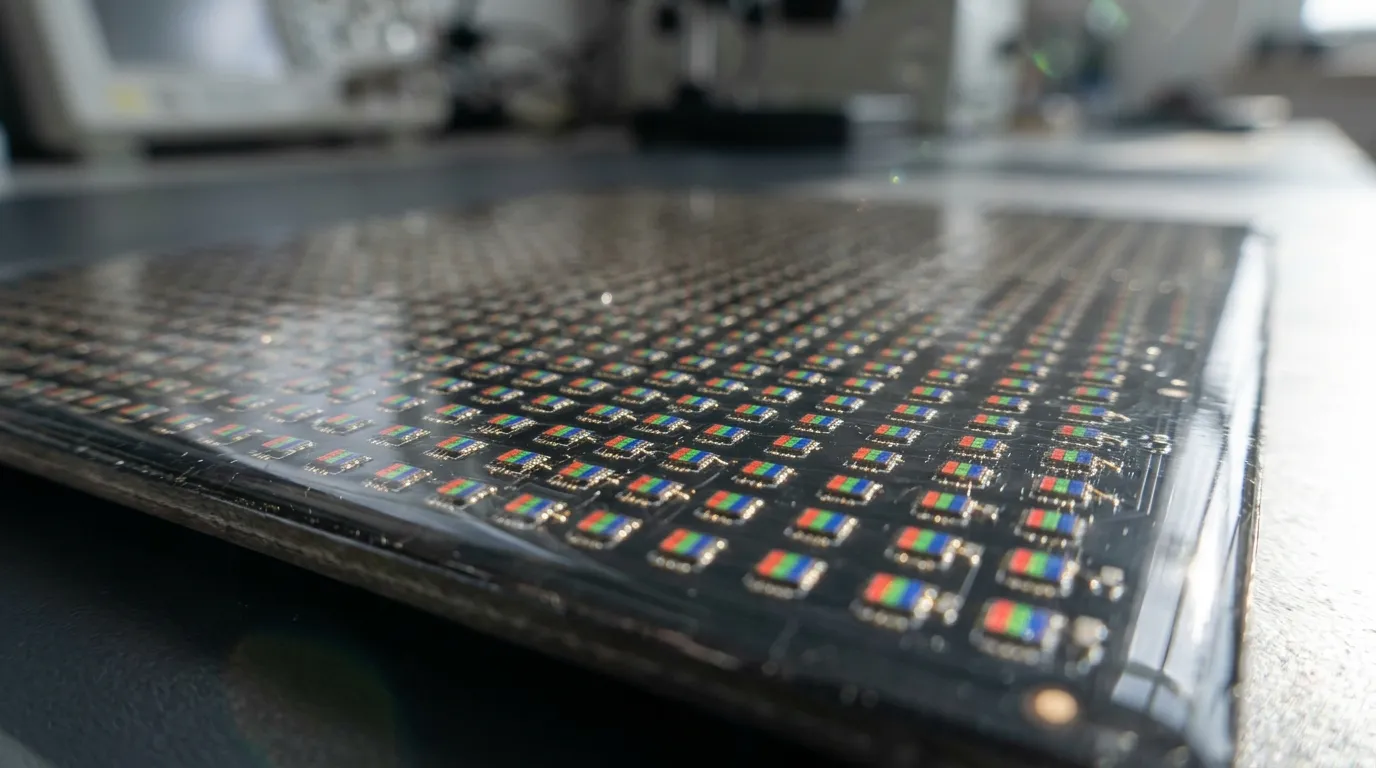
A COB LED display manufacturer is a supplier that mounts bare LED chips directly onto the circuit board and encapsulates them, instead of soldering pre-packaged SMD lamps onto the board. That difference is why the checks below are construction and service checks rather than brand-size checks.
According to Linsn, COB places the chips directly on the printed circuit board under an epoxy resin layer, and names flip-chip COB and standard COB as the two routes. Uniview advises buyers to compare pixel pitch, cabinet, serviceability and project requirements rather than selecting on the technology label alone. Neoti describes COB as suited to close viewing, which is the situation where surface finish and uniformity matter most.
For a project that has not yet chosen a technology, decide COB versus SMD versus GOB first, then come back to supplier selection. The COB LED display overview covers that technology decision in more depth.
Seven COB-specific checks to run on every shortlisted manufacturer
Ask every supplier the same seven questions in writing. The suppliers who reply with a model number, a datasheet value and a named service process are the ones worth a second call.
| Criterion | What to request from the supplier | How to judge the answer |
|---|---|---|
| Packaging route | The die-attachment route for the exact quoted model — flip-chip or face-up | Judge it as documentation, not as a performance claim |
| Surface consistency | Close-up photos or video of an assembled module under normal room lighting | Reject studio-lit renders that hide the encapsulation surface |
| Contrast claim basis | The model, ambient conditions and calibration state behind the figure | Discard any number that is not tied to the quoted model |
| Pitch versus viewing distance | The pitch list for the quoted series plus the closest intended viewing distance | Require the two to be matched before pricing |
| Repairability | Front or rear access, module replacement method, tools and training | For always-on rooms, require a spare-module plan |
| Quality evidence | Model datasheet, inspection process, after-sales route in writing | Evidence for a different model does not count |
| Range, customization and support | Which pitches the supplier actually builds and who supports the screen after handover | A stock model needing heavy site rework is higher risk |
Which die-attachment route does the proposed model use — flip-chip or face-up?
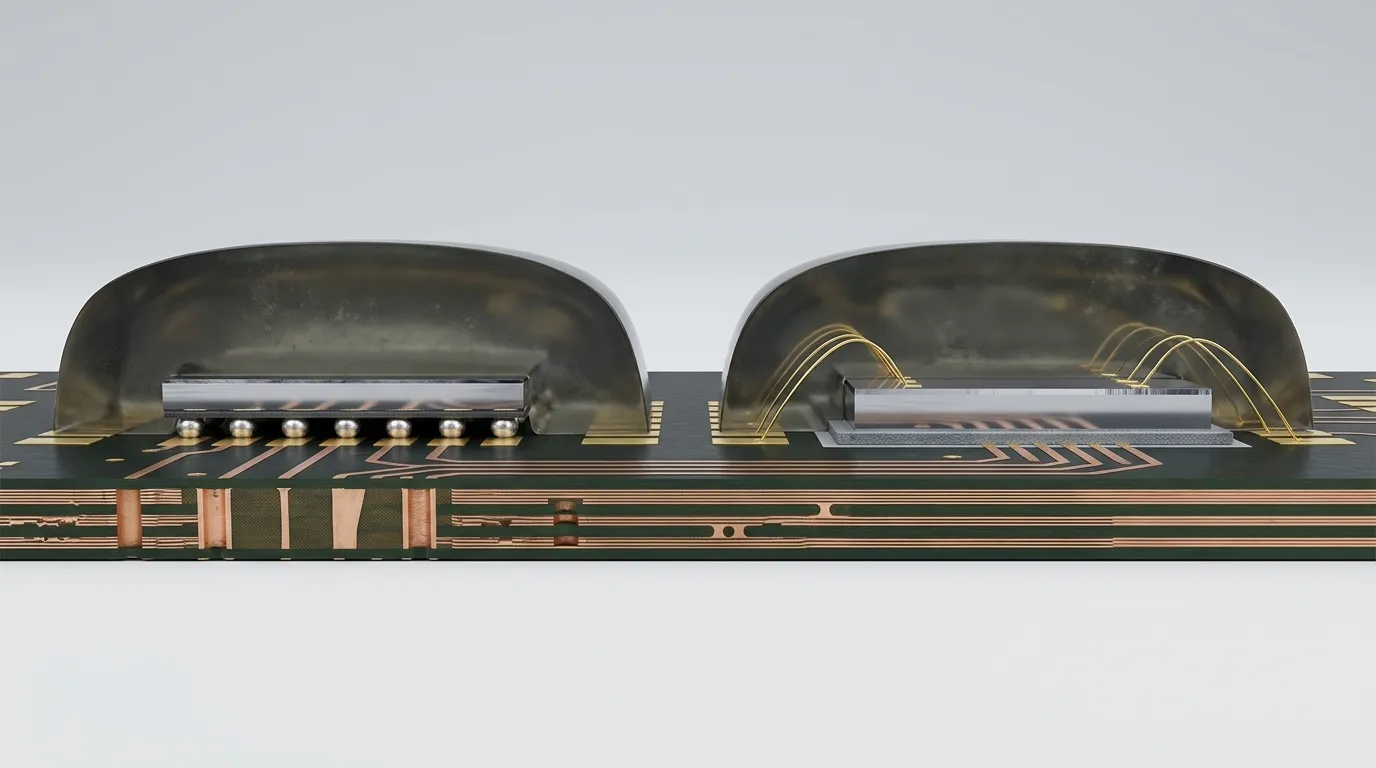
Ask which die-attachment route the quoted model uses and have the answer written on the model datasheet. "Flip-chip" describes how the chip is attached; on its own it does not prove a visible or measured advantage for your room.
Linsn names flip-chip COB and standard COB as the two routes. DOIT VISION states that its COB product lines use flip-chip COB and lists a product range of P0.62 to P1.87. For comparison, Linsn's MA600 specification table lists pitches of P0.9375, P1.25 and P1.56 with a refresh frequency of at least 3,840 Hz.
Decision rule: if a supplier will not commit the construction route to the datasheet for the quoted model, treat any flip-chip claim as unverified for that project. MIC Display's MC-COB Indoor Series construction route is not confirmed by the sources reviewed here, so put the same question to MIC Display.
How do you check surface consistency and visual uniformity?
Because the encapsulation layer covers the chips, the visible surface is effectively the product. Ask for close-up photography or video of an assembled module under ordinary room lighting and look for mottling, blotches or uneven black level across the panel.
Neoti describes COB as suited to close viewing, which is why finish quality carries more weight here than on a long-throw outdoor screen. Studio-lit renders and catalogue mock-ups do not show the surface a seated viewer will see.
Decision rule: for close-viewing rooms, ask for a sample module or loaner before the order, and be cautious of any supplier who supplies only renders.
How do you compare contrast-ratio claims fairly?
A contrast ratio is only comparable when it comes from the same model under the same measurement conditions. Ask what the figure applies to, at what ambient light level, and after what calibration.
DOIT VISION lists a figure of up to 10,000:1 for its own products. MIC Display's COB product page lists 15,000:1 for the MC-COB Indoor Series. Those are two different products published by two different suppliers, and neither number has been independently tested in the sources reviewed here, so they should not be presented as a ranking.
Decision rule: if a supplier cannot state the model and the conditions behind the number, leave that number out of your comparison.
What pixel pitch do you actually need, and how does it relate to viewing distance?
Pixel pitch is the distance between adjacent LED pixels, measured in millimetres, and it sets both the achievable resolution and the cost. Choose it from the closest intended viewing distance and the content being shown, because a finer pitch than the room requires adds cost rather than clarity.
MIC Display's COB product page lists the MC-COB Indoor Series at P0.78, P0.93, P1.25, P1.56 and P1.875. Separately, MIC Display quotes its wider small-pitch range as P0.9375–P1.86, so confirm the current model list for the specific project rather than assuming either range applies. Linsn's MA600 table, by contrast, lists P0.9375, P1.25 and P1.56 for that model.
A pixel pitch guide is useful for translating viewing distance into a target pitch. Decision rule: fix pitch only after the closest viewing distance, screen size and target resolution are written down.
How repairable is the module, and what service access does it allow?
Ask whether the cabinet allows front or rear access, how a single module is replaced, what tools and training the swap requires, and what spare-module plan the supplier proposes. The answers are model-specific and cannot be assumed from the phrase "COB display".
Neoti lists repairability as a factor when comparing COB, GOB and SMD screens. Linsn describes SMD as easier to repair and more cost-effective in its own technology comparison — that is the source's comparison of technologies, not a general service rule for every project.
Decision rule: for control rooms and other always-on installations, require a documented spare-module plan before purchase.
What quality and uniformity evidence should a supplier provide?
Request the datasheet for the quoted model, photography of a finished module, a description of the incoming and outgoing inspection process, and the after-sales route in writing. Evidence tied to a different model does not answer the question.
Uniview advises comparing serviceability and project requirements alongside specifications. MIC Display states that it provides remote technical support and after-sales service, and that its displays carry a 5–8 year warranty.
Decision rule: score each supplier on whether the evidence names the exact quoted model. If it does not, treat the evidence as unverified.
How do manufacturers differ in range, customization and project support?
Compare the pitches each supplier actually builds, whether it customizes structure, size and configuration to the installation environment, and who supports the screen after handover.
MIC Display states that its design team customizes screen structure, size and configuration to each project's installation environment, and that it serves commercial, advertising, control room and stage or event projects for integrators, rental and event companies, advertisers and project owners.
Decision rule: a supplier whose nearest stock model needs substantial site rework is a higher-risk choice than one that customizes to the measured environment.
How MIC Display's MC-COB Indoor Series measures against those checks
MIC Display's published MC-COB Indoor Series covers P0.78 to P1.875 with stated brightness of 600 nits and a stated contrast ratio of 15,000:1 for that series. Treat these as MIC Display's own published specifications for the named series and confirm the exact configuration before quoting.
| Specification | MIC Display published value | Note |
|---|---|---|
| Pixel pitches | P0.78, P0.93, P1.25, P1.56, P1.875 | From MIC Display's COB product page; confirm the live model list against the company's quoted small-pitch range of P0.9375–P1.86 |
| Module dimensions | 150 × 168.75 mm / 300 × 168.75 mm | From MIC Display's COB product page |
| Brightness | 600 nits | MIC Display published figure for this series |
| Contrast ratio | 15,000:1 | MIC Display published figure for this series; conditions and test method are not stated in the source |
| Typical applications | Control rooms, command centers, meeting rooms, premium commercial spaces | As listed by MIC Display for COB displays |
| Die-attachment route | Verify with the supplier | Not confirmed in the sources reviewed here |
MIC Display is an LED display factory in China established in 2011. It designs, produces and sells indoor, outdoor, rental, fine-pitch COB, transparent, LED floor tile and LED poster displays, exports to more than 100 countries, and backs its displays with a 5–8 year warranty plus remote technical support and after-sales service. Its fine-pitch COB work sits inside the broader fine pitch COB LED display range, which is where buyers comparing close-viewing room screens should look first.
Three caveats belong on this page rather than in a sales reply. First, the brightness and contrast figures are MIC Display's published figures for the MC-COB Indoor Series and are not independent test results. Second, the die-attachment route for that series is unconfirmed here — ask MIC Display the same question you ask every other supplier. Third, MIC Display's COB product page lists P0.78 to P1.875 while the company quotes its small-pitch range as P0.9375–P1.86, so confirm the current list before you price a project.
A six-step supplier due-diligence sequence
Run these six steps with every shortlisted COB manufacturer and compare the returned documents side by side rather than the sales presentations. The buyer's checklist for choosing an LED display manufacturer covers the commercial questions that sit alongside this technical sequence.
- Write down the closest viewing distance, screen size, content type and ambient light level for the installation.
- Request the datasheet for the exact quoted model, including its die-attachment route.
- Request close-up photography or video of an assembled module at working distance.
- Ask for the repair workflow, module replacement method and spare-part plan.
- Verify the factory and the inspection process rather than accepting a catalogue, using the factory visit guide as a structure for the questions.
- Confirm warranty terms, the after-sales route and technical support in writing before ordering.
Steps 2 and 3 are where most shortlists narrow. A supplier who cannot produce a model-specific datasheet and a real photograph of the encapsulation surface is unlikely to resolve a uniformity issue after installation.
Frequently asked questions
Who are the leading COB LED display manufacturers?
No published source reviewed here ranks COB suppliers objectively. Kinglight's 2026 worldwide list names Samsung Electronics, LG Electronics, Leyard, Unilumin, Absen, Daktronics, Barco, LianTronics, AOTO and INFiLED, but that is a broad LED manufacturer list rather than a COB-specific assessment, and presence on it does not indicate COB suitability. Evaluate candidates with the seven checks above instead.
Is a COB LED display the same as a COB LED light?
No. "Chip-on-board" describes a packaging method used in both lighting and display products, but the products, buyers and specifications are unrelated. A supplier's reputation in COB lighting says nothing about its ability to build and support a display screen. Keep lighting search results out of a display supplier shortlist.
How long should a COB LED display warranty be?
Warranty length is a commercial term that has to be confirmed in writing against the exact model. MIC Display states that its displays carry a 5–8 year warranty with remote technical support and after-sales service. Ask any supplier on your shortlist to put the term, what it covers and the service route into the quotation.
Send the closest viewing distance, screen size and required pitch for your project to MIC Display, and the team can confirm which MC-COB Indoor Series configuration applies and return the model datasheet, construction route and warranty terms in writing — contact us to start that exchange.
Share on Social:


Contact Us
Related Posts
LED Window Display- The Complete Guide for Retail, Advertising, and Commercial Spaces
October 26, 2026
Mini LED Display- What It Is, How It Works, and Where It Fits
October 26, 2026
Naked Eye 3D LED Display - How It Works, Key Specs, Cost and How to Plan One (2026 Guide)
October 16, 2026
Transparent LED Displays for Storefronts
October 14, 2026


