




Best LED Display for Outdoor Billboards: Specs That Matter
By miashuvo2077
Oct 01, 2026Related Posts
LED Window Display- The Complete Guide for Retail, Advertising, and Commercial Spaces
October 26, 2026
Mini LED Display- What It Is, How It Works, and Where It Fits
October 26, 2026
Naked Eye 3D LED Display - How It Works, Key Specs, Cost and How to Plan One (2026 Guide)
October 16, 2026
Transparent LED Displays for Storefronts
October 14, 2026
Choosing the best LED display for outdoor billboards comes down to six specs: pixel pitch for the road viewing distance, brightness with night dimming, front and rear IP ratings, service access, cabinet and site conditions, and remote content control. Get those right and a permanent billboard stays legible, serviceable and weather-ready for years.
Key takeaways
- LG Commercial Display publishes pitch guidance of under 4.0 mm for viewing under 15 m, 3.91–8.33 mm for 15–25 m, and 10 mm or larger for very long-distance highway viewing — a starting reference, not a rule.
- EagerLED's technical standards guide states that under IEC 60529, IP65 combines dust-tight protection with protection against water jets, and lists one model at front IP65 and rear IP54 — front and rear ratings can differ on the same cabinet.
- MIC Display describes die-cast aluminum cabinets as front- and rear-serviceable and iron cabinets as rear-serviceable, so the side your crew can reach decides which one you order.
- MIC Display lists its MS series at ≥5500 cd/m² and IP65, and its MC-PRO series at 7500 nits; these are configuration values to confirm in writing for the quoted model.
- MIC Display, established in 2011, supplies outdoor fixed displays with 5–8 year warranty cover, remote technical support and after-sales service.
The Billboard Spec Set at a Glance
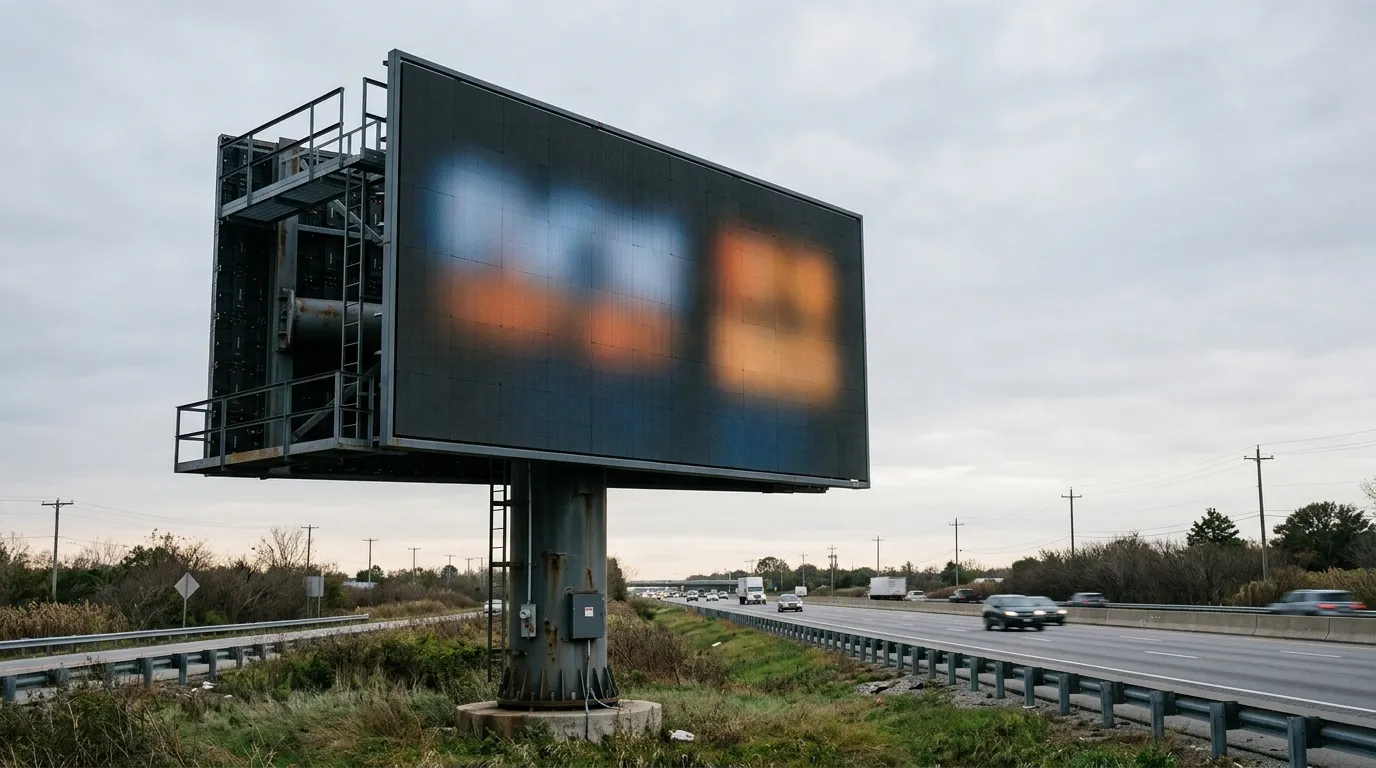
A billboard LED display is selected by six specifications, and almost every other number on a datasheet is a detail of one of them: pixel pitch, brightness with dimming, front IP rating, rear IP rating, service access side, and cabinet material together with its site conditions.
Pixel pitch is the distance between the centres of two adjacent pixels, measured in millimetres; a smaller number means a denser, more detailed image at close range. IP rating is the ingress protection code for resistance to dust and water. Use the table below as the working list for a billboard quotation, then work through each spec in the sections that follow.
| Spec | What it controls | What the buyer must decide | Evidence to request |
|---|---|---|---|
| Pixel pitch | Image detail at the nearest viewing distance | Pitch band for the closest meaningful viewer | Datasheet pitch and its configuration |
| Brightness and dimming | Daytime legibility and night comfort | Peak brightness plus a night dimming requirement | Dimming range in the quoted model |
| Front IP rating | Weather exposure on the road-facing side | Rating needed for the site's rain and wash-down | Front rating for the exact assembly |
| Rear IP rating | Protection at the rear access side | Whether the rear is exposed or sheltered | Rear rating for the exact assembly |
| Service access side | How modules and components are reached | Front access or rear access, based on the install | Confirmation in writing |
| Cabinet material and mass | Structure, mounting and service design | Load and mounting method with an engineer | Cabinet size, material and weight |
| Screen dimensions and native resolution | Fit to content and to the structure | Size on a cabinet multiple, and aspect ratio | Layout drawing and pixel count |
| Control and monitoring | How content and faults are handled | Written list of remote features | Feature list and any recurring costs |
| Warranty and service terms | Long-term support exposure | Term length and remote support scope | Warranty terms in the contract |
The exact numbers behind each row vary by model, so a manufacturer's outdoor led display range is best read as a set of configurations rather than a single product.
Match Pixel Pitch to the Road Viewer's Distance
Pixel pitch should be set by the closest meaningful viewing position, not by the average or the farthest one, because that is where a viewer notices the individual LEDs first.
LG Commercial Display publishes a working reference: below 4.0 mm for viewing under 15 m, 3.91–8.33 mm for 15–25 m, and 10 mm or larger for very long-distance highway-billboard or stadium viewing. These are LG's recommendations for its own products, so treat them as orientation rather than a fixed rule.
| Viewing distance | LG-recommended pitch | Source note |
|---|---|---|
| Under 15 m | Below 4.0 mm | LG recommendation, verify per project |
| 15–25 m | 3.91–8.33 mm | LG recommendation, verify per project |
| Very long distance (highway, stadium) | 10 mm or larger | LG recommendation, verify per project |
A common mistake is picking a fine pitch for a highway billboard where no one can stand close enough to benefit, or picking a coarse pitch for a screen that pedestrians pass at a few metres. If you are new to the relationship between pitch, distance and image detail, this led pixel pitch guide explains the underlying terms.
Plan Screen Size and Native Pixel Resolution Before You Approve Content
Screen dimensions, cabinet grid and native resolution are one decision, because a finished LED screen is normally assembled from whole cabinet modules rather than cut to an arbitrary size.
MIC Display lists its MS series cabinet at 1000 × 1000 × 83 mm and its MC-S series cabinet at 640 × 640 mm or 960 × 960 mm, which means the final screen size lands on a cabinet multiple. Divide the finished width and height by the chosen pitch to get the native resolution, then check that figure against the aspect ratio of the artwork or video that will actually run.
Choose Brightness for Daylight and Dim It at Night
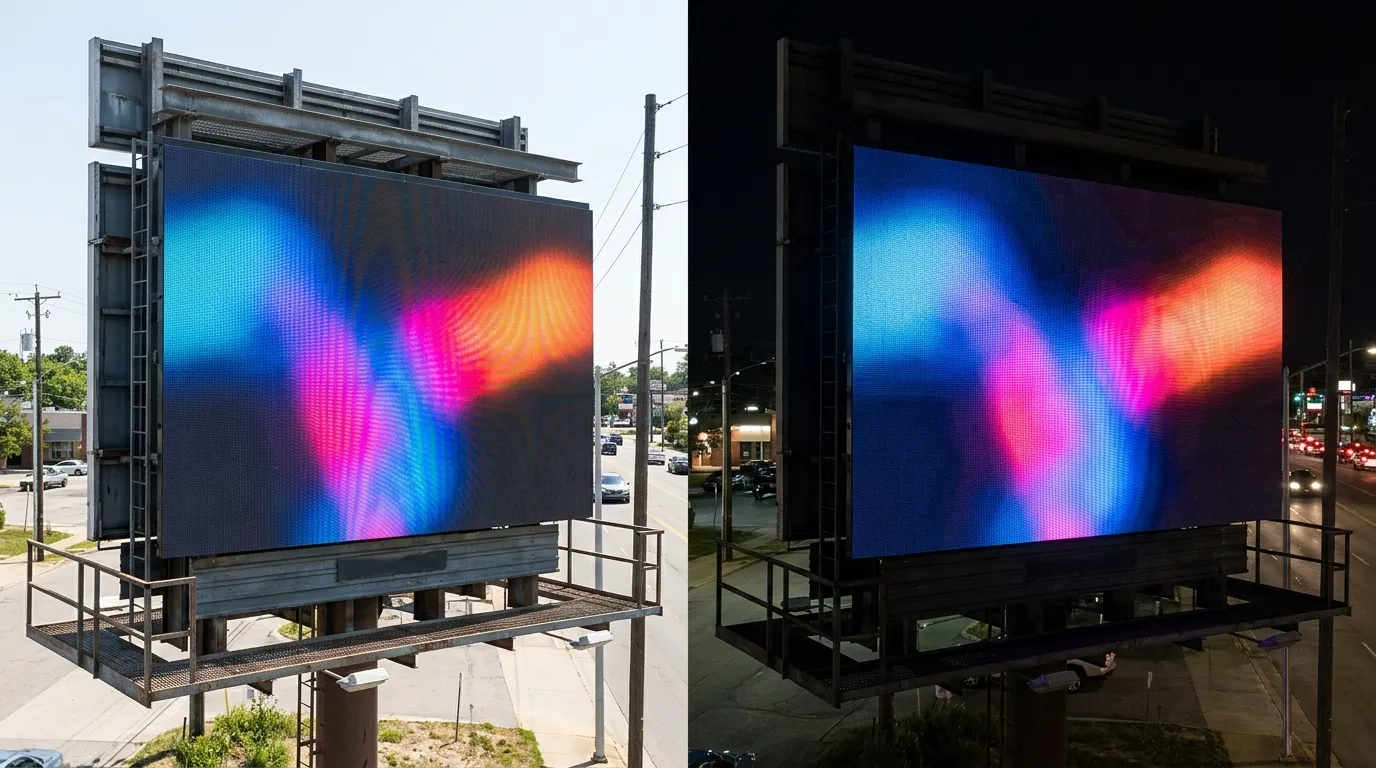
Brightness must beat the site's ambient light during the day and fall far enough at night to stay readable without glaring at drivers or neighbours, so the dimming range matters as much as the peak figure.
LG Commercial Display's outdoor page lists brightness filter options from 3,000 to 10,000 nits, which shows how wide the practical spread is across products. MIC Display lists ≥5500 cd/m² for its MS series and 7500 nits for its MC-PRO series, and EagerLED's technical guide lists its EA1000F2 example at 5,000 or 6,500 cd/m² depending on configuration.
| Site condition | What to check | Question for the RFQ |
|---|---|---|
| Direct-sun face | Peak brightness against worst-case daylight | What is the rated brightness and dimming range? |
| Shaded or north-facing | Whether a lower peak is sufficient | Which configurations suit lower ambient light? |
| Night-time residential frontage | Dimming floor and scheduling control | How low can brightness be scheduled? |
| Mixed day/night content | Automatic or scheduled brightness changes | Is brightness scheduling included? |
A brightness figure such as 5,000+ nits is a threshold to assess against site orientation, daylight exposure and night dimming, not a universal requirement — and every value above is a manufacturer-listed configuration value that should be confirmed for the exact quoted model.
Weather Protection: Read Front and Rear IP Ratings Separately
Front and rear IP ratings are separate specifications, so a cabinet can be IP65 on the road-facing side and IP54 at the rear access panel.
EagerLED's technical standards guide states that under IEC 60529, IP65 combines dust-tight protection with protection against water jets, and its example model carries IP65 at the front and IP54 at the rear. MIC Display lists IP65 for its MS series and refers to IP65/IP66 weather protection for selected configurations.
| Rating | Applies to | What it does not cover | What to ask for |
|---|---|---|---|
| Front IP | Display face and front assembly | Rear access side, structure, wiring | Front rating for the quoted model |
| Rear IP | Rear cabinet and access panel | Mounting frame and cable entry | Rear rating for the quoted model |
| Mounting structure | Steelwork, brackets, fixings | Display electronics | Separate engineering review |
| Electrical enclosure | Power and control housings | LED modules | Separate specification |
An IP rating covers the display assembly, not the mounting structure, the wiring or the installation as a whole, so request the exact model, the tested assembly, both front and rear ratings, and the environmental limits in writing.
Front or Rear Service: Decide From the Installation, Not the Datasheet
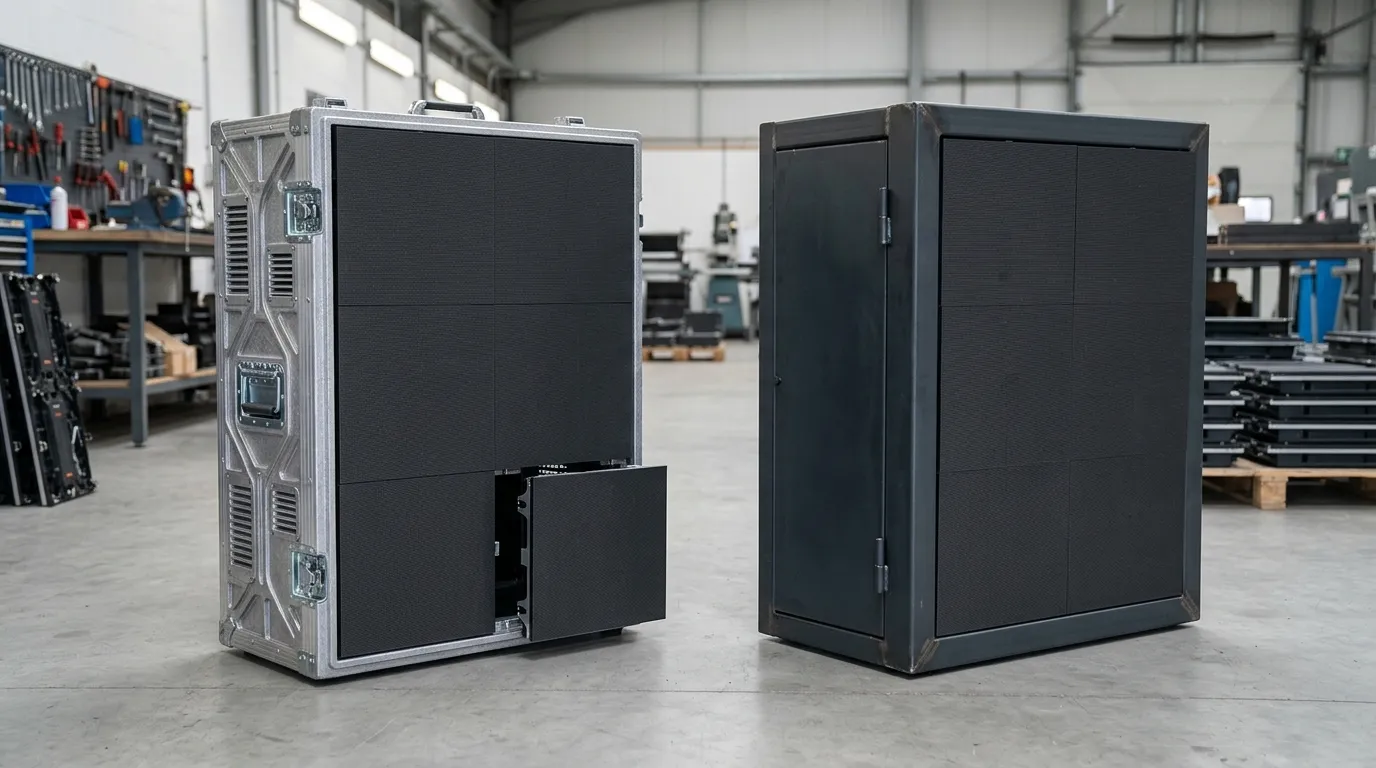
Service access is chosen by the side your maintenance crew can actually reach, and that is a mounting decision made before the order rather than a preference stated on a datasheet.
MIC Display's outdoor comparison describes die-cast aluminum cabinets as front- and rear-serviceable and iron cabinets as rear-serviceable, and its page positions the iron-box option toward permanent billboards and roadside signage. EagerLED's checklist also treats service access as one of the technical standards to verify.
If the screen sits tight against a wall, over water, over traffic or above a fixed façade, front access is the workable choice. Where a clear walkway or service corridor exists behind the display, rear access is often simpler, and an outdoor iron box led display is one documented option in that category.
Cabinet, Mounting and Site Conditions
Cabinet material, mounting method and site conditions decide whether a billboard display can be installed at all, before price enters the discussion.
MIC Display lists its MS series cabinet at 1000 × 1000 × 83 mm and its MC-S series cabinet at 640 × 640 mm or 960 × 960 mm with a weight of 13–18 kg, and describes aluminum cabinets as suited to façade and premium fixed installations and iron boxes to permanent billboards and roadside signage. A fixed, permanent installation of this kind is what the outdoor fixed led display category covers.
Thermal and power performance is not published in the sources reviewed here, so request the operating temperature range, cooling method, power draw and heat load for the quoted model, then have a qualified engineer check them against ambient conditions, wind loading and the available electrical supply. Permits and structural approval are local-authority and engineer matters.
Remote Content Control and Monitoring
Remote content control should be verified as a written feature list rather than accepted as a general claim that a display is "smart".
LG Commercial Display states that its outdoor advertising models for media façades can include remote control and management features, which confirms the feature category exists in outdoor products but does not establish the capability of any other manufacturer's configuration.
Ask for written answers on content scheduling, brightness scheduling, power on/off, fault and temperature alerts, the software or platform used, any licensing or subscription cost, and whether each feature is included or optional.
Quotation and Acceptance Checklist for a Billboard Display
A complete billboard quotation should name the model and state pitch, brightness, front and rear IP ratings, cabinet size and mass, service side, dimming range, control features, warranty and support terms, with the datasheet those numbers came from attached.
- Confirm the closest meaningful viewing distance and the content format.
- Fix screen dimensions on a cabinet multiple and record the native resolution.
- Set a brightness figure together with a night dimming requirement.
- Obtain front and rear IP ratings plus environmental limits.
- Choose the service access side from the installation.
- Have the structure, power and thermal load reviewed by an engineer.
- Confirm control features and any recurring costs.
- Confirm warranty length and remote support terms.
- Agree the acceptance test that will be run on site.
MIC Display supplies outdoor fixed displays with 5–8 year warranty cover, remote technical support and after-sales service, which are the terms to check against the warranty clause in your own contract.
Matching MIC Outdoor Series to a Billboard Requirement
MIC Display's outdoor range provides three documented starting points, and a configuration is then matched to the site rather than to a fixed size chart.
MIC Display lists its MS series at P2.976–P10.42 with a 1000 × 1000 × 83 mm cabinet, ≥5500 cd/m² and IP65; its MC-PRO series at P4.44, P5.7, P6.67, P8 and P10 with 7500 nits; and its MC-S series from P2 to P10 with 640 × 640 mm or 960 × 960 mm cabinets, above 5,000 nits and 13–18 kg.
| Series | MIC-listed pitch range | MIC-listed cabinet | MIC-listed brightness | Service side | Source note |
|---|---|---|---|---|---|
| MS | P2.976–P10.42 | 1000 × 1000 × 83 mm | ≥5500 cd/m² | Verify with the supplier | MIC Display outdoor page |
| MC-PRO | P4.44, P5.7, P6.67, P8, P10 | Verify with the supplier | 7500 nits | Verify with the supplier | MIC Display outdoor page |
| MC-S | P2–P10 | 640 × 640 mm or 960 × 960 mm | Above 5,000 nits | Verify with the supplier | MIC Display outdoor page |
Treat this table as a shortlist by pitch, brightness and service side, then confirm the build for your screen. MIC Display's published page does not provide a size-to-series map, so screen-size matching has to be confirmed for each project rather than assumed. For advertising work, MIC Display's outdoor advertising led display configurations and its advertising display project work are the closest documented starting points, and MIC Display's design team customizes screen structure, size and configuration to a project's installation environment.
How much does an outdoor LED billboard cost?
Cost is driven by screen area, pixel pitch, brightness, cabinet type, service side, mounting structure and control features, so it is quoted per project rather than published as a list price. No figures are given here because no verified pricing source was reviewed; ask for a configuration-based quotation that states the specification behind each line.
What is the best outdoor LED display for advertising?
The one that matches four things to your site: pixel pitch for the closest meaningful viewing distance, brightness with a workable night dimming range, front and rear IP ratings suited to the exposure, and a service access side your crew can reach. Specification fit matters more than any single brand name.
Do I need structural or permit approval before ordering?
As a rule, yes. Mounting structures, wind loading, electrical supply and advertising permits are local-authority and qualified-engineer matters, and requirements vary by location. Expect to supply the display datasheet and layout drawing as inputs, and confirm the approval sequence with the relevant authority before the display is ordered.
If you have the site's viewing distance, planned screen dimensions and mounting situation, send them to MIC Display for a configuration review and a specification-based quotation.
Share on Social:


Contact Us
In This Article
Related Posts
LED Window Display- The Complete Guide for Retail, Advertising, and Commercial Spaces
October 26, 2026
Mini LED Display- What It Is, How It Works, and Where It Fits
October 26, 2026
Naked Eye 3D LED Display - How It Works, Key Specs, Cost and How to Plan One (2026 Guide)
October 16, 2026
Transparent LED Displays for Storefronts
October 14, 2026


