




What Does an IP65 Rating Mean for Outdoor LED Screens?
By miashuvo2077
Oct 03, 2026Related Posts

LED Window Display- The Complete Guide for Retail, Advertising, and Commercial Spaces
October 26, 2026
Mini LED Display- What It Is, How It Works, and Where It Fits
October 26, 2026
Naked Eye 3D LED Display - How It Works, Key Specs, Cost and How to Plan One (2026 Guide)
October 16, 2026
Transparent LED Displays for Storefronts
October 14, 2026
An IP65 rating on an outdoor LED screen means the enclosure is dust-tight and protected against low-pressure water jets from any direction. The "6" covers solids; the "5" covers water. It does not mean the screen is waterproof in the sense of surviving immersion, and it does not cover corrosion, UV, impact or wind loading.
Key takeaways
- The first digit, 6, means dust-tight; the second digit, 5, means protected against low-pressure water jets from any direction, according to VMX Visual.
- IP65 is a water-jet rating, not an immersion rating — jets and submersion are separate test categories.
- IP66 keeps the 6 for dust and raises only the water-jet level, with noticeably different test parameters reported by Chipshow.
- Front and rear faces can carry different ratings, and a single figure may describe a module, a cabinet or the assembled display, per VMX Visual.
- According to INFiLED, IP testing does not establish resistance to salt corrosion, UV ageing, impact or wind loading.
What does IP65 actually mean on a screen specification?
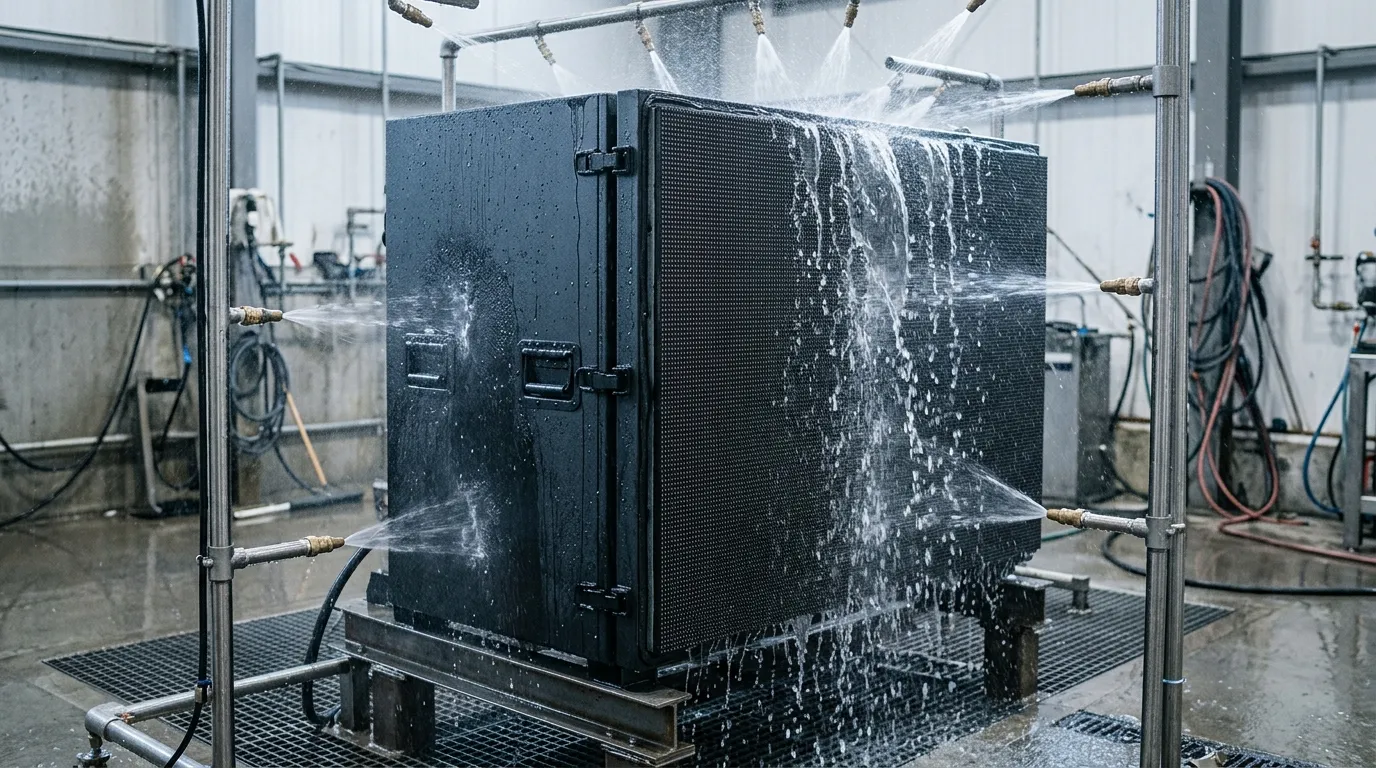
IP65 is a two-digit Ingress Protection code: the 6 means the enclosure is dust-tight and the 5 means it is protected against low-pressure water jets from any direction. The International Electrotechnical Commission (IEC) defines IP ratings as a classification of the degree of protection an enclosure provides against the intrusion of solid objects or water. According to VMX Visual, the code always carries two digits — the first for solids, the second for liquids — and a first digit of 6 indicates a dust-tight enclosure.
[DIAGRAM: Annotated "IP65" code, digit 1 labelled solids (6 = dust-tight), digit 2 labelled liquids (5 = water jets), referencing IEC 60529]
The first digit: 6 means dust-tight
A first digit of 6 is the dust-tight level. In practical terms, dust ingress is not expected to reach the interior of the rated enclosure under the test conditions of that digit. What this does not do is describe how long the seals hold that performance in a real installation, which is why the scope of the rating matters as much as the number.
The second digit: 5 means water jets
The second digit of 5 covers low-pressure water jets directed at the enclosure from any direction. According to VMX Visual, IP65 combines that jet protection with dust-tight construction. The word to note is "jets": this digit describes sprayed water, not standing water, pooled water or submersion.
Is IP65 the same as "waterproof"?
No. "Waterproof" has no fixed technical meaning, while IP65 refers to a defined water-jet protection level. According to VMX Visual, a jet rating should not be treated as proof of immersion protection, because jets and submersion are separate test categories. Chipshow reports that the IP65 water test uses a 6.3 mm nozzle at 12.5 L/min and 30 kPa; treat those as the source's reported parameters and confirm them against the applicable standard rather than as text quoted from IEC 60529.
The practical consequence: for a screen that must survive submersion or repeated high-pressure washdown, IP65 is the wrong benchmark to reason from, and the higher water digits — IP67 and IP68 — exist for immersion scenarios. Use "jet-protected" language, not "waterproof", whenever IP65 appears in a specification or a purchase order.
IP65 vs IP66 — what actually changes?
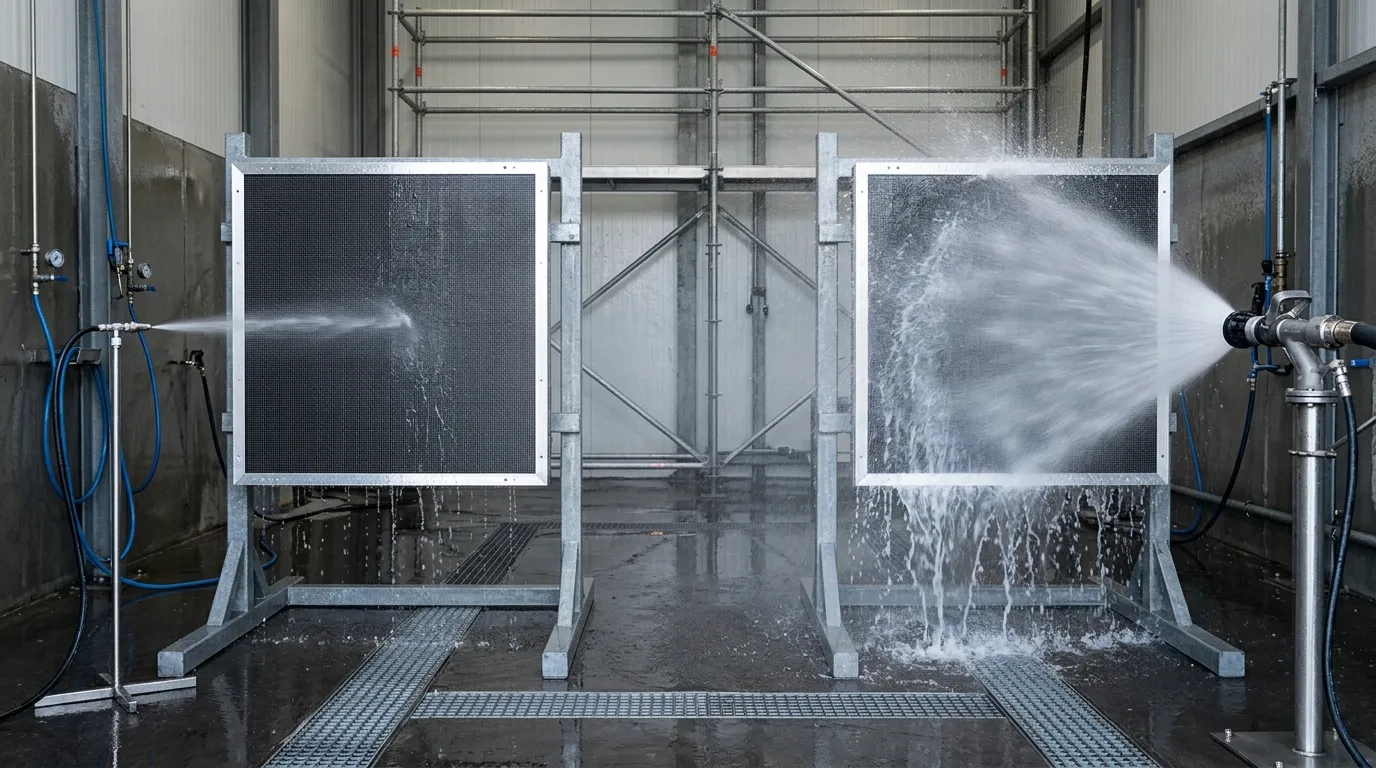
Only the second digit changes: IP66 keeps dust-tight protection at 6 and raises the water-jet level to a stronger jet. According to Chipshow, the reported test parameters differ substantially — IP65 uses a 6.3 mm nozzle at 12.5 L/min and 30 kPa, while IP66 uses a 12.5 mm nozzle at 100 L/min and 100 kPa. VMX Visual notes that IP66's water-jet protection is stronger than IP65's, and that neither figure establishes immersion protection on its own.
| Aspect | IP65 | IP66 | What it means on site |
|---|---|---|---|
| First digit (solids) | 6 — dust-tight | 6 — dust-tight | No difference between the two |
| Second digit (water) | 5 — low-pressure jets, any direction | 6 — stronger water jets | Only the water-jet exposure level changes |
| Reported test parameters* | 6.3 mm nozzle, 12.5 L/min, 30 kPa | 12.5 mm nozzle, 100 L/min, 100 kPa | Source-reported; verify against IEC 60529 |
| Immersion protection | Not covered | Not covered | Neither rating addresses submersion |
| Corrosion, UV, impact, wind | Not covered | Not covered | Handle these as separate site requirements |
*Parameter values attributed to Chipshow's published comparison.
[DIAGRAM: Side-by-side water-jet illustration for IP65 and IP66, captioned with the Chipshow-reported nozzle, flow and pressure figures]
The choice between them should follow the site's actual water exposure and cleaning method — outdoor advertising positions under a canopy and a coastal gantry face very different conditions. Do not treat the higher number as an automatic upgrade for every project.
Front and rear ratings — and what the rating actually covers
A single IP number on a datasheet often hides two ratings, because the front face and the rear access side of an outdoor screen can be rated differently. According to VMX Visual, front and rear ratings may differ, and a front-face rating on its own does not establish the protection of the rear, the connectors or the cable-entry points.
Front face vs rear cabinet and connectors
On a fixed outdoor installation, the front is usually the sealed, weather-facing surface while the rear is the service side where modules, power supplies and cabling are reached. Cabinet formats such as an outdoor fixed led display and an outdoor iron box led display are mounted and serviced differently, so the rear value deserves the same attention as the front value in the quotation.
Module, cabinet or complete assembled display
The rating may describe a module, a cabinet, or the fully assembled screen, and the three are not interchangeable. MIC Display's outdoor LED display page lists IP65/IP66 weather protection and gives one coastal installation example with an IP65 front and IP54 rear, with IP66 available; that is a model-specific statement for the configuration described and not a claim that applies across the range. Confirm in writing which of the three levels the figure refers to before comparing suppliers.
[DIAGRAM: Outdoor screen shown from front and rear, with the front face, rear cabinet, connectors and cable entries labelled as separately rated areas]
Is IP65 enough for an outdoor screen?
For many fixed outdoor installations, IP65 is adequate, but "enough" depends on exposure, mounting and orientation, the cleaning method, and the written specification for the assembled configuration — not on the number alone. A screen under a canopy, a screen on a coastal gantry and a screen washed down periodically are three different demands on the same rating.
Before treating IP65 as sufficient, check two things with the supplier: the rating for the exact assembled configuration being quoted, and whether the intended cleaning method stays within the water-jet level the rating covers. MIC Display lists IP65/IP66 weather protection across its outdoor led display range, and the coastal example above carries an IP66 option; the same confirmation applies to any supplier's offer.
What an IP65 rating does not tell you
An IP65 rating covers solid and liquid ingress only — it says nothing about salt-spray corrosion, ultraviolet ageing, impact, or wind loading. According to INFiLED, IP testing does not itself establish protection against salt corrosion, UV ageing, impact or wind loading. Each of those is a separate site question:
- Corrosion: coastal, industrial and de-icing environments ask for material and surface treatment information beyond the IP code.
- Ultraviolet ageing: gaskets and plastics age under sunlight, so ask how sealing components are specified.
- Impact: a ball, a trolley or debris strike is a mechanical question, not an ingress question.
- Wind loading: structural mounting and cabinet rigidity sit outside the IP code entirely.
- Heat and ventilation: sealed enclosures trap heat, so thermal design is assessed separately.
Cabinet material belongs in that conversation: aluminum and steel enclosures behave differently in wet or salty air, so confirm the material and finish for the location — an outdoor aluminum led display is one cabinet route worth discussing with a supplier when corrosion resistance is the driver.
How to verify an IP65 claim before you buy
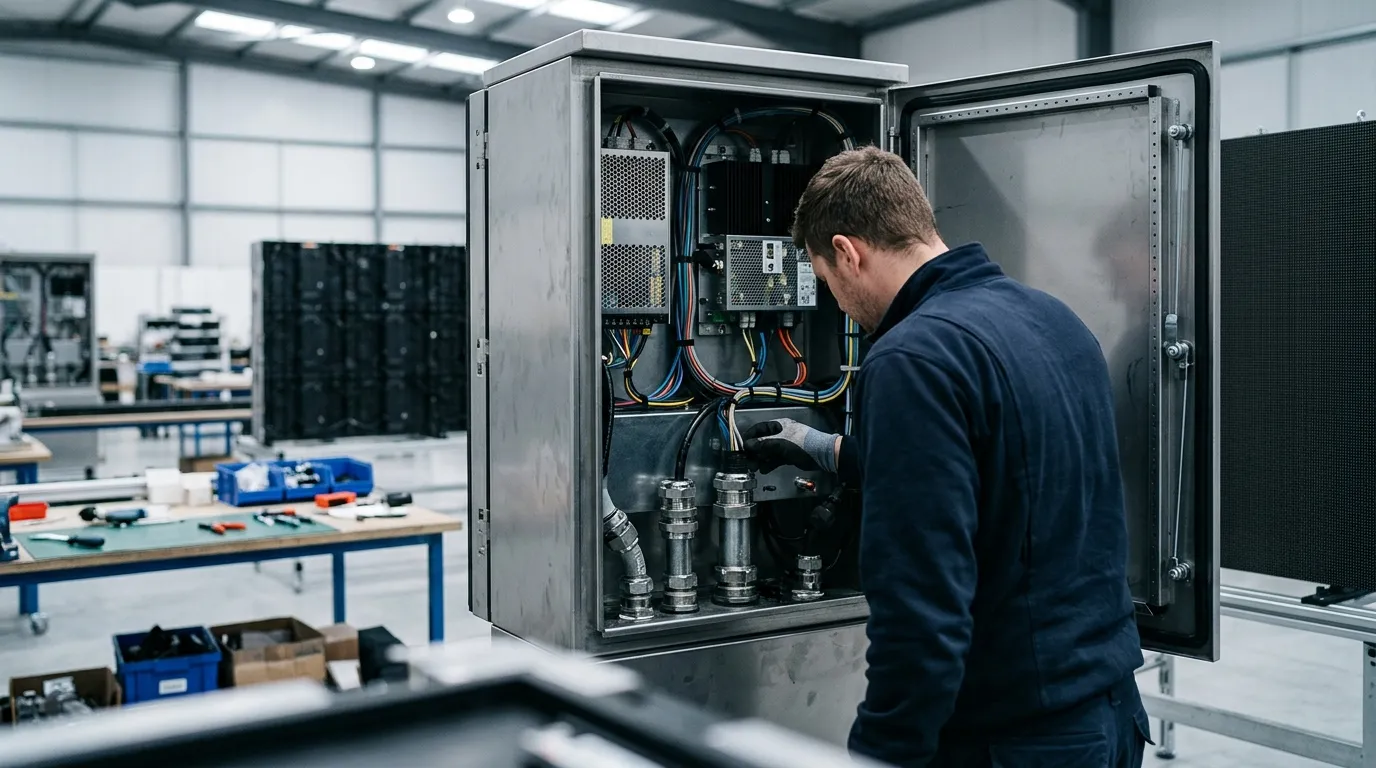
Ask the supplier for the rating scope, both the front and rear values, and test documentation for the exact configuration quoted. A short written checklist keeps the exchange specific:
- Scope — does the rating cover a module, a cabinet, or the complete assembled display?
- Both values — front rating and rear/connector-side rating, stated separately.
- Exact model and configuration — the item the rating refers to, matched to the quotation.
- Test documentation — the report or declaration, with the standard it references.
- Cleaning method — the on-site wash method, checked against the water-jet level.
- Site factors outside the IP code — corrosion, UV, impact, wind and heat, per "What an IP65 rating does not tell you".
A general supplier checklist helps here: the questions that apply to ingress claims are the same ones that apply to choosing an LED display manufacturer, and if a configuration needs clarifying after delivery, MIC Display's support channel handles configuration questions remotely.
Frequently asked questions
Does IP65 mean a screen can be submerged?
No. IP65 covers low-pressure water jets from any direction, while submersion is a separate test category. According to VMX Visual, a jet rating should not be treated as proof of immersion protection. If a project involves standing or pooled water, the higher water digits such as IP67 and IP68 are the relevant benchmarks to discuss with the supplier.
Is IP65 enough for heavy rain?
In many fixed outdoor installations it is, but adequacy depends on exposure, mounting and orientation, and the cleaning method used on site rather than the number alone. Confirm the rating for the complete assembled configuration in writing. A screen under a canopy and a screen on an exposed gantry do not face the same water exposure.
Can I pressure-wash an IP65 screen?
Not automatically. IP65 protects against low-pressure water jets, and a pressure washer produces conditions beyond that test level, as the Chipshow-reported parameters for IP65 and IP66 illustrate. Before any high-pressure cleaning, confirm the permitted cleaning method and the rated scope of the specific screen with the supplier, and follow their written guidance.


Contact Us
In This Article
Related Posts
LED Window Display- The Complete Guide for Retail, Advertising, and Commercial Spaces
October 26, 2026
Mini LED Display- What It Is, How It Works, and Where It Fits
October 26, 2026
Naked Eye 3D LED Display - How It Works, Key Specs, Cost and How to Plan One (2026 Guide)
October 16, 2026
Transparent LED Displays for Storefronts
October 14, 2026


