




Rent vs Buy LED Screens: A Cost Guide for Event Companies
By miashuvo2077
Oct 09, 2026Related Posts
LED Window Display- The Complete Guide for Retail, Advertising, and Commercial Spaces
October 26, 2026
Mini LED Display- What It Is, How It Works, and Where It Fits
October 26, 2026
Naked Eye 3D LED Display - How It Works, Key Specs, Cost and How to Plan One (2026 Guide)
October 16, 2026
Transparent LED Displays for Storefronts
October 14, 2026
Renting an LED screen usually fits event companies with low or unpredictable deployment frequency because it converts capital cost into per-event cost, while buying can fit higher-frequency operators when annualized ownership costs fall below comparable all-in rental costs. This guide compares both models using LED Screen Ownership Economics: usage frequency, payback, storage, transport, maintenance and a practical break-even rule.
Key takeaways
- Renting transfers many logistics and technical responsibilities to the rental provider, but the cost repeats at every event.
- Ownership adds storage, transport, maintenance, spare-parts and downtime responsibilities that belong in the comparison.
- Published break-even rules of thumb conflict, so event companies should calculate their own break-even point from their own costs and utilization.
- A hybrid fleet — owning a core inventory and renting extra or specialist configurations — can serve recurring demand without tying all capital to one screen mix.
- Rental quotes and purchase prices vary by market, pixel pitch, screen size, service package and contract scope, so any cited figure needs a source and a date.
Rent vs Buy LED Screens for Event Companies: The Short Answer
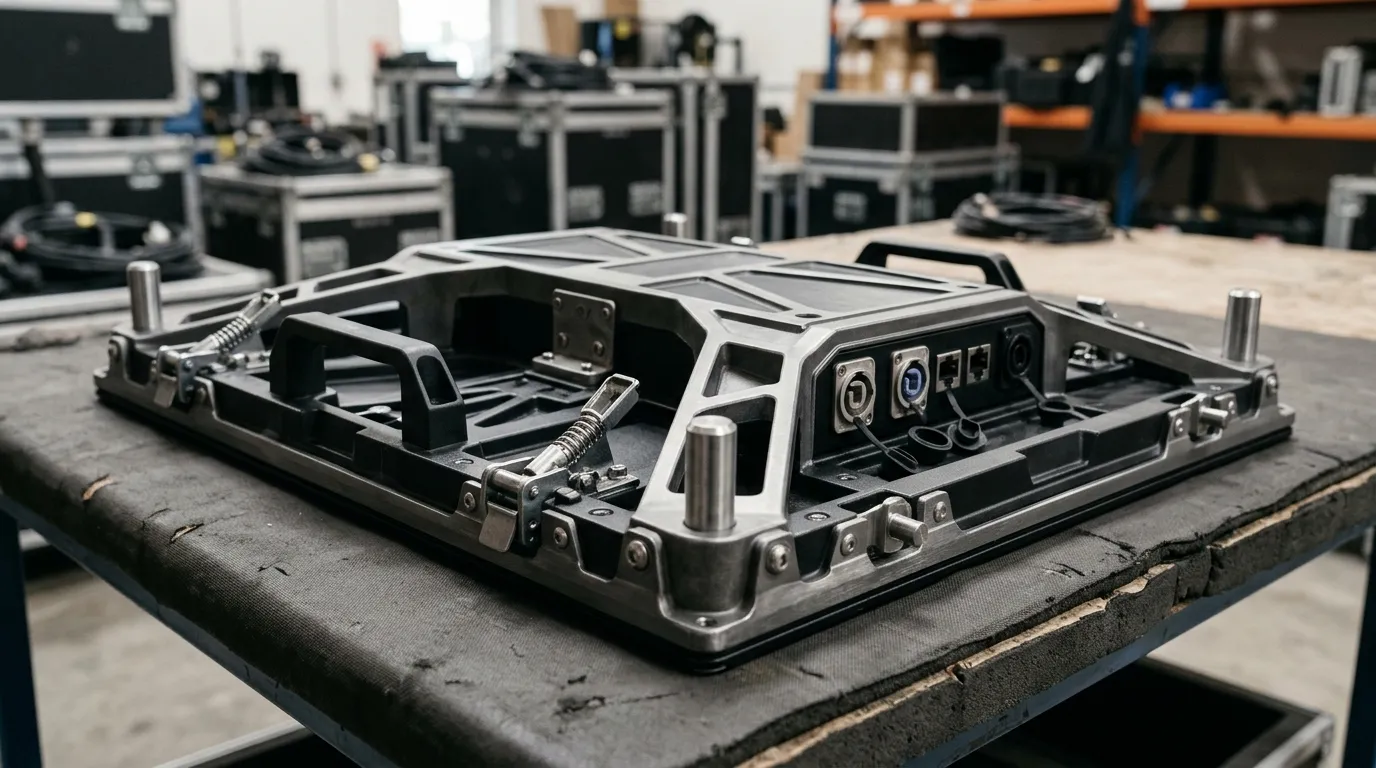
Renting an LED screen means paying for screen access per event or period, usually with the provider handling some transport, installation and technical support. Buying means purchasing the equipment and carrying the capital, storage, maintenance and deployment responsibilities yourself.
According to COBLINKS, a rental provider can normally supply panels, transportation, installation, dismantling and technical support for an occasional event, but that is a described service model rather than a guarantee for every rental contract, so the scope must be confirmed in writing. BizBash's comparison, published on 1 August 2024, is specific to mobile LED video trailers and frames the trade-off as rental convenience and support versus purchase control and possible cross-rental income.
Neither model is automatically cheaper. The decision turns on how often the company deploys screens, what a comparable rental package costs, and which operating costs the business is equipped to absorb. Renters looking at modular equipment for temporary use can review rental led display options, and event and concert work is covered under MIC Display's stage display solutions.
What Costs Belong in a Fair Rent-vs-Buy Comparison?
A fair comparison includes rental fees, purchase price, financing, transport, installation, dismantling, labor, storage, maintenance, repairs, downtime, insurance and residual value — with each cost assigned to the model that actually carries it. Comparing a screen's purchase price against a single rental rate leaves most of the decision unmeasured.
Rental pricing itself is not standardized. According to Chipshow, rental rates run from $600 to $1,500 per square meter per day depending on pixel pitch and service package, and the page text is dated 2026. American Image Displays states a much wider rental range of $500 to $5,000 per day depending on display size and specifications. The two ranges do not describe the same scope, which is exactly why a cited figure should never be treated as a market average.
Both figures are source-specific examples. Use them as evidence that pricing varies, then build the comparison from quotes and costs your own business can verify.
| Cost category | Rental model | Ownership model | Why it changes the decision |
|---|---|---|---|
| Screen access or purchase | Recurring rental fee | One-time purchase price | Converts a capital outlay into a repeating operating cost |
| Transport | Often bundled; confirm in writing | Carried by the owner | Depends on distance, fleet size and event schedule |
| Installation and dismantling | Often bundled; confirm in writing | Carried by the owner | Labor availability decides whether this is a cost or a bottleneck |
| On-site technical labor | Often bundled; confirm in writing | Carried by the owner | Affects how many events can run in parallel |
| Storage | Usually the provider's responsibility | Carried by the owner | Needs secure, dry, accessible space between events |
| Maintenance and repairs | Usually the provider's responsibility | Carried by the owner | Adds a reserve and a repair turnaround risk |
| Downtime | Usually the provider's risk | The owner's risk | A failed panel on show day is a commercial problem |
| Insurance | Confirm in writing | The owner's responsibility | Coverage differs by contract and venue |
| Residual value | Not applicable | Depends on condition and technology change | Reduces the effective cost of ownership if resale exists |
How Event Frequency and Utilization Change the Decision
The more often owned equipment is deployed and billed, the more rental fees it can displace — but event count alone misleads, because deployment days, travel time and idle periods also determine utilization and payback.
Published thresholds differ, and each one carries conditions:
| Source | Stated threshold or example | Conditions and limitations |
|---|---|---|
| Chipshow | Ownership may become financially advantageous above 25% utilization of the calendar year | The page text does not establish this as a cross-market rule |
| American Image Displays | Rental recommended under 5 events per year; buying may pay off above 10–15 events per year | Presented as the source's rule of thumb, not a validated break-even point |
| Radiant (published 28 March 2025) | Example table compares 12, 24 and 36 annual events; a separate example cites 34 events | Outcomes change with each example's assumptions |
Three sources, three answers. That is not a contradiction to resolve — it is evidence that the threshold depends on local rental rates, purchase cost, service life and how the company defines utilization. American Image Displays' guidance and Radiant's event-volume examples are useful as comparison points during your own calculation, not as targets to copy.
Define utilization before using any of these figures. For an event company, utilization is best expressed as billable deployment days or equivalent productive screen days per year, not simply the number of bookings. A company running twenty one-day exhibitions and a company running six multi-day tours may report similar event counts but very different payback profiles.
How to Calculate Your LED Screen Break-Even Point
Break-even deployment volume equals total annualized ownership cost divided by the difference between all-in rental cost per deployment and your own variable cost per deployment — provided that difference is positive. If the difference is zero or negative, owning never recovers its fixed costs through displaced rental fees, and renting remains the better model at any volume.
[DIAGRAM: Break-even formula showing annualized ownership cost divided by rental cost per deployment minus owner variable cost per deployment, with each input labelled]
Work through it in this order:
- Define a comparable deployment. Fix the screen size, pixel pitch, duration, indoor or outdoor use, and service scope so the rental quote and the owning scenario describe the same job.
- Collect all-in rental quotes. Include transport, installation, dismantling, on-site labor and technical support, not just the screen rate.
- List ownership costs. Cover purchase price, financing, storage, transport, installation labor, maintenance, spare parts, insurance, downtime and expected residual value.
- Annualize ownership cost over the expected service life, separating fixed annual costs from costs incurred per deployment.
- Subtract your variable cost per deployment from the rental cost per deployment to find the contribution each owned deployment recovers.
- Divide annualized ownership cost by that contribution to estimate break-even deployments.
- Stress-test the result under low, expected and high utilization, then revisit it whenever rental rates, purchase prices or service life change.
| Cost input | Treatment in the formula | Notes |
|---|---|---|
| Purchase price | Annualized over service life | The largest single fixed input |
| Financing | Added to annualized ownership cost | Include interest and fees where applicable |
| Storage | Fixed annual cost | Rent, climate control and security |
| Transport | Fixed or per-deployment | Depends on whether transport is in-house |
| Installation labor | Per-deployment variable cost | Deduct from your own numbers, not the rental quote |
| Maintenance and spare parts | Annual reserve | Should reflect realistic failure and refresh rates |
| Downtime | Risk allowance | Hard to quantify; treat as a risk, not a precise number |
| Residual value | Subtracted from total ownership cost | Depends on condition and technology change |
Do not fill this model with borrowed prices. A purchase price, rental rate or payback period that belongs to another company's market produces a break-even figure that means nothing for yours.
Storage, Transport, Installation and Labor: Who Handles What?
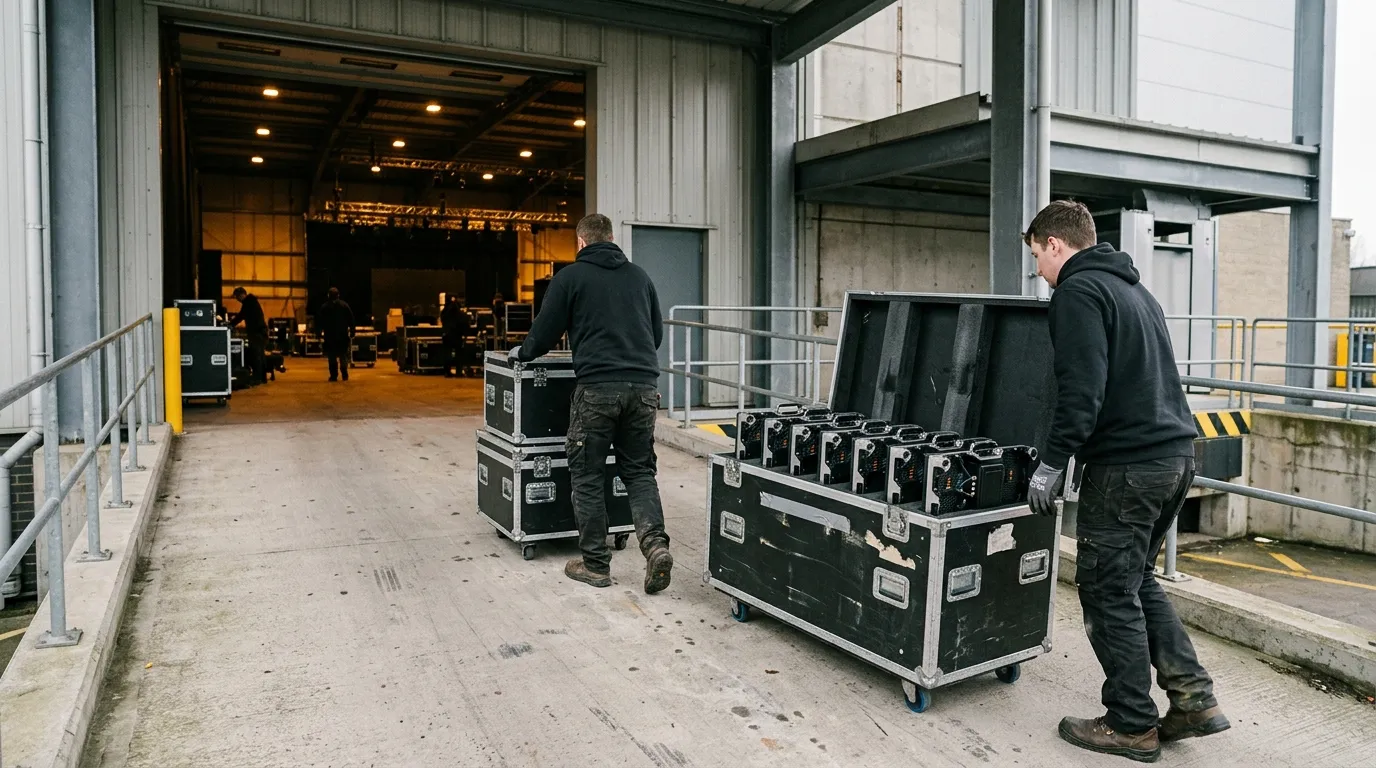
Rental contracts often place transport, installation, dismantling and technical support with the provider, while ownership places those responsibilities — and their scheduling risk — on the event company.
According to COBLINKS, a rental provider can normally supply panels, transportation, installation, dismantling and technical support for an occasional event, with the actual scope depending on the contract. BizBash's August 2024 mobile trailer comparison makes the same split: rental offers convenience and support, while purchase offers control and possible cross-rental.
| Task | Typical rental arrangement | Typical ownership responsibility | Decision impact |
|---|---|---|---|
| Transport | Provider arranges; confirm scope in writing | Owner arranges vehicles, drivers and loading | Adds fixed cost and scheduling complexity |
| Installation | Provider crew; confirm scope in writing | Owner crew or subcontractor | Determines how many events can run at once |
| Dismantling and load-out | Provider crew; confirm scope in writing | Owner crew or subcontractor | Affects turnaround time between events |
| On-site labor | Provider technician; confirm scope in writing | Owner technician | A skilled in-house technician is a fixed salary cost |
| Storage between events | Provider's warehouse | Owner's warehouse | Requires secure, dry, accessible space |
| Spare equipment | Provider's inventory | Owner's inventory | Determines resilience when a panel fails |
The scheduling risk is the part companies underestimate. When a provider supplies the crew, a busy weekend is the provider's problem to staff. When the company owns the screens, every concurrent event needs its own crew, vehicle and load-out window.
Maintenance and downtime risk are covered separately in the next section, because they follow a different logic from logistics.
[DIAGRAM: Side-by-side cost responsibility chart showing rental versus ownership for transport, installation, dismantling, labor, storage and maintenance]
Maintenance, Repairs and Downtime: The Ownership Risk
Ownership means the event company plans for maintenance, repairs, spare parts and downtime, while rental normally shifts most of that burden to the rental provider under the contract.
According to COBLINKS, technical support is part of the rental provider's service model for occasional events. On the ownership side, MIC Display states that its displays carry a 5–8 year warranty with remote technical support and after-sales service, which is an MIC Display-specific term rather than a market standard.
Before buying, work through a short checklist:
- Budget an annual maintenance reserve rather than treating repairs as an unexpected event.
- Identify whether spare panels, processing equipment and critical accessories are available.
- Ask what repair turnaround looks like and how it fits between booked events.
- Write a plan for a panel or processor failure on show day.
- Confirm what the warranty actually covers and what it excludes.
- Estimate the commercial cost of downtime, because a dark screen at a paid event costs more than the repair.
When a Hybrid Fleet Makes Sense
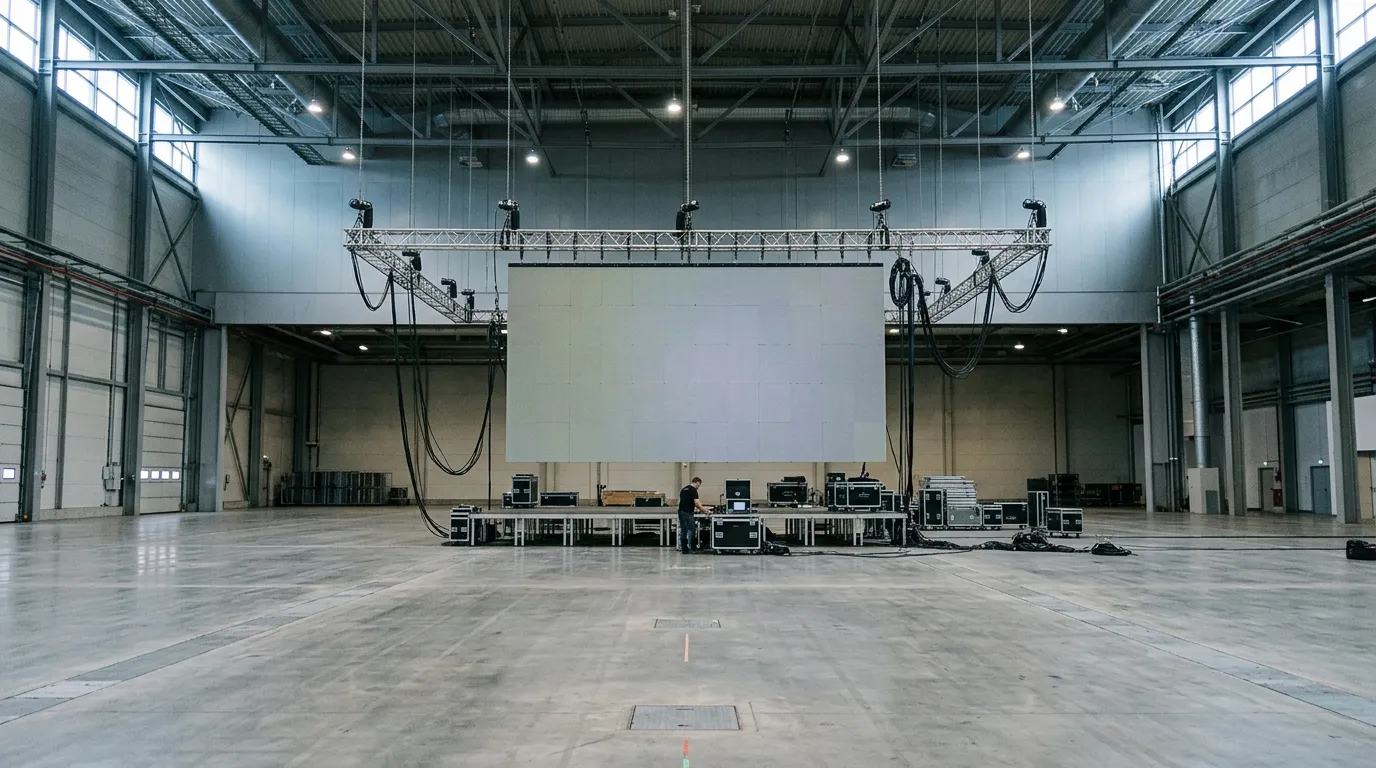
A hybrid fleet makes sense when an event company has recurring demand for a standard screen configuration but occasional demand for different pitches, sizes, indoor or outdoor formats, or specialist displays. It keeps capital concentrated on the work the company books most often while preserving access to everything else.
MIC Display's rental display page lists indoor rental pitches including P1.953, P2.604, P2.976 and P3.91, and outdoor rental pitches including P2.604, P2.976, P3.91 and P4.81 for the displayed product series — an illustration of why a single owned inventory rarely covers every brief.
| Scenario | Own a core fleet | Rent extra or specialist | Why hybrid fits |
|---|---|---|---|
| Recurring indoor events | Yes | For overflow | Predictable demand supports ownership |
| Recurring outdoor events | Yes | For overflow | Weather-rated outdoor stock is used often |
| Mixed indoor and outdoor calendar | Partly | For the smaller segment | Avoids capital tied to low-frequency formats |
| Unusual pitch or size | No | Yes | Specialist configurations are rarely cost-effective to own |
| Peak-season overflow | Yes | Yes | Covers demand spikes without year-round idle capacity |
Radiant's event-volume examples, published on 28 March 2025, show how break-even outcomes shift as annual volume changes, which supports testing a hybrid model rather than committing to a single answer. Hybrid configurations can be reviewed through MIC Display's indoor event rental led screen and outdoor event rental led screen ranges.
Decision Checklist for Event Companies
Before choosing, confirm your annual billable deployment volume, all-in rental quotes, annualized ownership cost, storage capacity, transport plan, maintenance plan and access to extra inventory for non-standard jobs.
- Annual billable deployment days, measured consistently across the last two years.
- At least one all-in rental quote that matches a real, repeatable job.
- Annualized ownership cost, including storage, insurance and a maintenance reserve.
- Storage space that is secure, dry and accessible on short notice.
- Transport capacity for your busiest simultaneous-event weekend.
- A crew or subcontractor plan for installation, dismantling and on-site technical work.
- Warranty terms, support terms and spare-parts availability.
- A hybrid fallback for configurations you cannot justify owning, and a supplier shortlist built against a structured how to choose an led display manufacturer a buyers checklist.
If the calculation is close, rent for another season and record actual deployment days. Real utilization data is worth more than any rule of thumb. Event companies comparing owned inventory options can review MIC Display's rental display range and warranty terms, or share their project parameters with the team to check configuration fit.
FAQ
What is the typical rental price for an LED wall screen?
Sources give different ranges. Chipshow states $600 to $1,500 per square meter per day in its 2026 page text, while American Image Displays states $500 to $5,000 per day. Pricing depends on pixel pitch, screen size, duration, market and service scope, so treat both as source-specific examples rather than universal rates.
How many events per year before buying makes sense?
There is no single threshold. American Image Displays suggests rental under 5 events per year and possible buying above 10–15 events, Chipshow discusses 25% annual utilization, and Radiant models 12, 24 and 36 events. Calculate your own break-even from local quotes, purchase cost and realistic deployment volume.
Does renting include installation and technical support?
According to COBLINKS, a rental provider can normally supply panels, transportation, installation, dismantling and technical support for an occasional event. Actual scope depends on the contract, so confirm what is included in writing before comparing the rental quote against ownership costs.
What ongoing costs do event companies forget when buying LED screens?
Common omissions include storage, transport, installation labor, dismantling, maintenance, spare parts, repairs, insurance and downtime. Each belongs in the annualized ownership cost before it is compared with all-in rental quotes, otherwise ownership looks cheaper than it is in practice.
Can an event company own some screens and rent others?
Yes. A hybrid fleet can cover recurring standard demand with owned equipment while renting extra capacity or specialist configurations. This reduces capital exposure while preserving access to indoor, outdoor or unusual pitch options that would be expensive to stock year-round.
Share on Social:


Contact Us
In This Article
Related Posts
LED Window Display- The Complete Guide for Retail, Advertising, and Commercial Spaces
October 26, 2026
Mini LED Display- What It Is, How It Works, and Where It Fits
October 26, 2026
Naked Eye 3D LED Display - How It Works, Key Specs, Cost and How to Plan One (2026 Guide)
October 16, 2026
Transparent LED Displays for Storefronts
October 14, 2026


